

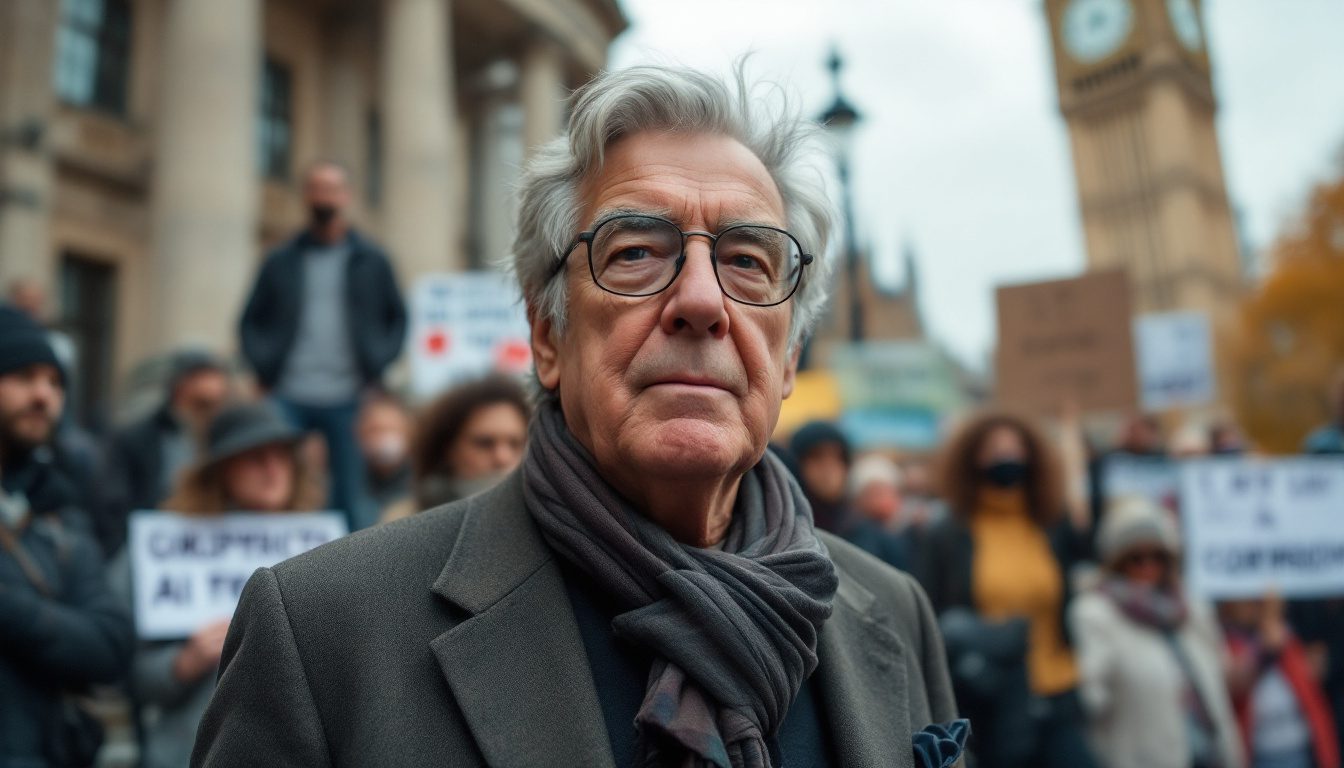
Okay, let’s talk about robots stealing your job. Sounds like a sci-fi movie, right? But hold on, because this isn’t some far-off future fantasy. This is happening now, especially if you’re in the creative biz. And Stephen Fry, bless his tech-savvy soul, is sounding the alarm bells louder than a dial-up modem trying to connect in 1995.
Stephen Fry vs. The Machines: A Battle for Creative Souls (and Copyright)
So, picture this: Stephen Fry, national treasure, voice extraordinaire, and all-around brilliant human, discovers something creepy. Turns out, someone, somewhere, decided his voice was just too darn good not to, well, borrow. And by “borrow,” I mean clone. Using Artificial Intelligence (AI), naturally. Fry, in a move that’s peak 2024, learned about this digital doppelganger not from some stuffy legal letter, but from a trailer for a documentary. Awkward. Turns out, his voice, or rather, an AI-generated version of it, was being used without so much as a “by your leave.” No permission, no payment, nada. Just straight up voice-napped.
Deepfake Voices and the Performer’s Plight
This isn’t just about Fry’s dulcet tones, though. It’s a canary in the coal mine moment for anyone who makes a living with their voice, their face, their creative *self*. We’re talking actors, musicians, voice-over artists – the whole shebang. This incident shines a glaring spotlight on a really thorny issue: AI copyright and copyright law in general, which, let’s be honest, is about as prepared for this AI tidal wave as a sandcastle facing a tsunami. Current copyright law, designed for a pre-AI world, is struggling to keep up with the speed at which technology is evolving. It’s like trying to use a horse-drawn carriage on the Autobahn.
Fry isn’t mincing words. He’s calling this what it is: AI exploitation. And he’s right. Imagine spending years honing your craft, perfecting your voice, your musical style, your acting chops, only to have some algorithm hoover it all up and spit out a digital replica that can be used for… well, anything. And you get nothing. Zip. Zilch. It’s not just unfair; it’s fundamentally undermining the very idea of creative work having value. Are we heading towards a world where human creativity is just raw data for machines to munch on and monetize? Because that’s a future nobody in the creative industry signed up for.
The Copyright Conundrum: Is Your Digital Self Yours?
Here’s where things get properly messy. Copyright law, in its current form, is brilliant at protecting, say, a finished song or a movie. But it’s less clear on protecting the *elements* that make those things possible – like an actor’s voice or a musician’s performance style. These are the building blocks, the raw materials of creativity, and AI is learning to mimic them with alarming accuracy.
Think about it. If someone samples a snippet of your song without permission, that’s a copyright violation. Clear cut. But what if an AI is trained on hours of your vocal performances, learns to mimic your voice perfectly, and then uses that voice to narrate an audiobook, star in a commercial, or even, shudder, create a whole new song in your style? Where do copyright law and performers’ rights stand then? The legal landscape is, to put it mildly, murky. And that murkiness is precisely what those looking to profit from creative industry AI are hoping to exploit.
Who Owns Your Voice? The Fight for Performers’ Rights
This isn’t just a legal debate; it’s a deeply human one. It’s about control, ownership, and the very definition of what it means to be a creative professional in the age of intelligent machines. Performers’ rights have always been about ensuring that actors and musicians are fairly compensated for their work and have some say in how their performances are used. But AI throws a giant wrench into the works. If an AI can convincingly mimic your performance, is that *your* performance anymore? Or is it just data, ripe for the picking?
The article rightly points out the urgent need for copyright law reform. We need laws that recognize the unique challenges posed by AI and that protect performer rights in this new digital frontier. This isn’t about stifling innovation; it’s about ensuring that innovation benefits everyone, not just tech companies looking to cut costs and corners. It’s about building an ethical AI ecosystem in the creative industry, one that values and respects human creativity rather than simply replicating and replacing it.
Beyond Copyright: The Ethical Tightrope Walk of AI in Creativity
Let’s zoom out for a second. This whole AI voice cloning thing is part of a much bigger picture. AI is rapidly transforming the creative landscape, from music composition to scriptwriting to visual arts. And while there are exciting possibilities – AI as a creative tool, a collaborator, even a muse – there are also serious risks. The risk of AI exploitation is real, and it’s not just about copyright. It’s about the potential devaluation of human skills, the displacement of creative jobs, and the erosion of the very things that make art meaningful and human.
The Impact of AI on Creative Jobs: A Looming Question
One of the most pressing questions is the impact of AI on creative jobs. Will AI become a powerful tool that empowers artists, or will it become a cheaper, faster replacement for human creativity? The answer, most likely, will depend on the choices we make *now*. Do we proactively shape the development and deployment of AI in the creative sector, ensuring it’s used ethically and responsibly? Or do we sit back and let the tech giants dictate the terms, potentially leading to a race to the bottom where human artists are squeezed out in favor of algorithms?
Stephen Fry’s experience is a wake-up call. It’s a reminder that we’re not just talking about abstract legal concepts or futuristic scenarios. We’re talking about real people, real livelihoods, and the future of creative expression itself. We need a serious conversation about ethical AI in the creative industry, one that involves artists, policymakers, and tech developers. We need to figure out how to harness the power of AI without sacrificing the human heart and soul of creativity.
Protect Performer Rights from AI: A Call to Action
So, what needs to happen? Firstly, copyright law needs to catch up. And fast. We need legal frameworks that specifically address AI-generated content and the protection of performers’ digital likenesses – their voices, their images, their styles. This means updating existing laws and potentially creating new legislation to deal with the unique challenges of AI. It’s not just about protecting Stephen Fry; it’s about protecting every actor, musician, writer, and artist who risks having their creative work, their very identity, replicated and exploited by machines.
Secondly, we need a broader ethical framework for AI in the creative industries. This goes beyond legalities and gets into the realm of responsible innovation. Tech companies developing AI tools for creative use need to prioritize ethical considerations from the outset. This includes transparency about how AI models are trained, mechanisms for consent and compensation for artists whose work is used to train these models, and safeguards against AI exploitation. It’s about building a system where AI and human creativity can coexist and even flourish together, but not at the expense of human artists.
Finally, and perhaps most importantly, we need to have this conversation openly and honestly. We need to involve the creative community in shaping the future of AI in their industries. This isn’t just a tech issue; it’s a cultural issue, an economic issue, and a fundamentally human issue. Stephen Fry’s experience is a stark reminder that the future is arriving faster than we think. And if we don’t act now to protect actor musician rights in the age of AI, we risk losing something truly valuable – the unique, irreplaceable spark of human creativity.
What do you think? Is AI a creative tool or a creative threat? Let me know in the comments below.



