

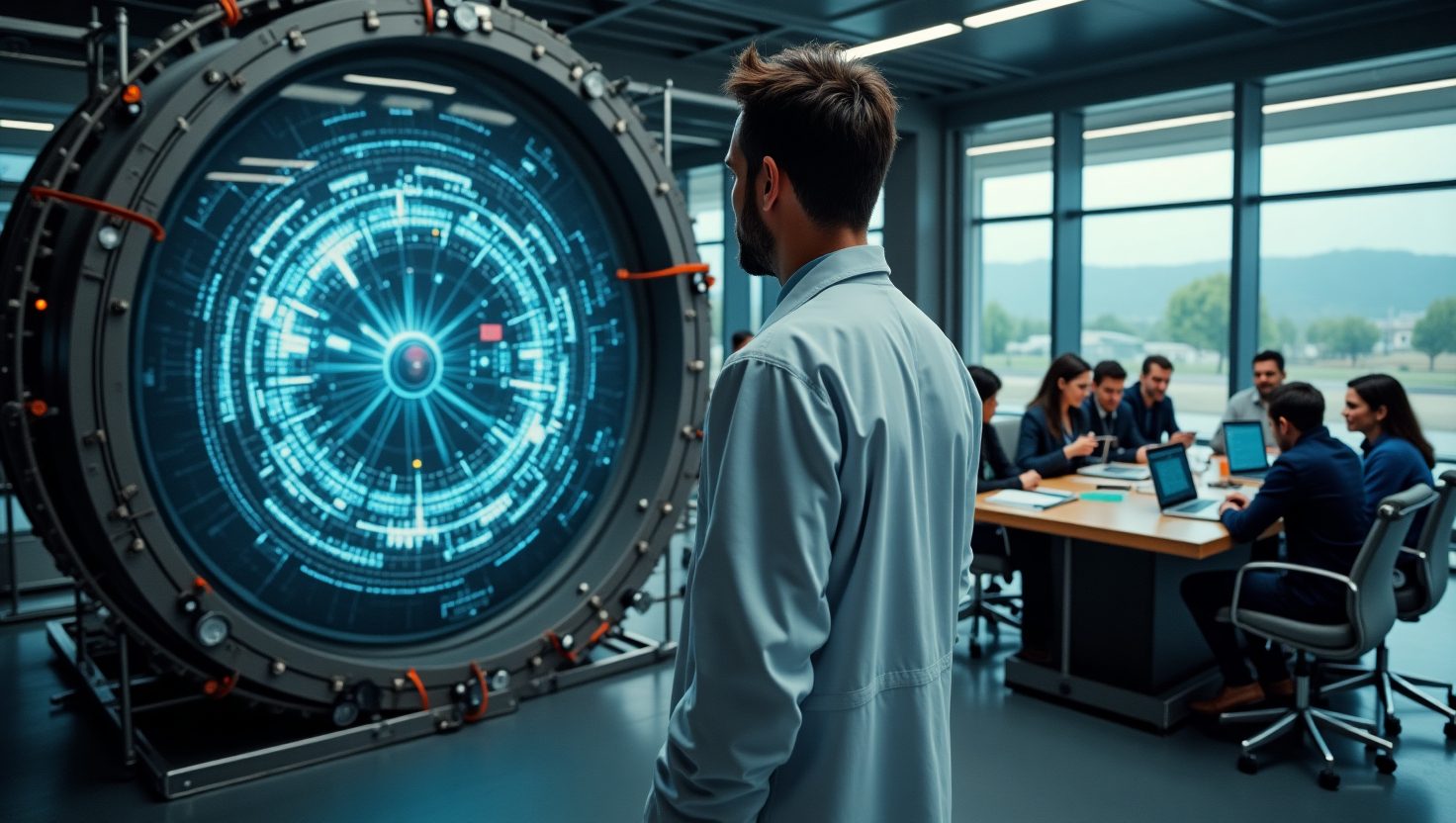
The recent announcement from CERN, the European Organisation for Nuclear Research, isn’t just another press release. It’s a blueprint. By formally approving a comprehensive, organisation-wide AI strategy, CERN is sending a clear signal: the future of fundamental science is inextricably linked with the future of AI. This isn’t about dabbling in machine learning models for a single experiment. This is about a complete scientific AI integration, embedding intelligent systems into every facet of the institution, from the research itself to the operational nuts and bolts that keep the lights on. It’s a move that other major research bodies should be watching with a notepad in hand.
The New Engine of Discovery: AI in Particle Physics Automation
For decades, the challenge in particle physics has been twofold: generating unprecedented events and then making sense of the data deluge that follows. The Large Hadron Collider (LHC), for instance, can produce up to a billion proton-proton collisions per second. Filtering this colossal stream of information to find the few events that might hint at new physics is like trying to find a single, specific grain of sand in a raging sandstorm. This is where particle physics automation has become less of a luxury and more of a necessity.
Joachim Mnich, CERN’s Director for Research and Computing, noted in a recent article that he first encountered neural networks decades ago in the L3 experiment. Back then, they were a promising but niche tool. Today, the situation is completely different. As he plainly puts it, “Could CERN live without AI? The answer is no.” This transformation is profound. AI models are now trained to perform real-time data filtering, identifying potentially interesting collision events with a speed and accuracy that far surpasses traditional methods. They are the tireless, hyper-efficient gatekeepers of discovery, ensuring that the terabytes of valuable data are captured while the background noise is discarded.
Key Benefits of AI in Particle Physics
The impact is tangible and can be broken down into a few critical areas:
* Unprecedented Accuracy: Machine learning, particularly deep learning models, can recognise subtle patterns in complex datasets that are invisible to the human eye or pre-programmed algorithms. This leads to more precise measurements of known particles and a higher sensitivity in the search for new ones.
* Radical Time-Saving: Automating the initial data filtering and analysis process frees up thousands of hours for physicists. Instead of manually sifting through event data, they can focus on higher-level interpretation, theoretical modelling, and planning the next generation of experiments. It’s a fundamental shift from data labourer to scientific strategist.
Smart Conduits: The Importance of Research Data Pipelines
Think of scientific data as fresh water. It’s essential, but it’s only useful if you can get it from the reservoir (the experiment) to the homes (the researchers) cleanly, efficiently, and without loss. A research data pipeline is the complex system of plumbing that achieves this. It covers everything from data acquisition and storage to processing, analysis, and final publication. In an environment like CERN, where data volumes are measured in petabytes (that’s millions of gigabytes), this plumbing has to be incredibly robust.
For years, these pipelines were largely static, built on rigid workflows. But what happens when the nature of the data changes, or a new, more efficient analysis technique is developed? Traditionally, it meant a painstaking, manual re-engineering of the entire pipeline. AI is changing this paradigm completely. By integrating intelligent agents into the pipeline, the system can become dynamic and self-optimising.
Supercharging the Flow: Enhancing Data Pipelines with AI
AI can act as the smart control system for the entire data journey. For instance, machine learning models can be used for “data triage”, automatically prioritising the processing of high-value datasets based on preliminary analysis. They can predict potential bottlenecks in the data flow—say, a storage system nearing capacity or a computing cluster being over-utilised—and proactively re-route data or allocate new resources. It’s the difference between a city having a manual water valve system versus one that intelligently adjusts water pressure based on real-time demand across neighbourhoods.
Furthermore, AI plays a crucial role in ensuring data integrity. Anomaly detection algorithms can continuously scan datasets for corruption or instrumental errors that might otherwise go unnoticed, flagging them for review. This ensures the data that reaches the physicist for final analysis is as clean and reliable as possible. It’s not just about moving data faster; it’s about making the data itself more trustworthy.
Fine-Tuning the Behemoth: Accelerator Optimization with AI
The accelerators at CERN are some of the most complex machines ever built. The 27-kilometre LHC is a marvel of engineering, using thousands of powerful superconducting magnets cooled to -271.3°C (colder than outer space) to steer particle beams. Achieving and maintaining stable, high-intensity beams is an art as much as a science, requiring constant monitoring and adjustment by a team of highly skilled operators. This is where accelerator optimization through AI offers game-changing potential.
Instead of relying solely on human operators and simulation models, CERN is increasingly using AI as a co-pilot. Reinforcement learning models, for example, can learn the intricate dynamics of the accelerator in real-time. They can experiment with tiny adjustments to thousands of parameters—magnet strengths, radiofrequency cavity voltages, cooling systems—to find operational regimes that are more stable, more efficient, and produce more collisions. This is particularly vital for the forthcoming upgrade to the High-Luminosity LHC (HL-LHC), which will increase the collision rate by a factor of five, pushing the machine to its absolute limits. AI will be indispensable in managing that complexity.
The Architect of Tomorrow: Future Accelerators Powered by AI
Looking beyond the HL-LHC, the role of AI becomes even more visionary. The design of future accelerators—whether a circular collider like the FCC or a linear one like CLIC—is a monumental challenge involving physics, engineering, material science, and civil engineering on a scale that dwarfs even current projects. AI is poised to become a core partner in the design process itself.
Generative AI models, trained on decades of accelerator physics and engineering data, could propose novel magnet designs or more efficient cooling systems. Complex simulations, powered by AI, could explore thousands of potential accelerator layouts in a fraction of the time it would take humans, identifying optimal configurations that balance performance, cost, and feasibility. Here, the concept of cross-disciplinary AI is key. An algorithm might take principles learned from optimising global supply chains and apply them to optimising the power grid for a future 100km accelerator tunnel. This is AI as a creative partner, not just an analytical tool.
Breaking Down the Silos: Cross-Disciplinary AI and Its Implications
The true power of an organisation-wide strategy, like the one CERN is implementing, is that it fosters cross-disciplinary AI. Historically, an AI model developed for particle tracking would stay within its physics silo. An AI for optimising electrical consumption would stay in the operations silo. This is incredibly inefficient. The real breakthroughs happen when these silos are broken down.
The new strategy, as outlined by CERN, explicitly aims to consolidate initiatives and foster collaboration. This means the insights gained from an AI model optimising the accelerator’s cryogenic systems could inform a model managing data centre cooling. Anomaly detection techniques honed in cybersecurity could be adapted to find anomalies in detector data. This interconnected approach creates a feedback loop where advancements in one area accelerate progress in all others. It turns the entire organisation into a learning ecosystem, with AI as the common language.
The Symbiotic Dance of High-Energy Computing and AI
None of this is possible without raw power. The sophisticated AI models used in modern physics require enormous computational resources for both training and inference. This is where high-energy computing comes into play. CERN’s Worldwide LHC Computing Grid (WLCG) is a global collaboration of over 170 computing centres in more than 40 countries, and it represents one of the largest and most sophisticated scientific computing infrastructures on the planet.
There is a symbiotic relationship here. The demands of AI are driving the evolution of high-energy computing, pushing for more specialised hardware like GPUs and TPUs and more efficient software frameworks. In turn, AI is being used to optimise the computing infrastructure itself. Machine learning models can predict job failures, manage energy consumption across data centres, and optimise data placement across the global grid to minimise latency. This self-optimising cycle is at the heart of building a sustainable and scalable platform for future scientific discovery.
The Road Ahead: Challenges and Opportunities in Scientific AI Integration
Of course, this journey is not without its hurdles. Integrating AI on this scale presents significant challenges. One is the “black box” problem: many deep learning models can provide incredibly accurate answers without revealing how they reached them. For science, where understanding the ‘why’ is paramount, this is a fundamental issue. Developing more interpretable and explainable AI (XAI) is a key area of research. There are also challenges in ensuring data quality, preventing algorithmic bias, and upskilling an entire generation of scientists and engineers to be AI-literate.
But the opportunities are far greater. As stated in their announcement, CERN’s strategy is built around four pillars: enhancing scientific discovery, improving operational efficiency, fostering AI talent, and building strategic partnerships. By committing to an “open and responsible” approach, CERN isn’t just building AI for itself; it’s creating models, tools, and ethical frameworks that can serve as a global standard for scientific AI integration. The knowledge generated won’t be locked away in a proprietary vault; it will be shared with the wider research community.
This is more than just a technological upgrade; it’s a philosophical one. Joachim Mnich captures it perfectly when he says, “AI is fundamentally reshaping how science is done. It’s no longer an accessory but a strategic imperative.” CERN’s methodical, holistic strategy is the most compelling proof of that statement yet. They are not merely adopting AI tools; they are weaving AI into the very fabric of their organisation.
The real question is not whether other research institutions will follow suit, but how quickly they can adapt. The blueprint is now public. Who will be the next to build from it? And what discoveries are waiting for us when they do?



