

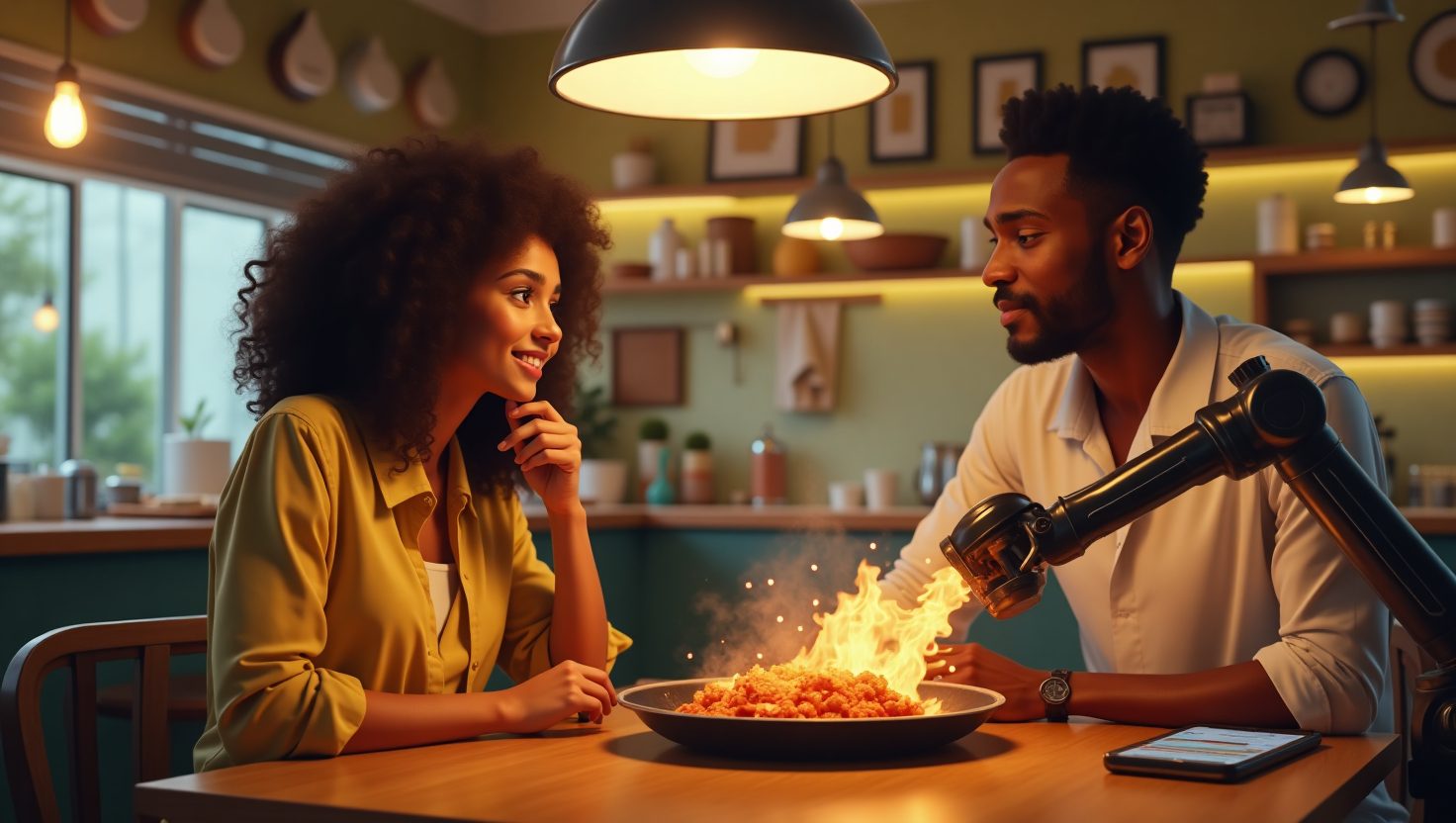
While you’ve been perfecting your sourdough starter, the giants of the food world have been busy teaching algorithms how to taste. No, I’m not kidding. The next frontier for artificial intelligence isn’t just writing your emails or driving your car; it’s redesigning your favourite biscuits and crisps. This is the world of predictive taste AI, and it’s about to fundamentally rewire an industry built on secret family recipes and the trained palates of master chefs. The question is, can an algorithm truly understand comfort?
So, What on Earth is Predictive Taste AI?
Before you imagine a robot with a tiny chef’s hat, let’s break this down. At its core, predictive taste AI is the application of machine learning to vast amounts of food-related data. Think of it less as a sentient Gordon Ramsay and more as the world’s most powerful data analyst, obsessed with flavour. This is where culinary data science comes into play. It involves deconstructing taste into thousands of data points: chemical compounds, aromatic molecules, textures, and even the sounds food makes when we eat it.
The system then cross-references this with sales figures, social media trends, and consumer reviews. It’s a bit like how Netflix builds a profile of you. It knows you watched a grim Scandinavian noir, then a lighthearted comedy, and it predicts you might enjoy a dark comedy from Denmark next. Predictive taste AI does the same, but for your mouth. It knows you buy spicy crisps and citrus-flavoured drinks, so it might predict you’d love a new lime and chilli chocolate bar. It’s all about spotting patterns in our behaviour that we might not even see ourselves.
The CPG R&D Kitchen Gets a Digital Makeover
For decades, research and development in the consumer-packaged goods (CPG) world has been a slow, expensive process. It involved hundreds of human testers, countless failed batches, and a hefty dose of guesswork. Now, that’s changing. The promised CPG R&D transformation isn’t a promise anymore; it’s a reality for the big players.
Companies like McCormick, the spice giant, are already leagues ahead. According to a recent CNBC report, they’ve used AI to slash product development timelines by a staggering 20% to 25%. Similarly, Unilever, the behemoth behind brands like Knorr and Hellmann’s, uses digital simulations to test thousands of virtual recipe variations in seconds. Their Knorr ‘Fast & Flavourful’ pastes were developed in half the usual time thanks to these sensory prediction models. This isn’t just about speed; it’s a seismic shift in efficiency. By simulating outcomes, they avoid wasting physical ingredients and expensive lab time, focusing human expertise only on the most promising candidates. It’s a classic case of using technology to augment, not replace, human skill.
Can an Algorithm Cook Up Nostalgia?
This all sounds very efficient for creating a new flavour of fizzy drink, but what about the food that’s tied to our emotions? This is where the conversation about comfort food innovation gets really interesting. Can an algorithm truly grasp the complex blend of salt, fat, and memory that makes a bowl of macaroni and cheese so satisfying on a rainy day?
The AI isn’t trying to feel nostalgia. Instead, it’s analysing what chemical and textural properties are consistently present in foods people label as “comforting.” It might identify a certain creamy mouthfeel, a specific Maillard reaction browning, or a ratio of savoury to sweet that triggers a positive response. Startups like Journey Foods are using AI to create optimised ingredient lists for CPG companies, focusing on everything from taste to supply chain stability. The goal is to create a new lasagne that tastes just as good as your mum’s but with a longer shelf life, a lower carbon footprint, and a more stable cost. The trick is hitting those sensory cues so perfectly that your brain fills in the rest.
The Algorithm Knows What You’ll Crave Next
Behind this whole enterprise are powerful consumer preference algorithms. These are the engines that forecast trends. They don’t just look at what you’re buying; they scan restaurant menus in trend-setting cities, analyse Instagram hashtags, and trawl through food blogs to predict the next big thing. Was gochujang’s rise predictable? An AI would argue it was, based on growing interest in Korean culture and a documented rise in searches for “sweet and spicy” flavour profiles.
For CPG companies, this is the holy grail. It’s the ability to get ahead of the curve instead of constantly reacting to it. By understanding the underlying drivers of taste trends, they can develop products that meet a demand that consumers don’t even know they have yet. It’s a strategic advantage that turns product development from a gamble into a calculated science.
The Human Palate Fights Back
Of course, it’s not all smooth sailing. Startups looking to break into this space face a huge barrier: data. The Unilevers and McCormicks of the world are sitting on decades of proprietary formulation data, a powerful moat that new entrants can’t easily cross. As food industry consultant Brian Chau bluntly put it, “I think all AI companies coming out are overstating what they can do.”
There’s also a biological reality that AI, for all its cleverness, can’t yet overcome. As Dr. Julien Delarue, a sensory science expert, noted in the same CNBC article, “There is no such thing as the average consumer.” Our perception of taste is wildly varied, influenced by everything from our genes (think of people who find coriander soapy) to our cultural upbringing. An AI can optimise for a statistical average, but it can’t replicate the deeply personal experience of taste. Annemarie Elberse from Unilever frames it perfectly: “Human creativity and judgment lead the way, and AI is a tool to help us amplify our impact.”
The £40 Billion Flavour Forecast
So where is this all heading? The market for AI in the food and beverage industry is projected to explode, ballooning from around $10 billion today to an estimated $50 billion by 2030. That’s not just growth; it’s a gold rush. AI will become indispensable for optimising everything from flavour pairings and shelf-life stability to creating healthier versions of our favourite snacks without sacrificing taste.
But the final vote will always belong to us. As Dr. Delarue insists, “Consumers will always be the ones who decide what tastes good. Not machines.” The real test will be one of trust. Will consumers embrace foods co-created by an algorithm, or will there be a backlash in favour of “all-natural,” human-made products? The industry will have to tread carefully, positioning AI as a silent partner that helps chefs, not as the chef itself.
Ultimately, predictive taste AI is a powerful new ingredient in the global kitchen. It’s making food development faster, more efficient, and more responsive to our hidden desires. It is not, however, a replacement for the human touch, creativity, or the beautifully illogical nature of a personal craving. The future of food isn’t human versus machine; it’s human and machine working together.
But I have to ask: when you discover your new favourite ice cream was designed by an algorithm, will it taste any less sweet? What do you think?



