

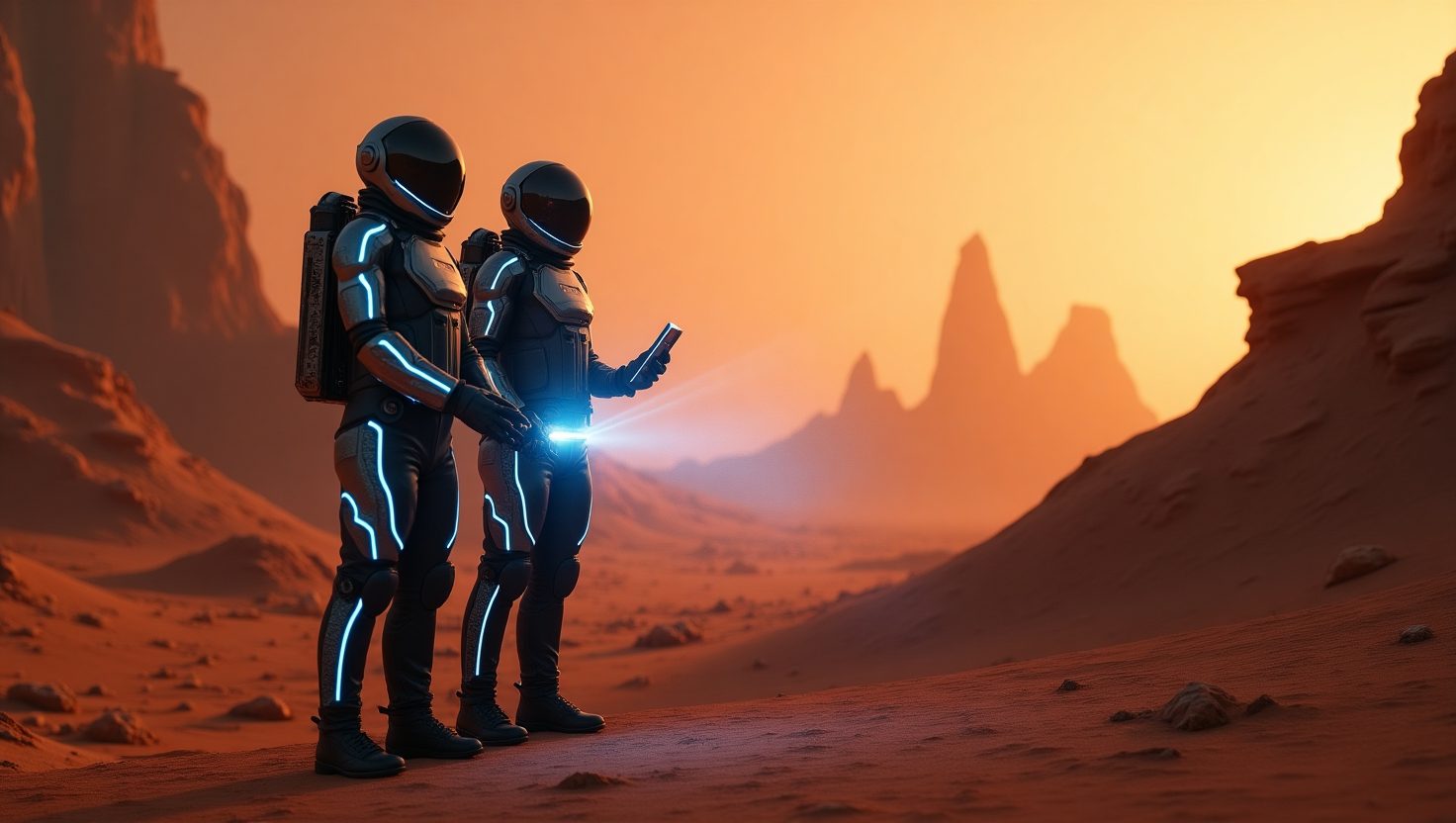
The secret ingredient, as you might have guessed, is artificial intelligence. We’re not talking about sentient robots from Hollywood films, but sophisticated algorithms capable of sifting through cosmic-scale datasets and finding patterns that would elude the human eye for a lifetime. This isn’t just about making things faster; it’s about asking entirely new questions and getting answers we once thought were impossible to find. We are witnessing the birth of a new kind of explorer—one that travels not on rockets, but on silicon chips.
### The New Frontier: What is Planetary Science AI?
At its core, planetary science is the grand human endeavour to understand our celestial neighbours—their geology, atmosphere, and history. It’s a field built on observation, collecting faint light signals and grainy images from across the solar system. For a long time, the bottleneck has been our ability to interpret this deluge of information. A single orbiter can send back more data in a day than an entire team could analyse in a year. It’s like trying to understand the ocean’s history by examining one teacup of water at a time.
This is where Planetary Science AI comes into play. It’s the application of machine learning models and complex algorithms to the colossal datasets gathered by our probes, rovers, and telescopes. Instead of just cataloguing images, these AI systems can learn the underlying physics of planetary processes. They can learn to identify geological formations, analyse atmospheric compositions, and even infer the climatic history of a planet simply by studying its surface features. It’s a powerful new lens that allows us to see not just what a planet looks like now, but what it was and what it might become.
Think of it this way: a human geologist can look at a sand dune on Earth and, based on their experience, make an educated guess about the winds that formed it. A Planetary Science AI can do the same for a dune on Mars, but it can run thousands of hyper-realistic physics simulations in minutes, testing every possible wind speed and duration until it finds a perfect match for the dune’s shape. It’s the difference between a rough estimate and a scientifically robust reconstruction of ancient history. This leap in capability moves us from educated guesswork to data-driven certainty.
AI as the Ultimate Co-Pilot in Exploration
The application of AI in space is not a single, monolithic concept. It’s a suite of specialised tools, each designed to tackle a different challenge in our cosmic quest. From navigating rovers across treacherous terrain to decoding the secrets buried in alien soil, AI is becoming the indispensable co-pilot for 21st-century exploration.
Space Exploration Algorithms: The Brains Behind the Brawn
When a rover trundles across the Martian surface, every metre is a potential risk. A wrong turn could end a billion-pound mission. Modern space exploration algorithms are the intelligent software that allows these machines to make smart decisions autonomously. They analyse stereoscopic images to build 3D maps of the terrain in front of them, identifying hazards like steep slopes, loose sand, or sharp rocks, and then plot the safest and most efficient path forward.
But their role goes far beyond navigation. These algorithms are also becoming scent hounds for scientific discovery. Onboard an orbiter, an AI can be trained to scan thousands of square kilometres of surface images, flagging specific mineral signatures that might indicate the past presence of water, or identifying unusual geological formations that merit a closer look. This allows mission controllers to focus their limited time and resources on the most promising targets, vastly accelerating the pace of discovery. We’re effectively teaching our probes to have scientific intuition.
Astrogeology Automation: Mapping Worlds at Lightning Speed
Astrogeology is exactly what it sounds like: the geology of other planets and celestial bodies. Traditionally, this involved geologists poring over images, manually mapping craters, volcanoes, and riverbeds. It’s a slow, laborious process susceptible to human bias and error. Astrogeology automation is changing that paradigm completely.
Using deep learning models, computers can now perform these tasks with blistering speed and remarkable accuracy.
* Crater Detection: AI can scan an entire hemisphere of a planet and count, measure, and classify hundreds of thousands of craters in a matter of hours. This data is vital for determining the age of a planet’s surface.
– Surface Composition Analysis: By analysing data from spectrometers, AI can create detailed mineralogical maps, revealing deposits of ice, metals, or clays that could be crucial resources for future human colonists.
– Change Detection: By comparing images taken years apart, AI can spot subtle changes, like the movement of sand dunes, the appearance of new gullies, or the seasonal melting of polar caps, providing dynamic insights into a planet’s current climate.
This automation isn’t about replacing human scientists; it’s about empowering them. It frees up expert time from tedious manual labour and provides them with comprehensive, data-rich maps to guide their higher-level analysis.
Decoding the Cosmos with Extraterrestrial Data Analysis
The ultimate goal of all this data collection is, of course, analysis. Extraterrestrial data analysis is the process of turning raw numbers and pixels into profound knowledge about the universe. The challenge here is not just the volume of data but its complexity. A single reading from a planetary probe might contain information about temperature, pressure, chemical composition, and radiation levels, all interwoven.
AI excels at untangling these complex, multi-dimensional datasets. Machine learning models can identify subtle correlations that humans would never spot. For example, an AI might find a faint link between a specific atmospheric gas and a certain type of rock on the surface, hinting at an unknown geological process. This is how we move from simply observing planets to truly understanding how they work.
This analytical power is fundamental for planning future missions. Before we send humans to Mars, we need to know everything we can about its environment. AI-driven analysis helps us answer critical questions: Where are the safest landing sites? Where can we find water ice? What are the risks from dust storms and radiation? Every insight gained from extraterrestrial data analysis makes future human exploration safer and more likely to succeed.
Case Study: Reading the Martian Winds
Perhaps the most exciting recent example of Planetary Science AI in action comes from a team at the University of Campinas in Brazil. As detailed in a report by Jordan News, these researchers developed a groundbreaking method to reconstruct the wind patterns on Mars over immense timescales. Their findings, published in the prestigious journal Geophysical Research Letters, offer a glimpse into the future of planetary exploration.
The team, including researchers Renato Miotto and Eric Franklin, focused on Martian sand dunes, known as barchans. These crescent-shaped dunes are sculpted by wind, and their specific shape and movement hold a physical record of the atmospheric conditions that created them. The problem is that we can’t place a weather station next to every dune. So, how can we read this history?
Their solution was brilliant. They combined two key elements:
1. Image Analysis: They used AI to precisely analyse high-resolution images of Martian barchans taken by orbiters.
2. Physics Simulations: They created a sophisticated computer model that simulates how granular materials (like sand) behave under different wind conditions on Mars, accounting for its lower gravity and thin atmosphere.
The AI essentially acts as a bridge between the real world and the simulation. It looks at the shape of a real dune on Mars and then runs the simulation over and over, tweaking the virtual wind’s speed and direction until the simulated dune perfectly matches the real one. By doing this for thousands of dunes, they could build a detailed historical map of wind patterns across the planet. As researcher Eric Franklin explained, “From images alone, we can infer past wind intensities and predict how Mars’ terrain will change in the future.”
The implications are enormous. Understanding historical and future wind patterns is not just an academic exercise. It is critical for the safety of human missions. It helps engineers design landers that can withstand powerful gusts and allows mission planners to choose landing sites that are less prone to being buried by shifting sands. This work transforms static images into a dynamic weather forecast spanning millennia. Renato Miotto highlights the versatility of their method: “Any granular system visible in images—from sand to ice—can be analyzed, as long as the simulations accurately reproduce the material’s behavior.” This means the same technique could be used to study icy plumes on Europa or the methane sands of Titan.
The Future: AI as a Predictive Oracle for New Worlds
The University of Campinas study is not an endpoint; it’s a signpost pointing towards the future. The next phase of Planetary Science AI will move beyond reconstruction and into prediction. We are on the verge of creating ‘digital twins’ of entire planets—fully dynamic simulations that can model geological and atmospheric evolution decades or even centuries into the future.
Imagine being able to ask: “If we build a habitat at this location on Mars, what is the probability it will be impacted by a major dust storm in the next 50 years?” or “How will the polar ice caps on Mars recede over the next century, and where will the resulting water vapour go?” These are the questions that predictive AI models will soon be able to answer. This capability will be the bedrock of establishing a sustainable human presence beyond Earth. It shifts the entire paradigm of mission planning from reactive to proactive.
This is a profound moment in our journey as an exploring species. For centuries, we have looked to the stars with wonder. Now, we are building intelligent tools that allow us to not only look but to understand, interpret, and predict. The partnership between human curiosity and artificial intelligence is unlocking cosmic secrets at an unprecedented rate, turning alien worlds from distant points of light into places with a history, a present, and a future we can begin to comprehend.
The story of Mars is being written, and AI is holding the pen. As these technologies mature, what once seemed unknowable will become predictable. The real question is, as we get better at reading the stories of other worlds, what will we learn about our own? What cosmic mysteries will this powerful new partnership help us solve next?



