

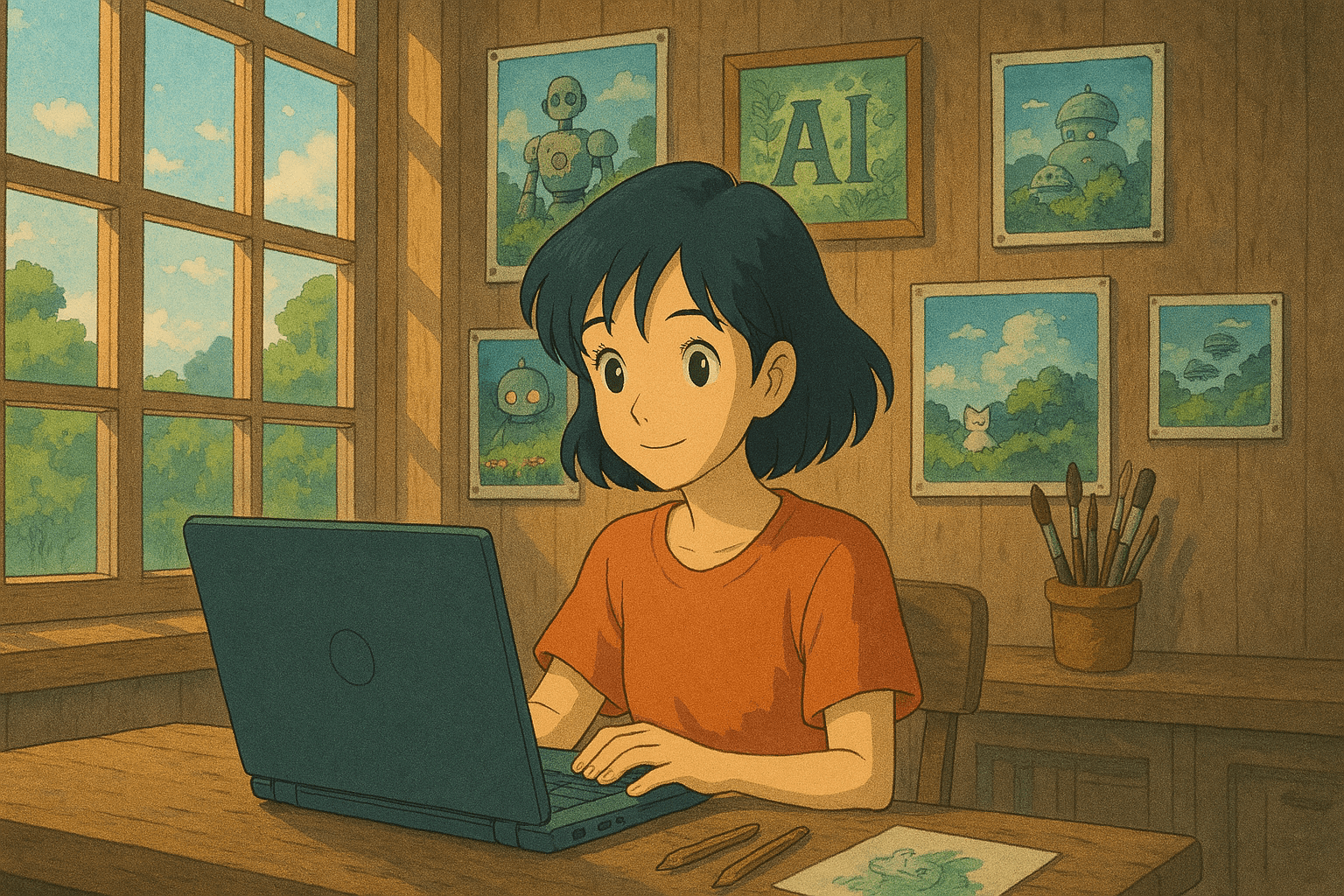
Recently, there’s been a lot of buzz online about AI image generators creating images in the style of Studio Ghibli. You know, just when you thought AI image generators couldn’t get any more bonkers, they go and pull a Studio Ghibli. Yes, that Studio Ghibli, the whimsical wizards behind films that make your heart ache and your imagination soar. It seems AI image generation technology, like that from OpenAI – those clever clogs behind ChatGPT and all that jazz – is now capable of producing images reminiscent of Miyazaki’s masterpieces. And predictably, it’s got the internet in a proper kerfuffle.
Ghibli-esque Dreams or Digital Theft? The AI Art Debate Heats Up
Now, before we get all misty-eyed about AI conjuring up Totoro in pixels, let’s have a proper chinwag about what this actually means. We’re talking about technology that can learn, parrot, and potentially, some might argue, pilfer artistic styles. It’s not just about mimicking a few brushstrokes; it’s about capturing the very soul of an aesthetic. Think of those lush landscapes, the emotive characters with eyes that could drown you, the sheer, unadulterated magic of Ghibli. Can an algorithm truly grasp that, or is it just clever mimicry?
Why All the Fuss About Style?
You might be thinking, “Blimey, isn’t imitation the sincerest form of flattery?” Well, in the world of art and copyright, things get a tad more… complicated. See, a big part of what makes Studio Ghibli, well, Studio Ghibli, is their instantly recognisable style. It’s their brand, their identity, their unique selling point if you want to get all business-y about it. And that style is built on decades of hard work, creativity, and sheer artistic genius from the likes of Hayao Miyazaki and his team.
So, when an AI comes along and can seemingly replicate that style at the click of a button, eyebrows are naturally raised. Is this innovation, or is it, dare we say it, a bit cheeky? This brings us right into the thick of the copyright debate, a right royal rumble that’s been brewing ever since AI started flexing its creative muscles.
Copyright Conundrums in the Age of AI
Here’s the rub: copyright law in the digital age is already a bit of a dog’s breakfast. Trying to apply it to AI-generated art is like trying to fit a square peg in a round hole. Traditional copyright is designed to protect human creators. But what happens when the ‘creator’ is an algorithm? Who owns the copyright then? OpenAI? The user who typed in the prompt? Or, stretching it a bit, could Studio Ghibli have a claim, even if their actual characters aren’t directly copied, but just their style is emulated?
These are the sorts of head-scratchers that keep legal eagles up at night. And it’s not just about Studio Ghibli, mind you. This is a much broader question about AI and artistic style in general. If an AI can learn to paint like Van Gogh, sculpt like Michelangelo, or, indeed, animate like Miyazaki, what does that mean for the livelihoods of human artists? Are we heading towards a future where human creativity is devalued, or even worse, rendered obsolete? Bit bleak, innit?
Sam Altman and the 2025 Vision: Utopia or Dystopia for Artists?
Now, into the fray steps Sam Altman, the head honcho at OpenAI. He’s been chatting about this very thing, painting a picture of a future where AI is, well, everywhere. Sam Altman has spoken about the transformative potential of AI and its ability to democratize creativity, making it accessible to everyone. Imagine being able to conjure up your own Ghibli-esque animation without spending years honing your artistic skills. Sounds brilliant, doesn’t it?
But hold your horses. There’s a flip side to this shiny coin. If everyone can create art in any style they fancy with a few typed words, what happens to the value of originality? What happens to the artists who have dedicated their lives to developing those unique styles in the first place? Will they be able to compete with the relentless output of AI-powered image generators? It’s a bit like the music industry facing Napster all over again, but this time it’s not just about distribution, it’s about creation itself.
The URL Access Error in the Room: System Limitations and the Bigger Picture
Interestingly, while researching this topic, I encountered some technical difficulties accessing online articles, experiencing URL retrieval problems and website access issues. This personal experience serves as a reminder of the occasional glitches in our hyper-connected digital world. It’s a reminder, if we needed one, that even in this hyper-connected world, we still bump into occasional technical hiccups. Sometimes, the digital highways get a bit clogged, and we experience a temporary request processing failure.
You might be asking, “Why can’t this system access URLs?” Good question! Is it gremlins in the machine? A temporary glitch in the matrix? Or perhaps something more fundamental? Whatever the reason, it throws a bit of a spanner in the works when you’re trying to get the full scoop. And it makes you think about the occasional technical issues and the reliability of the internet itself.
Now, while I’m scratching my head trying to fix URL access errors and figure out how to fix URL access errors?, let’s get back to the Ghibli AI story. This little tech hiccup is a tiny microcosm of the bigger challenges we face with AI. We’re building these incredibly powerful tools, but we’re still grappling with the ethical, legal, and even technical infrastructure to support them properly.
Human Creativity vs. Algorithmic Imitation: A False Dichotomy?
Perhaps we’re framing this whole thing wrong. Maybe it’s not about human creativity versus algorithmic imitation. Maybe it’s about human creativity enhanced by algorithmic tools. Imagine artists using these AI image generators not to replace themselves, but to augment their own abilities. To explore new styles, to rapidly prototype ideas, to overcome creative blocks.
Think of it like photography. When photography first emerged, painters were terrified. “Is this the end of painting?” they wailed. Of course, it wasn’t. Photography became its own art form, and painting evolved alongside it. Perhaps AI image generation will be similar. It might disrupt the art world, no doubt, but disruption isn’t always a bad thing. It can force us to rethink, to innovate, to push the boundaries of what’s possible.
The Human Touch in a Digital World
Ultimately, though, there’s something about the human touch that’s hard to replicate. Studio Ghibli’s magic isn’t just about a style; it’s about the stories, the emotions, the sheer heart that goes into every frame. It’s about the collective vision of a team of artists working together, pouring their souls onto the screen. Can AI truly replicate that intangible human element?
Maybe the Ghibli-esque AI will be a fun gimmick, a novelty that wears off. Or maybe it will genuinely transform the animation industry, and the art world as a whole. Either way, it’s a conversation worth having. And even if we can’t always access every URL we click on (technology, eh?), we can still chew the fat, debate the ethics, and ponder the future of creativity in this brave new AI-powered world.
What do you reckon? Are you excited or terrified by the prospect of AI Ghibli? Let me know in the comments below.
“`



