

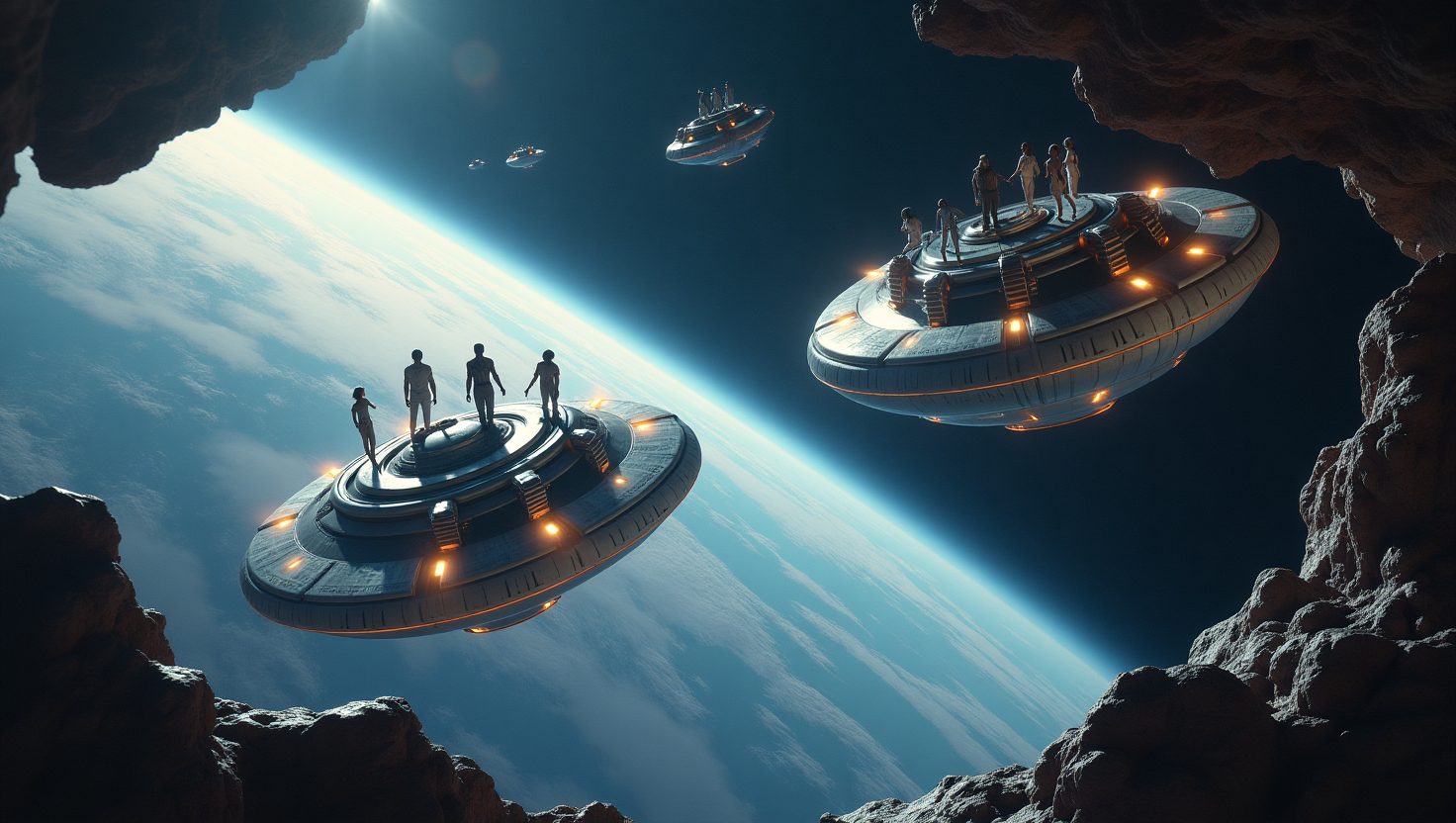
Right, let’s talk about Elon Musk’s latest, and perhaps most audacious, plan. Just when you think he might be content with electric cars, rockets, and attempting to rewire the global town square, he decides the next logical step is to hoist the world’s computing infrastructure into orbit. It sounds like a plot from a science fiction novel he read as a child, but a recent flurry of activity suggests this is anything but fiction. A filing with the US Federal Communications Commission (FCC) here, a strategic shuffle of his corporate assets there—suddenly, the concept of orbital data centers has rocketed from abstract theory into a very real, very expensive business plan.
Is this a visionary leap for humanity’s digital backbone, or is it a stratospheric folly? Honestly, with Musk, it’s often a bit of both. But the strategic implications for AI computing and global space infrastructure are too enormous to ignore. Let’s break down what’s really going on.
What Exactly is an Orbital Data Centre?
At its core, the idea is simple. Instead of building colossal, power-hungry data centres on Earth—sprawling across acres of land and sucking gigawatts from national grids—you put them in space. We’re talking about satellites, or entire constellations of them, designed not just for communication but for heavy-duty data processing and storage, powered by the one thing space has in limitless supply: direct, unfiltered sunlight.
Think of your standard data centre. It’s a massive, air-conditioned warehouse filled with servers, requiring eye-watering amounts of electricity and a constant battle against overheating. Now, imagine that warehouse in space. You solve the two biggest problems in one go: real estate and power. There are no neighbours to complain about the noise, and you’re parked next to a giant fusion reactor we call the Sun.
The Strategic Advantages: It’s All About the Economics
This isn’t just about sounding cool, although it certainly achieves that. The business case, as Musk lays it out, is brutally logical. It hinges on a few key pillars that could fundamentally reshape the economics of future computing.
1. Unlocking Inefficient Power
The killer argument is energy. On Earth, we lose a huge amount of solar energy to the atmosphere, clouds, and the simple fact that it’s dark for half the day. As Musk himself put it, “Any given solar panel is going to give you about five times more power in space than on the ground”. This isn’t a minor efficiency gain; it’s a fundamental shift in the cost of energy, which is the single biggest operational expense for any data centre. As TechCrunch has reported, this five-fold increase in power generation is the linchpin of the entire venture.
It’s like owning a petrol station where the fuel is delivered for free, 24/7. On Earth, every other data centre is paying for fuel and delivery from miles away. In space, you’re floating in the refinery.
2. The AI Computing Flywheel
Why now? Because the demand for AI computing is exploding. Training models like GPT-4 and its successors requires computational power on a scale that makes previous internet booms look quaint. The global data centre capacity is projected to hit 200 gigawatts by 2030, representing an infrastructure investment of roughly £800 billion.
By merging his AI company, xAI, with SpaceX’s launch capabilities, Musk is creating a vertically integrated behemoth. SpaceX can launch the orbital data centers cheaper than anyone else, these centres can power xAI’s models at a fraction of the cost of terrestrial rivals, and the advancements in AI can then be used to optimise the satellite networks and rocket launches. It’s a self-reinforcing loop—a flywheel that could give his ventures an almost unassailable competitive advantage.
The Key Players Orbiting This Idea
Naturally, Musk is the gravitational centre of this plan. The recent FCC filing by SpaceX for a network of up to a million satellites wasn’t just about internet service; it was laying the groundwork. FCC Chairman Brendan Carr has already publicly endorsed the proposal, a significant green light from regulators.
Musk’s timelines are, as ever, breathtakingly aggressive. He claims that within “30 months,” space will become the “most economically compelling place to put AI.” He goes even further: “Five years from now… we will launch and be operating every year more AI in space than the cumulative total on Earth.”
If he’s even remotely correct, the billions being poured into terrestrial data centres by Amazon, Google, and Microsoft might start to look like a bad bet. They are building bigger, better horse-drawn carriages while Musk is designing the engine for the first automobile.
A Healthy Dose of Scepticism: The Challenges Ahead
Of course, this is where we have to come back down to Earth. The vision is spectacular, but the practical hurdles are monumental.
1. Who’s Going to Fix a Broken Server?
This is the question that critics like investor and podcaster Dwarkesh Patel have rightly raised. Hardware fails. It’s a fact of life. On the ground, you send a technician to swap out a faulty drive or a burnt-out power supply. How do you do that in zero gravity, hundreds of miles above the Earth?
Are we envisioning robotic repair arms? Fully disposable satellite racks? The logistics and cost of hardware maintenance in orbit are a colossal, and largely unsolved, problem. A single, unfixable point of failure could turn a billion-dollar satellite into a very expensive piece of space junk.
2. The Crowded Skies and Red Tape
While the FCC has shown initial support, the path to launching a million satellites is fraught with regulatory and logistical nightmares. Low-Earth orbit is already getting alarmingly crowded, raising concerns about space debris and potential collisions. Gaining approvals and coordinating this massive space infrastructure will be a diplomatic and technical challenge of immense proportions.
The Final Frontier for Computing
Despite the challenges, the sheer scale of the ambition is compelling. If the problem of maintenance can be solved—perhaps through radical new hardware designs or advanced robotics—then orbital data centers could genuinely become the foundation for the next era of computing. The synergy between reusable rockets, ever-improving satellite networks, and the insatiable demand for AI is powerful.
Musk is betting that the long-term economic benefits of near-free power and limitless space will ultimately outweigh the steep upfront costs and logistical headaches. He is not just building a product; he is trying to build a new utility, a new type of infrastructure as fundamental as the power grid or the internet itself.
The question is, is this the inevitable next step in our technological evolution, or is it one man’s ego trip written in the stars? And as we watch this grand experiment unfold, one can’t help but wonder: would you bet against him? Let me know your thoughts below.



