

Let’s talk about robots, responsibility, and righteous rebellion in the tech world. Because this week, it’s not just about the whizz-bang of the latest AI, but who’s wielding it and for what purpose. And trust me, it’s getting a bit spicy in Silicon Valley, or should I say, Redmond?
Microsoft Under the Microscope: AI and the Israel-Gaza Conflict
Microsoft, the behemoth of software and now a major player in the AI game, is facing a bit of a kerfuffle. Seems some of their own employees are rather miffed about where their hard work might be ending up. We’re talking protests, petitions, the whole shebang. Why? Because of the company’s AI dealings, particularly in the context of the ongoing Israel-Gaza conflict. It’s a thorny issue, tangled up in tech ethics, global politics, and the age-old question: just because we can build something, should we?
Tech Workers Say “Hold On a Minute!”
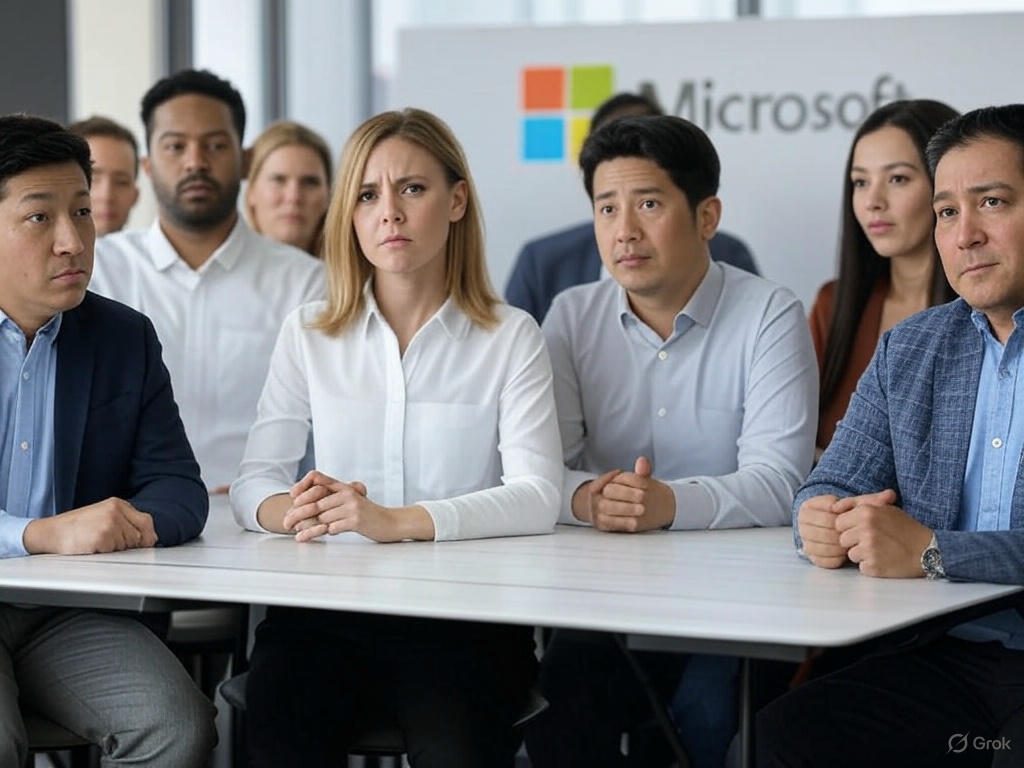
Now, you might think of tech workers as being all about the code, the caffeine, and the corner office perks. But increasingly, there’s a strong undercurrent of tech worker activism bubbling up. These aren’t just automatons churning out algorithms; they’re people with consciences, and they’re starting to use their collective voice. In this case, a coalition of Microsoft employees, under the banner of ‘Microsoft Workers 4 Good,’ staged protests outside the company’s offices in cities like San Francisco and New York. Their beef? Microsoft’s contracts providing AI and cloud services to both the Israeli military and government.
Think about it: we’re constantly told AI is the future – transforming everything from healthcare to how we order our takeaway. But what happens when this powerful tech gets deployed in conflict zones? That’s the question these Microsoft workers are asking, and frankly, it’s a question we all should be pondering. Are we sleepwalking into an era where AI in military applications becomes the norm, without properly grappling with the AI ethics implications?
Project Nimbus and the Cloud of Controversy
At the heart of this protest is “Project Nimbus,” a hefty $1.2 billion contract that Microsoft and Amazon Web Services landed to provide cloud computing and AI services to the Israeli government and military. Now, on the face of it, cloud services sound pretty innocuous, right? It’s just data storage, servers humming away in the background. But in reality, these services are the backbone for running sophisticated AI systems. And that’s where the alarm bells start ringing.
The protesting employees are worried – and rightly so – that Microsoft’s technology could be used to enhance AI surveillance capabilities, potentially fueling the conflict and infringing on human rights. They’re not just throwing stones from the sidelines; they’ve penned an open letter, signed by hundreds, demanding Microsoft pull out of the Project Nimbus contract. They argue that the tech could be used to further what they describe as the “unlawful occupation of Palestinian land” and the “violence against Palestinians.” Strong words, and they highlight the deep ethical chasm that’s opening up in the tech industry.
Facial Recognition: A Sharper Edge to the Sword?
One of the most contentious aspects of AI, and one that’s particularly relevant here, is facial recognition. Imagine AI-powered surveillance systems that can identify individuals in real-time, across vast areas. Sounds like something straight out of a dystopian film, doesn’t it? But the reality is, this technology is here, and it’s getting more powerful by the day. And guess what? It’s often baked into these very cloud and AI services that companies like Microsoft are providing.
The protesters are raising serious concerns about the potential for AI facial recognition racial bias. Studies have repeatedly shown that facial recognition systems are often less accurate when identifying people with darker skin tones. In a conflict situation, where tensions are already sky-high, the risk of misidentification and wrongful targeting becomes terrifyingly real. Are we comfortable with AI potentially exacerbating existing inequalities and biases in such critical and fraught contexts? I’d wager most of us aren’t, and certainly not the Microsoft employees taking to the streets.
Echoes of the Past, Warnings for the Future
This isn’t the first time tech workers have stood up against their employers over ethical concerns. Remember Google employees protesting Project Maven, the Pentagon AI project? Or the walkouts at Amazon over climate change and worker treatment? This Microsoft AI protest is part of a growing trend of tech worker activism, a sign that the people building these technologies are increasingly unwilling to leave their ethics at the office door.
And it’s not just about specific projects or contracts. It’s about a fundamental shift in how we view the role of tech companies in society. Are they simply neutral platforms, providing tools that can be used for good or ill? Or do they have a responsibility to consider the ethical implications of their technology, especially when it comes to sensitive areas like AI in law enforcement and AI in military weapons? The employees at Microsoft clearly believe it’s the latter.
Beyond the Protest: The Bigger Picture of AI Ethics
This Microsoft situation is a microcosm of a much larger debate raging about the ethical implications of AI surveillance and the broader use of AI in sensitive sectors. It’s not just about Microsoft; it’s about the entire tech industry grappling with its conscience. As AI becomes more pervasive, the potential for misuse, unintended consequences, and ethical dilemmas only grows.
We need to have a serious conversation – and fast – about setting clear ethical boundaries for AI development and deployment. Who decides what’s acceptable? Should it be left solely to tech companies, driven by market forces and profit margins? Or do we need stronger regulatory frameworks, informed public debate, and a more robust ethical compass guiding innovation?
The protests at Microsoft are a wake-up call. They remind us that technology isn’t neutral, that algorithms aren’t value-free, and that the choices we make today about AI will shape the world of tomorrow. It’s not just about the code; it’s about our collective future. And that’s a story that’s only just beginning to be written.



