

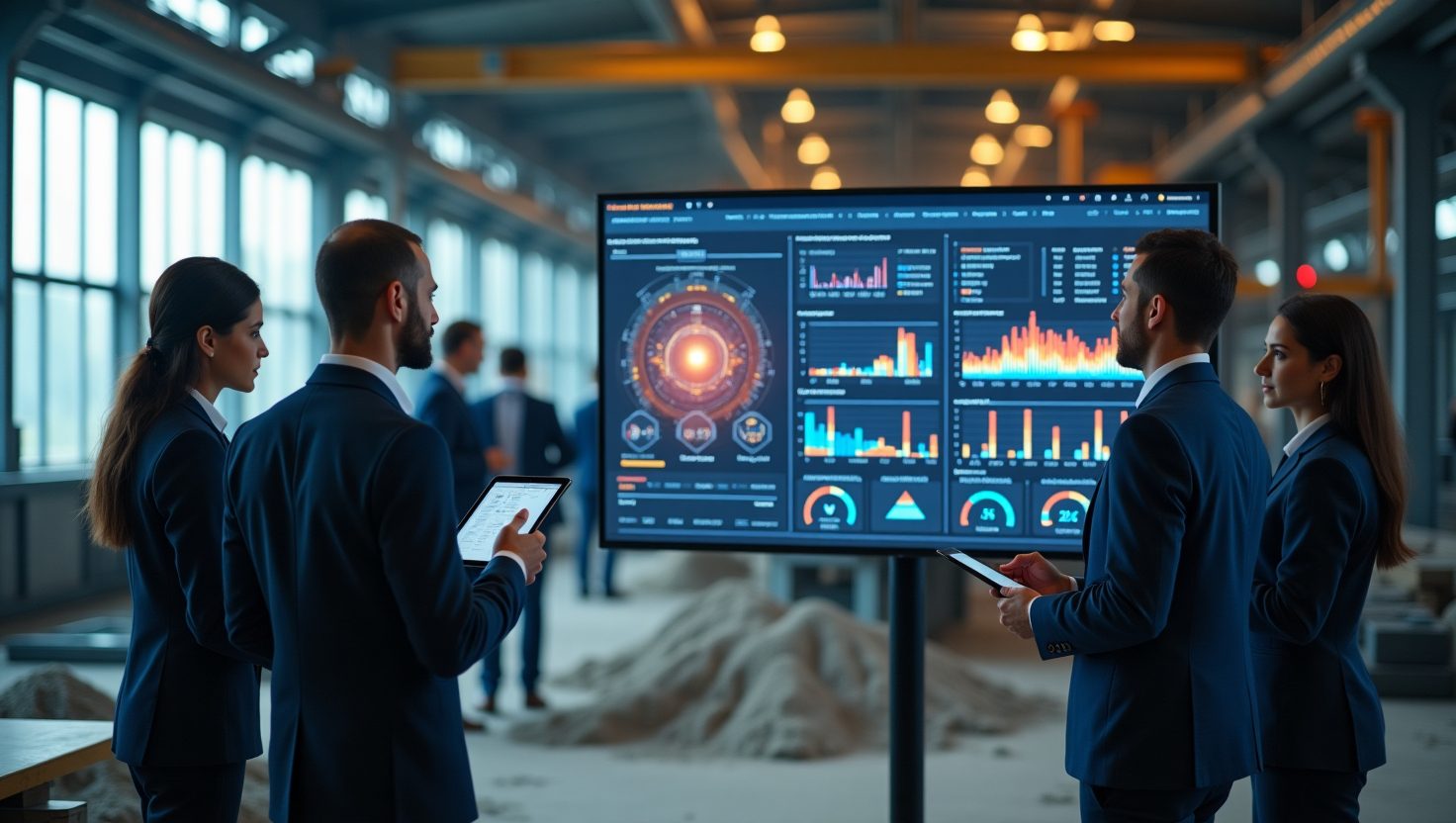
Huawei, a company you might associate more with smartphones and 5G towers, has been working with giants like Conch Group to embed this intelligence directly into the heart of cement production. The results, as detailed in a recent report by Artificial Intelligence News, are nothing short of transformative. A 1% reduction in coal consumption might not sound like much, but in an industry where margins are tight and environmental impact is massive, it’s a monumental achievement. This is the story of how abstract algorithms are getting their hands dirty, turning clinker into code and showing us the future of heavy industry.
So, What Exactly Is Manufacturing Process AI?
Let’s clear something up. When we talk about AI in manufacturing, many people picture a robotic arm on a car assembly line, performing a repetitive task with superhuman speed. That’s automation, and it’s been around for ages. Manufacturing process AI is something different altogether. It’s the central nervous system, the digital overseer that manages the entire workflow. It’s less about replacing a single worker and more about augmenting the entire factory’s intelligence.
Think of it like this: a traditional factory operates like a rowing team where each rower follows the coxswain’s calls based on experience and what they can see. Manufacturing process AI, on the other hand, is like giving that team a central computer that monitors every rower’s heart rate, oar pressure, water conditions, and the boat’s velocity. The AI doesn’t just shout “stroke!”; it makes a thousand micro-adjustments to each rower’s rhythm to achieve peak efficiency. It’s predictive, not just reactive.
This intelligence is fuelled by a constant stream of information from the factory floor. This is where the industrial IoT (Internet of Things) comes in. Thousands of sensors measuring temperature, pressure, chemical composition, and vibration are the nerve endings of the factory. They feed data to the AI, which then analyses it to find patterns and opportunities for optimisation that a human operator, no matter how experienced, could never spot.
The Tangible Wins: Saving Fuel and Perfecting the Product
Why would a company like Conch Group, a behemoth in the cement world, bother with all this? The answer comes down to two of the most critical metrics in any manufacturing operation: cost and quality.
#### Slashing Energy Bills
Heavy industries are notoriously thirsty for energy. In cement production, the process of calcination—heating limestone and other materials to over 1,400°C to create “clinker,” the key ingredient in cement—is incredibly energy-intensive, primarily burning coal. The Huawei system, by constantly analysing data from the kiln, can make tiny adjustments to airflow, fuel injection, and material feed rates. The goal is to maintain the perfect temperature without wasting a single lump of coal.
The result? A 1% reduction in coal consumption. As the analysis from Artificial Intelligence News highlights, this figure is a huge deal. For a single cement plant, this translates into thousands of tonnes of coal saved per year, a direct boost to the bottom line and a significant cut in CO2 emissions. When you imagine scaling this across the entire global cement industry—which is responsible for around 8% of global CO2 emissions—that 1% starts to look like a genuine climate solution.
Achieving Unprecedented Quality Control
The other side of the coin is quality control. The final strength of the cement is determined by the quality of the clinker produced in the kiln. For generations, this has been a bit of a dark art. Operators relied on experience and periodic lab tests to get it right, but this often meant inconsistent quality and wasted batches.
The AI model developed by Huawei can predict the final strength of the clinker with 90% accuracy, with deviations of less than 1 megapascal (MPa). This is an astonishing level of precision. It means the system can flag a potential drop in quality before it happens, allowing for proactive adjustments rather than reactive rejection. This data-driven approach moves quality control from an end-of-pipe inspection to an integrated, predictive part of the manufacturing process AI. It ensures a consistently high-quality product, reduces waste, and ultimately builds more trust with customers who rely on that cement for everything from skyscrapers to bridges.
The Unseen Engine: Industrial IoT and Hybrid Architecture
None of this AI magic happens in a vacuum. The AI is the brain, but the industrial IoT is the body’s sensory system. Without a constant, reliable flow of data from sensors embedded throughout the kiln, the AI would be flying blind. This synergy is what makes the system so powerful. The IoT devices provide the granular, real-time data, and the AI provides the analytical horsepower to make sense of it all.
Huawei’s approach, as outlined by their Cloud CTO Zhang Yuxin, is particularly clever. They have developed what they call a “hybrid compute architecture.” This isn’t just about throwing massive processing power at the problem. Instead, it combines general-purpose computing for standard tasks with specialised intelligent computing designed specifically for AI workloads. This creates a system that is both powerful and efficient.
This move towards what Huawei calls “agentic AI” is a significant leap. Previous AI systems were largely reactive; they responded to commands or identified anomalies. These new agentic systems are proactive. As described in the artificialintelligence-news.com article, they are capable of autonomous planning and execution. The AI doesn’t just tell an operator, “The temperature is dropping.” It concludes, “The temperature is dropping, and based on the current material composition and airflow, I am increasing fuel injection by 0.5% to stabilise it without compromising clinker quality.” It’s a subtle but profound shift from being a tool to being a partner in the operation.
The Future: Autonomous Factories on the Horizon?
So where is this all heading? The case of Huawei and Conch Group is a powerful proof-of-concept. It demonstrates that manufacturing process AI isn’t just a theoretical advantage; it delivers measurable results in some of the world’s most challenging industrial environments. The next logical step is to move from process optimisation to full-scale automation.
We are likely to see the emergence of semi-autonomous and eventually fully autonomous factories. A plant could one day manage its entire supply chain, ordering raw materials when its sensors detect low stock, scheduling its own maintenance when a component shows signs of wear, and optimising its production schedule based on energy prices and customer demand, all with minimal human intervention.
This obviously raises questions about the future of the workforce. But the story here isn’t necessarily one of mass job replacement. It’s a story of workforce evolution. The skills required to run a cement plant in 2030 will be vastly different from today. There will be less need for manual operators and more demand for data scientists, robotics engineers, and AI system managers—people who can build, maintain, and oversee these complex digital ecosystems. The challenge for industries and governments will be managing this transition and reskilling the workforce for the factories of tomorrow.
The journey from clinker to code is well underway. What Huawei has accomplished in the cement industry is a playbook for virtually every other heavy manufacturing sector, from steel and glass to chemicals and paper. The integration of manufacturing process AI with industrial IoT is delivering phenomenal gains in energy reduction and quality control. It’s making our foundational industries smarter, cleaner, and more efficient.
The question is no longer if AI will reshape manufacturing, but how quickly companies can adapt. The pioneers are already reaping the rewards. For everyone else, it’s a race to catch up. What do you think is the biggest barrier for older, more traditional industries looking to adopt these new AI-driven processes?



