

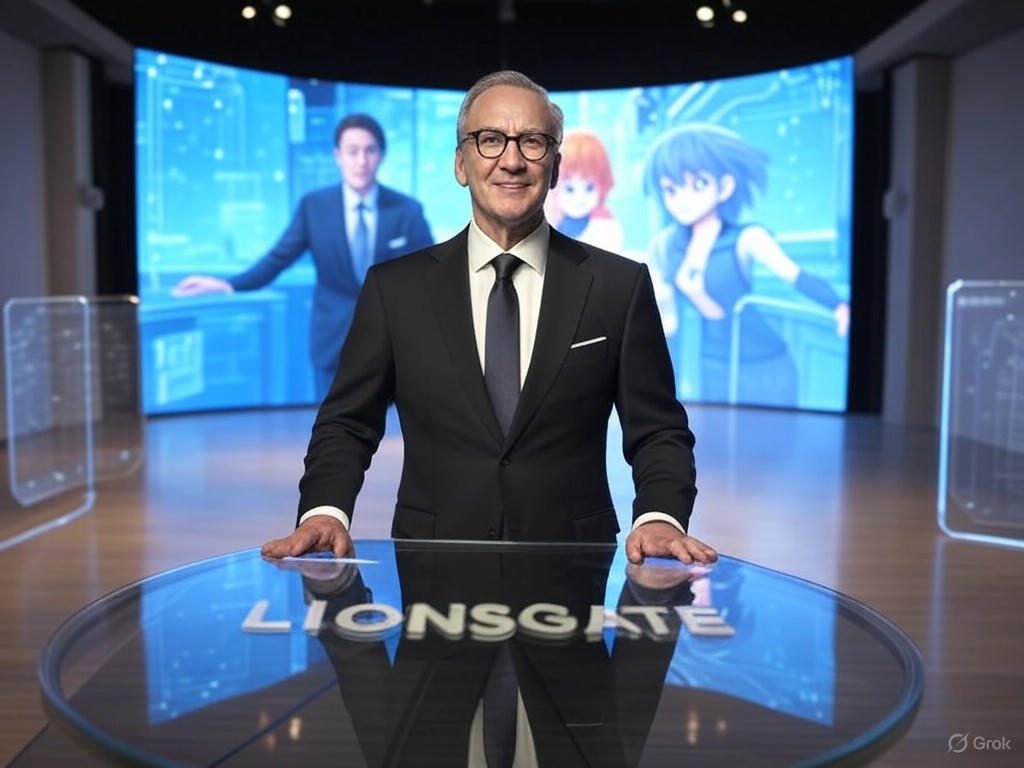
Right then, gather round, because Michael Burns, the Vice Chairman over at Lionsgate, has popped up with a rather attention-grabbing statement about AI in entertainment that’s certainly set the cat amongst the pigeons. He’s suggested that using Lionsgate AI tools, they could apparently take a film and remake it as an anime… in a mere three hours. Yes, you read that right. Three. Hours. It’s the kind of claim that makes you blink a few times and wonder if you’ve accidentally stumbled into a sci-fi flick, or perhaps a particularly ambitious tech demo.
The Speed of Thought? Lionsgate’s Bold AI Anime Remake Claim
Speaking, presumably, in a context where numbers and efficiency are paramount, Michael Burns Lionsgate dropped this bombshell. The core driver behind this astonishing speed? Cost reduction film production. In an era where content is king but budgets are under increasing scrutiny, especially with the shifting sands of streaming economics, the allure of significantly cheaper production methods is understandable. The idea is that using Film production AI, tasks that currently take teams of skilled animators weeks, months, or even years could be compressed into a coffee break and a quick flick through an AI prompt guide.
He wasn’t just spitballing hypotheticals either, according to reports. Burns reportedly mentioned that Lionsgate has AI test footage. This suggests they’re not just talking theoretically, but perhaps exploring what this looks like in practice, although details about this footage and its existence beyond his statement remain limited. The specific claim, “we can remake a film as anime in 3 hours in AI,” is incredibly precise, which makes it either remarkably true or remarkably… well, a bit of a stretch. (See analysis from Cartoon Brew for more on the feasibility debate). Let’s lean towards the latter for a moment, shall we? Because turning a complex live-action film into a visually distinct and narratively coherent piece of anime usually involves far, far more than a morning’s work.
Unpacking the “How”: What Does an AI Anime Remake in Three Hours Actually Mean?
So, how on earth would Lionsgate can remake film as anime in 3 hours using AI? This is where the technical details get murky, and frankly, the claim seems rather ambitious, bordering on improbable for a complete, finished product. Current AI capabilities, while advancing at a dizzying pace, still typically involve significant human oversight and input, especially for creative tasks like animation.
Let’s consider what goes into an anime remake:
- Artistic Interpretation: Character designs, background art, colour palettes – all need to be translated into the anime style, which isn’t a one-size-fits-all process. It requires artistic choices and cultural understanding.
- Animation: This involves keyframes, inbetweening (drawing the frames between the keyframes), timing, and lip-syncing. Even with AI tools assisting with motion transfer or inbetweening, applying these consistently and artistically across an entire film is a mammoth task.
- Layout and Cinematography: Anime often employs specific visual storytelling techniques, camera angles, and scene compositions that might differ significantly from the source film. Re-storyboarding and adapting these isn’t trivial.
- Voice Acting and Sound Design: A crucial part of the anime experience, this would need to be re-recorded and mixed. That alone takes time.
- Editing and Post-Production: Pulling it all together, adding effects, grading, etc.
Could an AI *generate* a *very rough* version of something resembling an anime version of a film sequence in three hours? Possibly. AI models can perform style transfer, turning live-action footage into something that looks superficially like animation. They can also generate images and potentially assist with motion. But a *complete remake*? That implies a level of creative understanding, continuity, and technical execution across an entire feature film that seems well beyond current publicly known AI capabilities operating at such speed and minimal human intervention.
Perhaps Michael Burns’ statement on AI is referring to a highly automated process that generates preliminary assets or a very basic animated outline, needing extensive human polish afterwards. Or maybe they’ve developed something truly groundbreaking internally. Without seeing the reportedly mentioned Lionsgate AI test footage, it’s difficult to gauge the quality or completeness of what they’ve achieved.
The Business Imperative: AI Reducing Film Production Costs
While the three-hour claim might be the headline grabber, the underlying motivation – AI reducing film production costs – is where the real industry disruption lies. Hollywood, like many creative industries, is constantly seeking ways to optimise budgets without sacrificing (too much) quality. Animation, in particular, is notoriously expensive and time-consuming.
If AI in entertainment can genuinely streamline parts of the animation pipeline – automating tedious tasks like inbetweening, generating background art variations, assisting with colourisation, or even facilitating rapid concept iteration – that would have a significant impact on the bottom line. This isn’t just about anime; the potential for Film production AI spans across visual effects, editing, scripting, and even pre-production.
The dream for studios is clear: faster turnaround, lower labour costs, and the ability to produce more content for the same or less money. This could unlock new types of projects, make niche genres more economically viable, or simply boost profit margins on mainstream productions. However, this push for efficiency inevitably raises concerns about the impact on the human workforce – the animators, artists, and technicians whose skills are currently essential. (Read more on industry reactions, including those in Japan, via CBR).
The Test Footage: A Glimpse or the Whole Picture?
The reportedly mentioned Lionsgate AI test footage, if it exists and is substantial, is intriguing. What does it show? Is it a single scene re-rendered? A short clip? Or something more substantial? The gap between a proof-of-concept test and a full feature film production is vast. Creating a consistent visual style, character performance, and narrative flow across 90-120 minutes of runtime using AI is a far greater challenge than generating a few minutes of footage.
Historically, early tests of new technology often look promising in isolation but encounter significant hurdles when scaled up to feature film complexity. Think of early CGI tests versus the first fully CGI feature. The technology wasn’t quite ready. It’s entirely possible this AI film test is more of a ‘can we make *something* look like anime quickly?’ rather than ‘can we make a *good, complete film* look like anime quickly?’
Seeing the test footage would provide crucial context. Does it maintain artistic integrity? Is the animation fluid? Does it capture the nuances of the original performances? Or is it more of a novelty, a demonstration of technological capability rather than a viable production method for high-quality content?
Art Versus Algorithm: The Cultural Implications of AI Anime Remakes
Beyond the technical and financial aspects, the idea of an AI anime remake raises fascinating questions about art, culture, and authenticity. Anime isn’t just a style; it’s a medium deeply rooted in Japanese culture, with distinct artistic traditions, storytelling conventions, and a massive global fanbase that appreciates the human craft involved.
Can an algorithm truly replicate the nuance, the passion, and the specific creative decisions that human artists pour into their work? Is an AI-generated product the same as a hand-drawn or digitally-drawn animation created by artists who have dedicated their lives to the craft? For many fans and creators, the human touch is integral to the art form.
Using AI as a tool to *assist* artists in making anime is one thing – speeding up tedious tasks, providing reference, or generating initial concepts. Using it to potentially *replace* large swathes of the creative workforce and process in pursuit of speed and cost reduction is quite another. This isn’t unique to anime; the debate around AI’s role in creative fields is raging globally. But given the specific cultural identity of anime, this application feels particularly pointed.
Looking Ahead: Hype, Hope, and the Realities of AI in Film
So, what do we make of the Lionsgate AI three-hour AI anime remake claim? It could be calculated hyperbole designed to boost investor confidence or generate buzz around the company’s tech initiatives. It could be based on a very specific, narrow definition of “remake” that doesn’t equate to a finished feature film. Or, just perhaps, it’s a hint at future capabilities that are closer than many in the industry currently believe.
Regardless of the exact reality behind the three hours, the core message is clear: studios like Lionsgate are seriously exploring how AI remakes films as anime (or just assists in the process) as a way to drastically cut costs and increase production speed. This will undoubtedly continue to be a major trend in AI in entertainment and Film production AI.
The potential benefits – making animation more accessible, enabling new types of storytelling, streamlining production – are significant. But the potential pitfalls – devaluing artistic skill, job losses, ethical concerns around generated content – are equally large. The conversation needs to move beyond headline-grabbing speed claims to a deeper discussion about how these powerful tools can be developed and implemented responsibly, ensuring they augment human creativity rather than simply aiming to automate it away.
What do you make of Michael Burns’ claim? Is the idea of a three-hour AI anime remake exciting or terrifying? How do you think AI should realistically be used in animation and film production? Let us know your thoughts in the comments below!
Disclaimer: This analysis is based on reported statements and general knowledge of AI capabilities in media production as of today’s date and should not be taken as definitive proof or disproof of specific, unverified claims or proprietary technology.



