

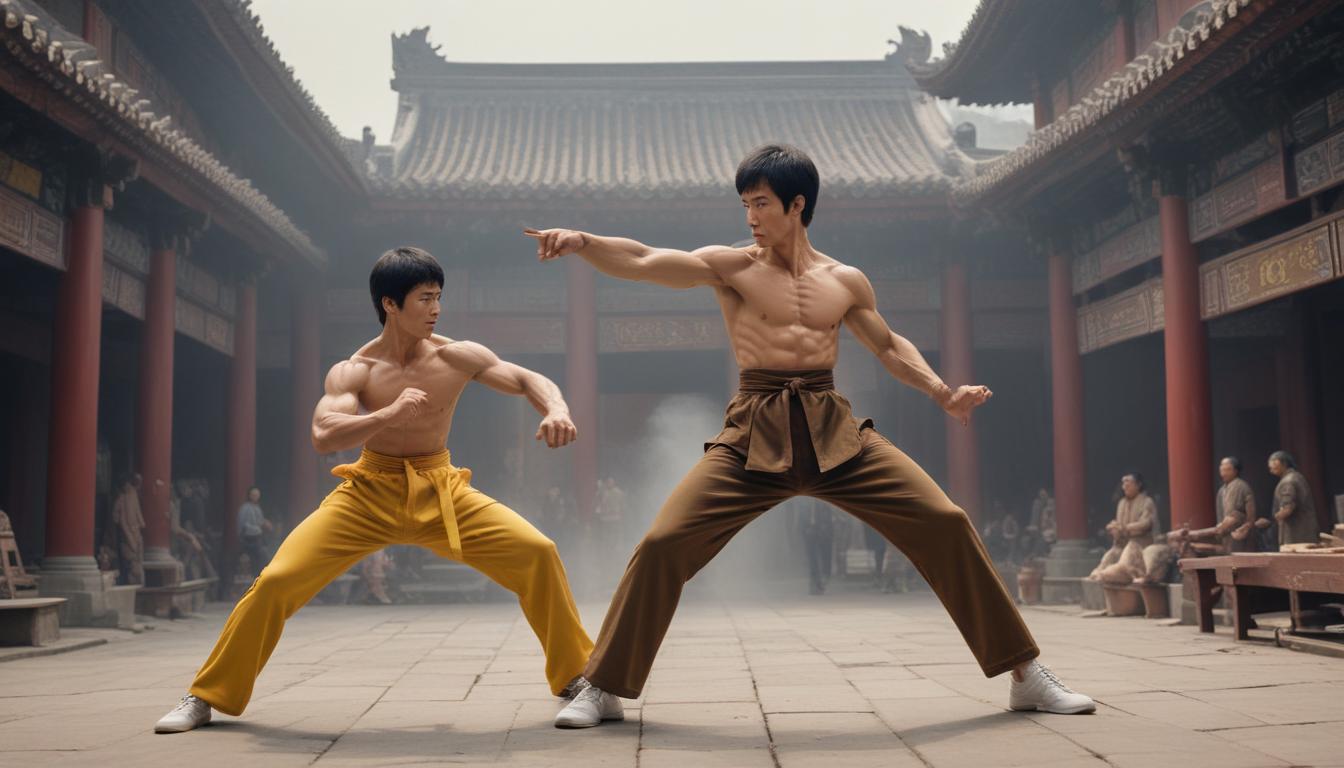
Let’s talk a bit about AI, cultural icons, and whether our favourite kung fu legends can be brought back to life – digitally, anyway. It seems the folks over in China are having a crack at it, and not just some indie tech lab, mind you. We’re talking about a state-affiliated initiative using Artificial Intelligence for the revitalization and reimagining of 100 classic kung fu films, a collection that includes titles featuring absolute giants like Bruce Lee and Jackie Chan. Blimey, that’s a headline and a half, isn’t it?
When you hear something like this, it makes you pause. Bruce Lee! Jackie Chan! These aren’t just actors; they’re global phenomena, masters of their craft, embodying a blend of philosophy, athleticism, and pure charisma that feels utterly unique. And now, the idea is to replicate that using algorithms and data? It’s exciting, terrifying, and frankly, utterly bonkers all at once. It throws up so many questions about legacy, artistry, technology, and who actually owns a performance once the performer is no longer with us or has moved on.
The Dragon Awakens (in the Digital Realm)
China’s big push into AI isn’t exactly news. We’ve seen their ambitions across manufacturing, surveillance, autonomous vehicles – you name it. They’ve been clear about wanting to be a global leader in this space, pouring vast sums of investment into research and development. But moving into the realm of classic cinema, specifically iconic figures like Bruce Lee and Jackie Chan, feels like a significant, and perhaps strategically canny, step. This particular initiative, titled the “Kung Fu Movie Heritage Project 100 Classics AI Revitalization Project,” was announced at the Shanghai International Film Festival and involves the China Film Foundation along with various studios and tech partners.
Why target these legends? Well, their appeal transcends borders. Bruce Lee remains a symbol of strength, discipline, and rebellion worldwide, despite his tragically short career. Jackie Chan brought a unique blend of slapstick comedy and breathtaking stunts that captivated generations. Their films aren’t just popular in China; they’re beloved global treasures. By using AI to revisit these works, China isn’t just flexing its technological muscle; it’s potentially tapping into a vast reservoir of cultural soft power. It’s saying, “Look, we can not only build the future, but we can also digitally curate and perhaps even *expand* upon cherished global cultural heritage.” That’s a powerful statement.
The involvement of the China Film Foundation and other state-affiliated entities adds another layer to this. It suggests this isn’t just a speculative tech project by a single studio. This is a national initiative, likely linked to broader goals around developing the creative industries, exporting technology, and reinforcing cultural identity – or projecting a new, tech-savvy one. When state-affiliated bodies put their weight (and likely leverage state-backed funds, like the reported 100 million yuan fund for this project) behind something, you know it’s serious. It raises questions about control, artistic freedom (or lack thereof), and how intellectual property might be handled under such a model.
But How Does This AI Magic Actually Happen?
Alright, let’s peek under the bonnet a bit, shall we? The core idea here revolves around technologies like deep learning and generative AI, applied specifically to video and image synthesis. Think of it as teaching a computer to not just recognise patterns (like Bruce Lee’s distinctive stance or Jackie Chan’s comedic timing) but to *create new patterns* based on that learning.
The process likely involves feeding vast amounts of data – footage of the actors, their movements, facial expressions, vocal nuances, even behind-the-scenes takes and outtakes if available – into sophisticated AI models. These models learn the subtle intricacies that make a performance unique. It’s not just about putting someone’s face on another body (that’s the slightly creepy “deepfake” stuff we’ve already seen), but about simulating their *performance*. Can the AI learn to replicate Bruce Lee’s lightning-fast jab, his focused gaze, the subtle shifts in his weight? Can it capture Jackie Chan’s improvised reaction to a botched stunt or the precise moment he uses a chair as a shield and then a weapon?
It’s like training a digital mimic. The AI watches, learns, and then tries to generate new sequences that look and feel authentic to the original performer. This could involve synthesising new footage frame by frame, generating entirely new sequences of movement, or even trying to replicate vocal patterns. You might combine this with existing footage, digital environments, and traditional CGI techniques. It’s a complex soup of algorithms, data, and computing power. While specific technical details of the “100 Classics” project aren’t fully public, the broader field of digital human creation and video synthesis heavily relies on these techniques.
Think of it using an analogy: imagine you want to paint a new picture in the style of Van Gogh. You could study his brushstrokes, colours, and subjects for years. Or, you could train an AI on thousands of his paintings. The AI doesn’t understand *why* Van Gogh painted that swirling sky, but it can learn to replicate the *style* of the swirl, the colour palette, the texture. Applied to performance, the AI doesn’t *understand* the emotional depth of a scene, but it can learn to mimic the *way* an actor expressed similar emotions in past performances. It’s a powerful tool for replication and variation, but it immediately brings up the big question: is replication the same as creation?
The Promise and the Peril: What Could Go Right… and Terribly Wrong
This technology opens a Pandora’s Box of possibilities, some genuinely exciting, others frankly alarming.
The Upsides: A Second Life for Cinematic Gold?
The “100 Classics” project encompasses restoration, 4K remastering, and potential “reimagining.” This could mean anything from simply cleaning up old prints to creating entirely new content. Imagine a new generation discovering Bruce Lee through a high-quality remaster or even a ‘new’ short film segment created using AI to extend his incredible, tragically short career. Or perhaps AI could ‘complete’ projects left unfinished due to an actor’s passing. For Jackie Chan, who is thankfully still with us but understandably slowing down from his most dangerous stunt work, AI could potentially allow him to ‘perform’ feats his body can no longer manage, preserving his unique style in action sequences without the physical risk.
It could also be a way to remaster or even ‘re-shoot’ scenes in classic films that were technically limited at the time, enhancing the action or clarity without altering the core performance. Theoretically, it could make the production process faster and cheaper for certain types of content, removing the need for complex stunt rigging or hazardous locations by simulating them digitally with the AI ‘actor’. It offers a tantalising prospect: giving new life to cherished IP and introducing it to audiences who might not seek out older films. The project is already set to include titles like Bruce Lee’s Fist of Fury, Jackie Chan’s Drunken Master, and Jet Li’s Once Upon a Time in China, with a notable reimagining of John Woo’s A Better Tomorrow being developed as a fully AI-generated cyberpunk animated film.
The Downsides: The ‘Uncanny Valley’ and the Loss of Soul
Here’s where it gets sticky. The most immediate hurdle is the “uncanny valley” – that unsettling feeling we get when something looks *almost* human but is just slightly off. Early deepfakes often fall squarely into this. While the technology is improving rapidly, replicating the full spectrum of human emotion, spontaneity, and subtle physical presence is incredibly difficult. A digitally resurrected Bruce Lee might look perfect, but can he truly embody the raw intensity and philosophical depth Lee brought to his roles? Can an AI Jackie Chan replicate the genuine wince after a hard fall or the improvised bit of physical comedy born from a mistake on set?
There’s a real risk of producing content that is technically impressive but artistically sterile. A performance isn’t just a set of movements and expressions; it’s infused with the actor’s life experience, their choices in the moment, their chemistry with others. Can AI replicate that human *soul*? Many artists and film lovers would argue a resounding no. Even figures like director Tim Burton have expressed strong criticism regarding the use of AI in creative processes, fearing a loss of human artistry.
Then there are the legal and ethical minefields. Who owns the rights to an AI-generated performance based on a deceased actor? Their estate? The studio? The AI developer? What about likeness rights? If an actor is alive, is it ethical to use their digital double without their full, explicit, and fairly compensated consent? This technology has massive implications for actors, stunt performers, and potentially writers and directors whose creative choices might be overridden by algorithmic suggestions. Will human artists be displaced? These are debates currently raging across the entertainment industry, with various guilds and individuals raising concerns about IP, compensation, and the future of human creativity. Figures like Zack Snyder, director of films like Justice League, have suggested filmmakers need to embrace AI, while platforms like Netflix reportedly believe audiences care less about how content is made and more about the final product. This highlights the division within the industry.
Furthermore, what about the legacy of the originals? Does creating endless AI-generated sequels or remakes dilute the very essence of what made the original films and performers special? Is it a celebration, or ultimately an exploitation?
Beyond the Fist and the Foot: Broader Implications for AI in Creativity
This initiative isn’t happening in a vacuum. It’s part of a much larger trend of AI encroaching – or assisting, depending on your view – in creative fields. We’ve seen AI generating art, composing music, writing text, and even attempting scripts. The film industry, with its high costs and complex workflows, is a prime target for technological disruption.
This AI kung fu project is a high-profile example of attempting to automate, or at least augment, a core element of filmmaking: performance. It forces us to confront fundamental questions about creativity itself. Is creativity purely a human endeavour? Or is it something that can be distilled into patterns and algorithms? If an AI can perfectly replicate the *style* of a master, does it diminish the master’s genius?
Crucially, even with advanced AI, the role of the human artist isn’t necessarily eliminated, but it changes. You still need directors to provide vision, writers to craft compelling stories, editors to shape the rhythm, and *human* actors to potentially interact with their AI counterparts or provide the emotional core the AI can’t replicate. The AI might become a powerful tool in the human creator’s toolkit – imagine being able to visualise complex stunt sequences with digital doubles before risking human lives – rather than a complete replacement. It raises the idea of AI as a collaborator, albeit a very different kind, rather than a sole creator.
Show Me the Money (and Maybe the Politics)
Let’s not be naive; while cultural preservation might be part of the narrative, there’s serious economic potential driving this. The global film market is worth billions, and iconic franchises or stars are invaluable assets. Breathing new life into beloved but dormant IP using AI could unlock massive revenue streams through new films, digital experiences, merchandise, and more.
China is one of the largest film markets in the world, and its domestic industry is booming. Investing in advanced film production technology like this could give its studios a competitive edge globally. While I cannot pull specific, verified figures from external sources *right now* to detail the exact investment or projected revenue mentioned in the article, it’s clear from China’s broader AI strategy and the value of these specific cultural icons that the potential financial upside is enormous. Analysts following the intersection of AI and media production consistently point to billions in potential savings or new revenue generated by these technologies over the next decade. This project isn’t just a tech demo; it’s a calculated business play on a global scale, perhaps linked to state-owned or state-affiliated media companies, as suggested by the involvement of the China Film Foundation.
The political angle is also hard to ignore. Successfully executing such a project would be a powerful demonstration of China’s AI capabilities on a global stage, specifically in a creative domain where human artistry is paramount. It’s a form of technological soft power, showcasing that China isn’t just building infrastructure or manufacturing goods, but also pushing the boundaries of digital creation. It aligns with national goals to become a technology superpower and a leader in emerging industries.
Is This the Future, or a Flash in the Pan?
Where does this leave us? Are we on the cusp of an era where deceased actors regularly star in new blockbusters? Where AI-generated films become commonplace? It’s too early to say definitively. The technical challenges are immense, particularly in achieving truly convincing and emotionally resonant performances. The ethical and legal hurdles are significant and largely unresolved. And perhaps most importantly, audience acceptance is an unknown factor. Will people flock to see an AI Bruce Lee film, or will they find it unsettling, even disrespectful?
However, the pace of AI development is staggering. What seems impossible or clunky today could be commonplace in just a few years. This initiative from China feels like a high-stakes experiment. It’s a test case for whether AI can successfully replicate human performance in a way that is commercially viable and culturally acceptable, or perhaps more broadly, how AI can contribute to the revitalization and reimagining of classic cultural assets. Even if full-length AI-actor films don’t become the norm immediately, the underlying technology will undoubtedly find its way into filmmaking – assisting with digital doubles, de-aging actors, creating realistic VFX, and more.
This isn’t just about kung fu movies. It’s about the future of entertainment, the definition of performance, and the increasingly blurred lines between the digital and the real. It forces us to consider what we value in art and who gets to create it.
So, while we might not be seeing an AI-generated sequel to *Enter the Dragon* or *Police Story* hitting cinemas tomorrow, the fact that a national government-affiliated entity is backing such an ambitious project tells us that the digital resurrection and AI-driven creativity are no longer just sci-fi concepts. They are becoming concrete goals with significant investment and strategic intent behind them. And that, whether you find it thrilling or chilling, is worth paying attention to.
What do you think about using AI to ‘remake’ films with digital versions of iconic actors? Is it a fascinating technological step forward, or does it cross an ethical line? Share your thoughts below!



