

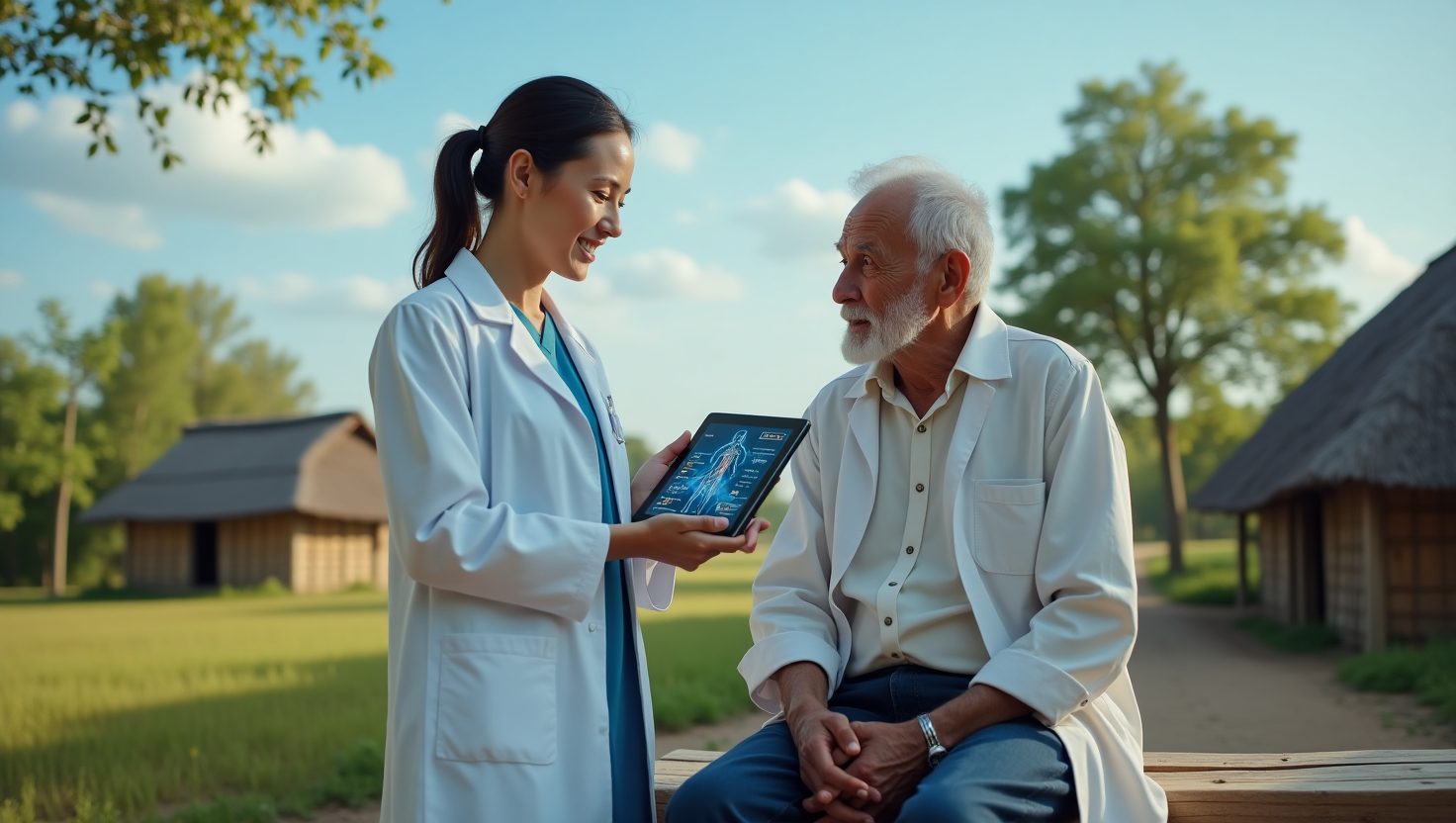
The state of healthcare in our rural communities is, to put it mildly, a bit of a mess. While city dwellers might be pondering the pros and cons of the latest wellness app, folks in the countryside are watching their local hospitals shut down. Data from KFF shows over 190 have closed since 2005. This isn’t just an inconvenience; a 2024 CDC report confirms it’s a matter of life and death, with rural residents more likely to die prematurely from the five leading causes. So, when figures like Dr. Mehmet Oz propose a grand £40 billion AI initiative to plug these gaps, you have to sit up and listen. But is parachuting in AI avatars the silver bullet we’ve been waiting for, or is it a classic case of tech solutionism gone mad? The answer, as always, lies somewhere in the middle, in a concept we call hybrid healthcare AI.
So, What on Earth is Hybrid Healthcare AI?
Before we get carried away with visions of robotic surgeons, let’s be clear. Hybrid healthcare AI isn’t about replacing doctors and nurses with automatons. Think of it more like giving a brilliant-but-overstretched practitioner a team of hyper-efficient assistants.
At its core, this model integrates artificial intelligence with human medical professionals. The goal is not substitution, but technology augmentation. It’s a partnership where machines handle what they’re good at—processing vast amounts of data, spotting patterns, and running routine checks—freeing up humans to focus on what they are good at: empathy, complex decision-making, and the all-important human touch. Key components often include:
– AI-assisted diagnostics to help spot diseases earlier.
– Automated systems for managing administrative tasks.
– Remote monitoring tools and communication platforms.
It’s about building a smarter, more connected system, not an emptier, automated one.
The Promise of AI in Rural Health Optimisation
The challenges in rural healthcare are stark. Fewer specialists, longer travel times, and under-resourced facilities create a perfect storm. This is where clever technology augmentation can be a game-changer, acting as a force multiplier for the healthcare workers on the ground.
Imagine a GP in a remote village. With a hybrid model, they wouldn’t be working in isolation. They could use an AI tool to get a second opinion on a tricky skin lesion scan, or rely on an automated system to manage patient scheduling, freeing up an extra hour a day for patient consultations. This is the fundamental promise of rural health optimization: using technology not to remove people, but to empower the ones we have, extending their reach and expertise. The goal is to bridge the gap in services without paving over the human element of care.
Telementoring Systems: A Digital Lifeline
One of the most powerful tools in the hybrid toolkit is telementoring systems. This isn’t just a fancy term for a video call. It describes a structured system where an experienced specialist in London, for instance, can guide a less-experienced nurse practitioner in Cornwall through a complex procedure in real-time.
Think of it like an expert pilot in a simulator, talking a rookie through a difficult landing. The rookie is still flying the plane, but they have the calm, authoritative voice of experience in their ear. For rural healthcare, this means:
– Upskilling local staff: Practitioners can learn new skills and gain confidence without needing to leave their community for extended training.
– Immediate access to expertise: Patients get the benefit of specialist knowledge without the costly and time-consuming travel.
– Building collaborative care models: It breaks down the silos that often separate urban and rural medicine, fostering a sense of a single, unified health system.
AI-Assisted Diagnostics: The Super-Powered Second Opinion
This is where the ‘AI’ part really shines. AI-assisted diagnostics use machine learning algorithms trained on millions of medical images and data points—X-rays, CT scans, retinal images—to spot signs of disease that the human eye might miss.
Dr. Oz’s slightly provocative pitch for using robots to perform ultrasounds on pregnant women, as mentioned in an NPR report, perfectly illustrates the principle. His litmus test was simple: “I just have to know if the image is good enough.” The AI isn’t delivering the baby; it’s capturing a high-quality, standardised image that a human expert, anywhere in the world, can then analyse. This accelerates diagnosis, allows for earlier treatment, and ultimately, saves lives. We’re already seeing AI tools drastically improve the early detection rates for diabetic retinopathy and certain types of cancer, turning a reactive process into a proactive one.
Collaborative Care Models and Their Advantages
Bringing all this together is the shift towards collaborative care models. The old way of thinking—a single doctor holding all the knowledge—is inefficient and unsustainable, especially in underserved areas. A hybrid system fosters teamwork.
The AI becomes a central team member. It can flag a patient whose vitals look worrying, summarise their history, and suggest potential diagnostic pathways. The nurse on the ground can verify the data, the remote specialist can weigh in via a telementoring link, and the local GP can make the final call, synthesising all the inputs. As Honey Health’s Matt Faustman pointed out, physicians can spend “30-40% of their time on administrative work.” Imagine reclaiming that time. This collaborative firepower is simply unattainable in a purely analogue, human-only system.
The Ethical Wrinkles and Human Connection
Now, for the pushback. And it’s important. Critics like Carrie Henning-Smith, from the University of Minnesota Rural Health Research Center, rightly raise the alarm. As she told NPR, “Health care has always been about humanity and relationship.” Is using AI avatars a slippery slope towards sterile, impersonal care? Are we turning vulnerable rural populations into guinea pigs for unproven tech?
These aren’t questions to be brushed aside. The “digital divide” is real; you can’t run a sophisticated AI diagnostic tool without a reliable internet connection, something that’s still a luxury in many rural spots. Furthermore, the human connection in healthcare is not a “nice-to-have”—it’s a critical component of healing. A distressed patient needs empathy, not just an efficient diagnosis from an algorithm. Any hybrid healthcare AI model that ignores this is doomed to fail. A solution must be human-led, with technology serving, not directing, the care.
Future Trends: What’s Next on the Horizon?
Looking ahead, the integration of AI will only deepen. We can expect more sophisticated AI-assisted diagnostics, predictive models that can forecast disease outbreaks in a community, and logistics platforms—perhaps even involving drones, as Dr. Oz suggested—for delivering prescriptions and medical supplies.
The key to successful rural health optimization will be seamless integration. The technology needs to become invisible, a natural part of the workflow that helps, not hinders. The ultimate vision is a healthcare system where your postcode doesn’t determine your quality of care. AI, used wisely, could be the most powerful tool we have for making that vision a reality.
A Tool, Not a Tyrant
In the end, hybrid healthcare AI is just that—a tool. It holds immense potential to revolutionise rural healthcare, extending the reach of our human experts and bringing world-class diagnostics to the most remote corners. But it is not a cure-all. Implementing it requires a thoughtful, human-centric strategy that respects the need for personal connection and navigates the very real ethical and logistical challenges. Simply dropping AI avatars into underfunded clinics is not a strategy; it’s an abdication of responsibility. The real work is in building a system where technology empowers our healthcare professionals, giving them the support they need to do their life-saving work better.
So, what do you think? Can we successfully blend the efficiency of AI with the empathy of human care, or are they fundamentally incompatible forces in medicine? Share your thoughts below.



