

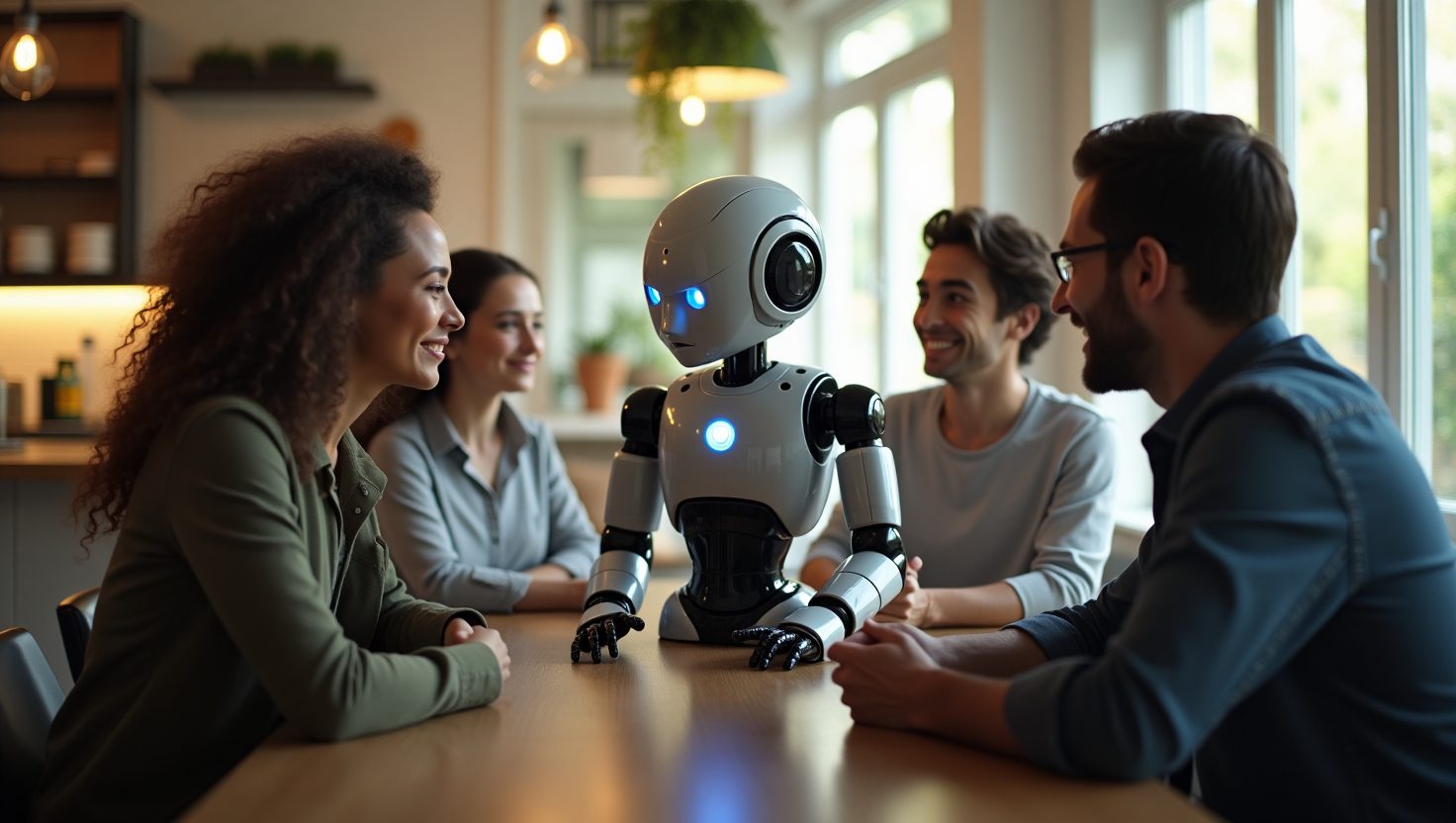
The age of practical humanoid robotics is suddenly, and rather awkwardly, shuffling into view. This isn’t about the charming droids of science fiction; this is about a multi-billion-dollar corporate race to build a workforce of metal and code. And for Musk, this isn’t just a passion project. His recently approved, and eye-watering, pay package is directly tied to this very vision. As the BBC reports, one of the milestones he must hit is the delivery of one million AI bots within the next decade. So, is this a visionary leap into the future, or the most expensive distraction in corporate history?
Musk’s Grand Design: More Than Just a Robot
Let’s be clear: Musk’s vision for Optimus is the central pillar of Tesla’s future identity as an AI company. The cars, with their millions of miles of real-world driving data, were simply the first step. They were the rolling data centres that taught the AI how to see and navigate a messy, unpredictable human world. Now, Musk wants to take that same AI brain and place it into a body that can interact with that world in a much more granular way. A car is limited to the road, but a humanoid robot can, in theory, go anywhere a person can.
This is where the strategy gets really interesting. Tesla isn’t just building a robot; it’s building a platform. Think of it like this: the company spent a decade developing the world’s most advanced self-driving software (the success of which is still a hot debate, mind you). That software is an operating system for navigating physical space. Putting it in a car is one application. But putting it in a humanoid form? That opens up an almost infinite number of industrial applications. Every factory, warehouse, shop, and home is a potential market. The robot isn’t the product; the Giga-factory producing the real-world AI is the product. Optimus is just its first physical expression beyond the car.
A Bot for Every Business: The Industrial Gold Rush
So, where would these robots actually work? Analyst Brian Hopkins of Forrester sums it up perfectly: “From warehouses and restaurants to elder care and security, new use cases are gaining traction fast.” We’re already seeing glimpses. Amazon has been using wheeled robots in its warehouses for years, but they are confined to specific, structured tasks. A humanoid robot could, hypothetically, move from unloading a lorry to stocking a shelf to even picking and packing a complex order—tasks that currently require human dexterity.
Musk has already shown off Optimus prototypes folding laundry and, as the BBC notes, even serving food in a public demonstration. These are early, tentative steps, but they signal the direction of travel.
Potential to Disrupt Various Industries
* Manufacturing and Logistics: Imagine an assembly line or a fulfilment centre where robots handle the repetitive, physically strenuous tasks, freeing up human workers for quality control, problem-solving, and system oversight.
* Healthcare and Elder Care: With ageing populations in many Western countries, the demand for care is soaring. A robot could assist with patient mobility, deliver meals and medication, or simply provide companionship, easing the immense pressure on human carers.
* Retail and Hospitality: From stocking shelves in a supermarket overnight to preparing food in a commercial kitchen, the potential to automate routine service jobs is enormous.
The economics are also starting to make sense. Norwegian firm 1X, backed by OpenAI’s Sam Altman, is planning to sell its ‘Neo’ android for a reported $20,000. If a business can replace a minimum-wage role with a robot that works 24/7 with no holidays or sick pay, the return on investment becomes very tempting indeed.
The New Arms Race: Silicon Valley Wants a Body
Tesla is far from alone in this pursuit. The race to commercialise humanoid robotics is heating up. Morgan Stanley has predicted that if Apple entered the market, it could be generating an incredible $133bn a year from robots by 2040. Foxconn, the manufacturing giant that assembles the iPhone, has been developing its own robots for years to automate its factories. Then you have the specialists like Boston Dynamics, whose Atlas robot’s gymnastic feats have been terrifying and amazing us on YouTube for years.
Falling Component Costs and Improved Dexterity
What’s catalysing this sudden frenzy? Two things: cheaper parts and smarter brains. The cost of sensors, high-torque motors, and processors has plummeted, driven by the smartphone and electric vehicle industries. At the same time, breakthroughs in AI are giving these robots the “smarts” to understand and interact with their surroundings. They are moving from being puppets following a script to agents that can perceive, reason, and act. This convergence of cheap, powerful hardware and adaptable AI software is the key that’s unlocking the commercial door.
The Great Debate: Should a Robot Look Like Me?
For all the excitement, a fierce debate is raging within the robotics community: why a human shape? Many seasoned researchers argue that the humanoid form is an inefficient vanity project. Legs are complex and unstable, heads filled with sensors are just asking to be knocked over, and two arms aren’t always the best tools for a given job.
The Efficiency of Wheels vs. Legs
This is the classic argument of the specialist versus the generalist. For moving heavy pallets in a flat warehouse, nothing beats a forklift. It’s a specialised tool, perfected for its environment. A bipedal robot attempting the same task would be slower, less stable, and more expensive. So, why legs? The answer is generality. Our world—our buildings, our cities, our tools—is designed by humans, for humans. Stairs, doorways, tool handles, and vehicle controls are all shaped for the human form. A robot built in our image doesn’t require us to redesign the world for it; it can, in theory, adapt to ours. It’s the difference between a custom-built machine and a universal platform.
The Sci-Fi in Our Heads: Our Psychological Need for a Humanoid
There’s another, less tangible reason for the humanoid push: us. We are simply more comfortable with things that look like us. Decades of science fiction, from Star Wars’ C-3PO to Rosie the Robot in The Jetsons, have shaped our cultural expectations. A faceless, multi-limbed machine scuttling around a hospital ward is the stuff of horror films. A robot with a head, a torso, and two arms feels more like a helper.
Resonance with the Public
This psychological appeal is not a trivial matter. User acceptance is one of the biggest hurdles for radical new technologies. A humanoid design, while perhaps not the most efficient from a pure engineering standpoint, might be the most effective from a human-interaction standpoint. It provides a familiar interface. We instinctively know how to interact with it, how to read its “body language,” and how to work alongside it. As even the cautious Sam Altman noted, while the “world isn’t ready for humanoids,” he described their arrival as an “incoming moment.” The form factor matters because it bridges the emotional and psychological gap between man and machine.
The Ghost in the Machine: AI and the Collaborative Future
Ultimately, the physical shell of the robot is only half the story. The true revolution is in the software—the AI that allows for genuine human-AI collaboration. A robot that can learn by watching a human perform a task, that can understand verbal commands, and that can predict a human co-worker’s intentions to assist them safely is the end game. This is where the lines blur between a simple tool and a true partner.
This isn’t about replacement; it’s about augmentation. The future isn’t a dystopian landscape of humans being put out of work. It’s a future where a construction worker uses a robotic partner to lift heavy materials, where a surgeon collaborates with a hyper-precise robotic arm, and where a care worker manages a small team of bots to provide better care to more people. The robot handles the dull, dirty, and dangerous, while the human provides the creativity, empathy, and strategic oversight.
The dream of a robot in every home might still be a way off, but a robot in every factory, warehouse, and hospital is now a question of ‘when’, not ‘if’. Musk’s vision, for all its hyperbole, has crystallised this moment. He has tethered the abstract potential of AI to the physical reality of a humanoid machine and, in doing so, has kickstarted a race that could reshape our physical world as profoundly as the internet reshaped our digital one. The debate between form and function will continue, but the direction of progress is clear. The machines are learning to walk.
What task would you first give to a personal humanoid robot if you had one tomorrow? Let me know your thoughts in the comments below.



