

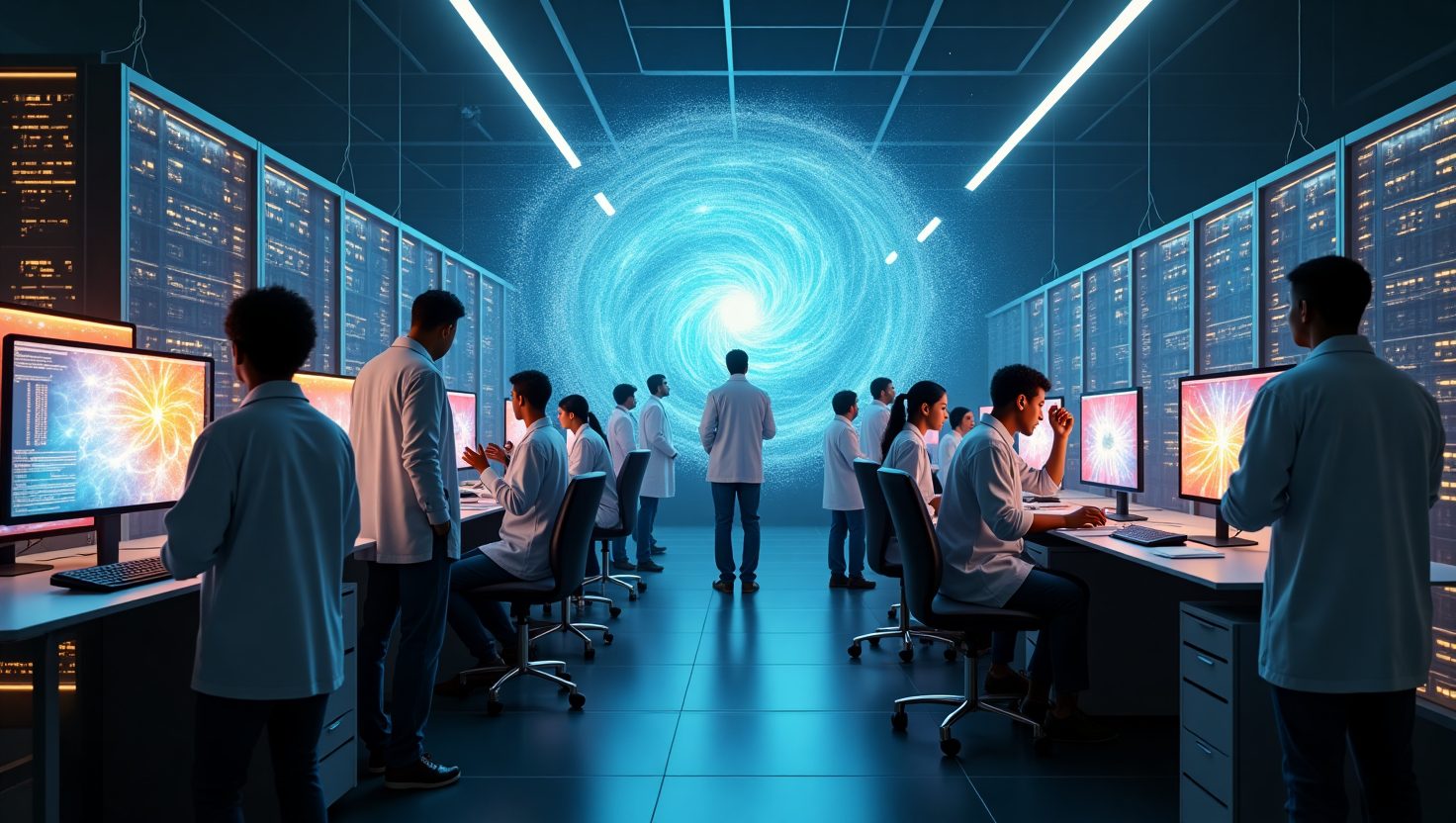
It seems every week another monumental announcement about Artificial Intelligence lands on our desks, each promising to reshape the world. But amidst the clamour of chatbots and image generators, a quieter, more profound revolution is taking place. This isn’t about AI that can write a passable sonnet; it’s about AI that can help us unravel the very fabric of the universe. We’re witnessing the powerful fusion of two technological titans: High-Performance Computing (HPC) and Artificial Intelligence. And a recent partnership between chipmaker AMD and the U.S. Department of Energy (DOE) is throwing this HPC-AI convergence into sharp relief, revealing a strategy that is as much about national ambition as it is about enterprise innovation.
HPC and AI: A Power Couple for the Ages
So, what exactly are we talking about here? For decades, High-Performance Computing has been the engine of big science. Think of it as the ultimate number-cruncher, a colossal machine designed to run incredibly complex simulations. Want to model a star’s explosion, predict hurricane paths with pinpoint accuracy, or simulate the airflow over a new jet wing? You need an HPC system. These are the thoroughbreds of computation, built for raw, sustained power and precision.
Artificial Intelligence, particularly deep learning, is a different beast altogether. It’s less about brute-force calculation and more about pattern recognition and inference. AI excels at sifting through mountains of data—data often generated by HPC simulations—to find the proverbial needle in the haystack. It learns, adapts, and makes predictions. It’s the Sherlock Holmes to HPC’s steadfast Inspector Lestrade. The HPC-AI convergence is, quite simply, the moment these two characters realise they are far more effective working together. It’s about building systems that don’t just run a simulation but actively learn from it in real-time to steer it towards a more interesting or efficient outcome.
The Government’s Grand Gambit: National Labs as Innovation Hubs
This fusion isn’t happening in some Silicon Valley garage. The scale is far too immense. Instead, the crucible for this new era is the network of U.S. national labs. As detailed in a recent report from Artificial Intelligence-News.com, the Department of Energy is spearheading a colossal $1 billion public and private investment to build two next-generation AI-focused supercomputers. This isn’t just a procurement deal; it’s a statement of intent. The DOE is positioning itself, and by extension the United States, at the absolute forefront of scientific discovery.
The partnership involves some of the biggest names in tech, with AMD at the centre, alongside collaborators like Hewlett Packard Enterprise (HPE) and Oracle. Two flagship systems are the result:
– Lux AI: Set to be operational by early 2026 at Oak Ridge National Laboratory (ORNL), this machine is a pure-play AI training behemoth. Powered by AMD’s Instinct MI355X GPUs and EPYC CPUs, its primary job is to train foundational AI models on vast scientific datasets.
– Discovery: Launching in 2028, this system is the epitome of HPC-AI convergence. It will leverage future AMD technology—specifically, Venice EPYC processors and MI430X GPUs—to balance traditional simulation with AI-driven analysis, all with a fanatical focus on efficiency.
Why are national labs the perfect home for this? Because they sit at the intersection of government funding, academic curiosity, and industrial application. They tackle problems too large, too long-term, or too risky for the private sector to pursue alone. This initiative is a prime example of a public-private partnership where the government provides the grand vision and foundational funding, while companies like AMD bring the cutting-edge hardware and commercial drive. This model is critical for research acceleration, turning decade-long projects into year-long sprints.
The Elephant in the Room: Power Consumption
Let’s address a very real-world constraint: energy. You can’t just keep bolting on more processors to build a bigger supercomputer. Modern data centres and HPC systems are already consuming eye-watering amounts of electricity. The pursuit of exascale computing—a quintillion calculations per second—is as much an engineering challenge in power management as it is in computational design. An exascale system that requires its own power station isn’t just impractical; it’s unsustainable.
This is where the focus on energy-efficient computing becomes paramount. It’s not the sexiest part of the story, but it’s arguably the most important. AMD’s strategy, as highlighted in the DOE partnership, hinges on this. Their “Bandwidth Everywhere” design philosophy, mentioned in the Artificial Intelligence-News.com analysis, aims to dramatically increase memory and network performance—key bottlenecks in AI workloads—without a corresponding explosion in power usage.
Think of it like this: an old muscle car might have a massive, gas-guzzling V8 engine to produce a lot of power. It’s loud, impressive, but horribly inefficient. A modern Formula 1 car, however, uses a smaller, hybrid engine with sophisticated energy recovery systems to produce even more performance from a fraction of the fuel. That’s the leap AMD and its partners are trying to make with systems like Discovery. They are engineering for performance-per-watt, ensuring that the next generation of scientific breakthroughs doesn’t come with an unsustainable energy bill. This isn’t just good for the planet; it’s good economics, lowering the total cost of ownership for these billion-dollar machines.
What Lies Ahead: From Grand Strategy to Enterprise Reality
So, a government agency and a chip giant are building giant computers. Why should anyone outside of a national lab care? Because what happens in these advanced facilities is a direct preview of what will become mainstream in enterprise AI within the next five to ten years. The technologies being stress-tested by the DOE today will power the financial models, drug discovery platforms, and logistics networks of tomorrow.
The partnership points to several key trends:
1. Public-Private Partnerships are the Future: The sheer cost and complexity of foundational AI and HPC infrastructure mean that collaboration is no longer optional. Governments set the strategic direction and de-risk the initial investment, while private companies compete to provide the most innovative and efficient technology.
2. Secure Data is the Bedrock: One of the understated but critical components of this plan is the creation of a secure data infrastructure. You can’t have researchers from different institutions collaborating on sensitive projects—spanning everything from energy grids to national security—without a robust framework for managing and protecting that data. This focus on secure, federated data systems will inevitably trickle down to the enterprise.
3. Efficiency Will Define the Winners: The AI arms race won’t be won by the company with the most raw processing power, but by the one that can deliver that power most efficiently. As AI models become larger and more data-hungry, the cost of training and running them—measured in both dollars and watts—will become a primary competitive differentiator.
Dr. Lisa Su, AMD’s CEO, isn’t just selling chips to the government; she is aligning her company’s roadmap with the long-term, strategic needs of the most demanding customers on the planet. This ensures AMD’s hardware is forged in the most extreme environments, making it more robust and attractive for the broader commercial market.
Real-World Problems, Accelerated Solutions
Ultimately, this is all in service of one goal: solving real-world problems faster. When ORNL Director Stephen Streiffer says that “Combining high-performance computing and AI can shorten the time between research problems and real-world solutions,” he is summarising the entire premise of this multi-billion dollar endeavour.
What does that look like in practice?
– Materials Science: Instead of spending years in a lab mixing chemicals through trial and error, scientists can use HPC to simulate molecular interactions and then use AI to analyse those simulations, predicting which combinations are most likely to yield a breakthrough material for, say, a more efficient battery or a lighter, stronger alloy.
– Energy Systems: We can build a “digital twin” of a national power grid, using HPC to model its complex behaviour and then unleashing AI to identify vulnerabilities or test new renewable energy integration strategies without risking a single real-world blackout.
– Personalised Medicine: By combining genomic data with clinical trial results, HPC-AI systems can simulate how a new drug will interact with different genetic profiles, dramatically accelerating the path to personalised treatments and potentially predicting side effects before a single patient is treated.
The HPC-AI convergence moves science from a reactive process of observation and experiment to a proactive one of simulation and prediction. It is a fundamental shift in the scientific method itself, enabled by a new class of machine.
This partnership between AMD and the DOE is more than just a press release about powerful new computers. It’s a blueprint for the future of technological and scientific progress. It demonstrates a sophisticated understanding that true innovation requires a fusion of public ambition, private ingenuity, and a relentless focus on sustainable efficiency. The race for AI dominance is well and truly on, but the most important victories won’t be measured in chatbot response times, but in the scientific barriers we finally break.
What previously unsolvable scientific mystery do you think will be the first to fall in the era of HPC-AI?



