

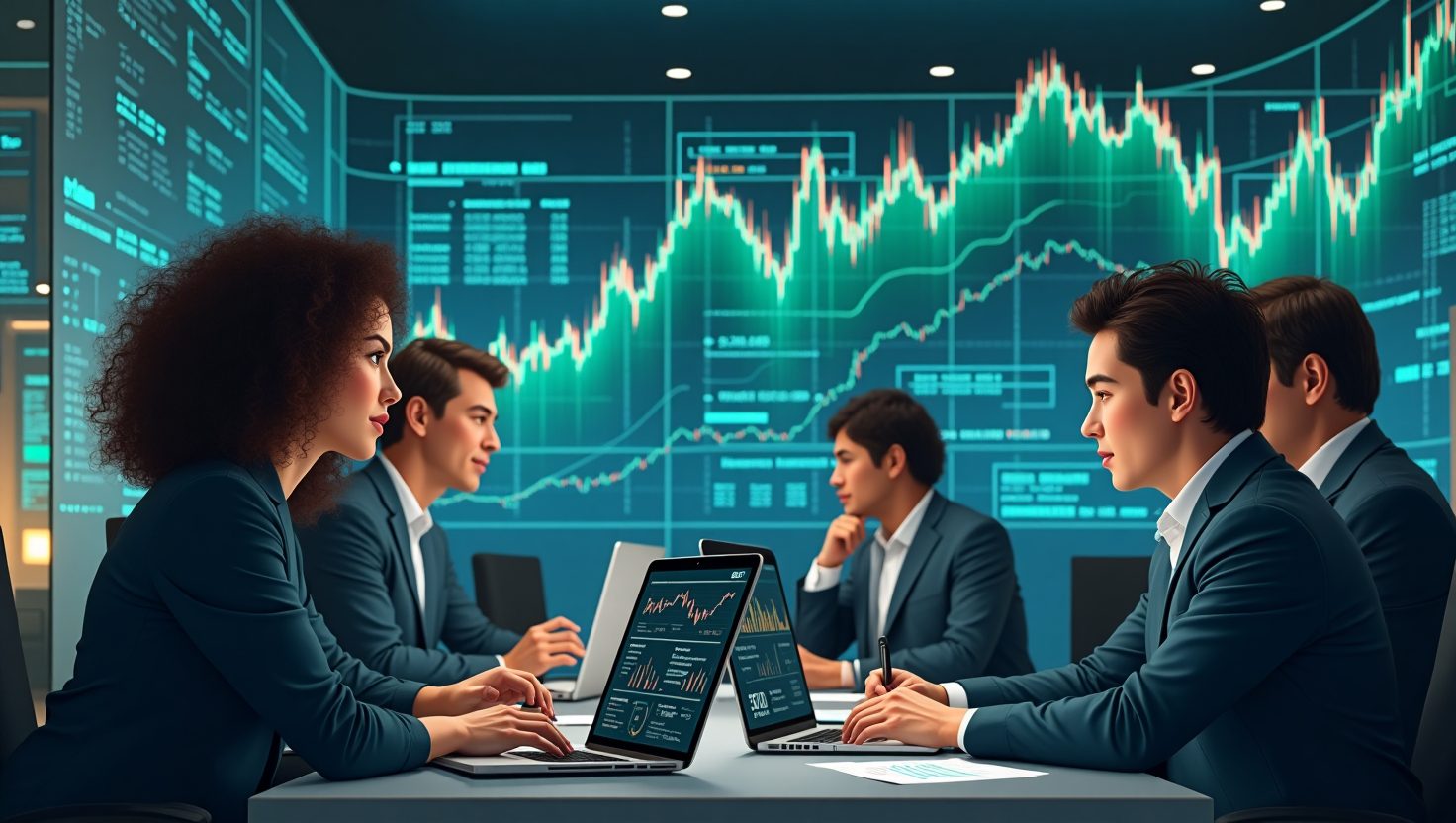
This relentless pursuit of speed highlights a fundamental truth about today’s markets. As Professor Juho Kanniainen of Tampere University puts it, “In principle, nothing should be predictable in financial markets – except at the very shortest time scales, the millisecond level.” It is in this microscopic window, invisible to any human, that the next generation of finance is being forged.
So, What on Earth Are We Actually Talking About?
When we talk about financial ML models, we’re not talking about some generalist AI that can write a poem one minute and price a stock the next. Forget the ChatGPT hype. As Professor Kanniainen rightly notes, “This is not about building ChatGPT-style solutions but extremely fast, dedicated models.”
Think of it this way: a general AI is like a Swiss Army knife. It’s useful for a lot of things but isn’t the best tool for any single, specific job. A dedicated financial model, on the other hand, is a surgeon’s scalpel. It is designed with one purpose in mind—to execute a specific task like predicting a price tick or managing risk with extreme precision and speed. This is the heart of modern computational finance research: building scalpels, not pocket knives.
These models are fundamentally changing the game, moving us from traditional financial analysis—which often felt like driving while looking in the rear-view mirror—to a predictive, forward-looking approach.
Taming the Beast with Market Volatility Algorithms
Markets are chaotic. This chaos, or volatility, is where both immense risk and opportunity lie. Market volatility algorithms are the mathematical charmers designed to tame this beast. They analyse torrents of data in real-time to predict and react to sudden market swings.
In the world of high-frequency trading (HFT), these algorithms are everything. They might execute thousands of trades per second, profiting from tiny price discrepancies that exist for only a fraction of a moment. They’re also crucial for risk management, helping institutions brace themselves for a potential downturn before it fully materialises. It’s a high-stakes, high-speed game where a millisecond can be the difference between profit and ruin.
Gazing into the Digital Crystal Ball: Time-Series Forecasting
How do you predict the future? For decades, analysts have relied on time-series forecasting, looking at past data points to project what comes next. Traditional methods like ARIMA models were the standard, but they often struggle with the sheer complexity and non-linearity of financial data.
This is where machine learning, particularly models like Long Short-Term Memory (LSTM) networks, has made a huge impact. LSTMs are a type of neural network specifically designed to recognise patterns in sequences of data, making them uncannily good at understanding the “memory” of a market. They can process vast histories of price movements, trading volumes, and even news sentiment to make more nuanced predictions about future trends.
The Finnish Frontline: A Case Study in Extreme Prediction
To see where this is all heading, you need to look at the work being done by pioneers like Professor Juho Kanniainen and his research group at Tampere University. They aren’t just tweaking existing models; they’re building the engine for the future of finance in what they call an “exceptionally demanding environment.”
Their research pushes the boundaries of trading pattern recognition with two fascinating applications:
– Millisecond-Level Market Prediction: The team develops models that predict market movements by analysing limit order books—the real-time list of all buy and sell orders for a given asset. By decoding the intricate dance of orders being placed and cancelled, their algorithms can anticipate tiny price shifts before they happen. This is the digital equivalent of reading the market’s mind.
– Detecting Insider Trading: Perhaps even more compelling is their work on uncovering illicit trading. By mapping the professional and social networks of corporate board members, their models can spot suspicious trading activity. As the university’s research points out, “Board memberships create a surprisingly dense social network.” When a cluster of connected individuals starts making unusual trades ahead of a big announcement, the algorithm can flag it. This is financial ML models acting not just as a profit engine, but as a digital watchdog.
This isn’t just theoretical academic work, either. The group is actively working to commercialise these technologies through a Business Finland-funded project, aiming to put these tools into the hands of traders, risk managers, and regulators.
The Inevitable “But…”
Of course, this technological leap isn’t without its perils. These models are incredibly complex, and their “black box” nature can make it difficult to understand why they make a certain decision. This can lead to catastrophic failures, like the “flash crashes” where automated trading algorithms created a sudden and severe market collapse in minutes.
Then there are the ethical questions. Does this technology simply create a two-tiered market where only those with enough capital for multi-million-dollar cables and teams of PhDs can compete? Does it increase systemic risk by making the market more interconnected and fragile? These aren’t easy questions, and regulators are still playing catch-up.
Where Do We Go From Here?
The future of computational finance research is clearly pointed towards more specialised, faster, and—one hopes—more robust models. The trend is moving away from monolithic models towards ecosystems of interconnected, specialised agents that can handle everything from trade execution to regulatory compliance.
The key will be collaboration. The work at Tampere University, which brings together machine learning theory with applied data science, shows the way forward. Academia provides the foundational research, while the industry provides the real-world problems and, frankly, the immense resources required to compete.
This isn’t just an incremental improvement; it’s a fundamental rewiring of how money moves around the world. The speed is already beyond human comprehension, and the complexity is growing exponentially. The real question we should be asking is not “can we build faster models?”, but rather, “as these models increasingly become the market itself, who is truly in control?”
What are your thoughts on algorithms having this much power in our financial systems? Let me know in the comments below.



