

The construction industry has a reputation, not entirely undeserved, for being a bit of a laggard when it comes to technology adoption. While fintech and e-commerce were being revolutionised by algorithms, construction was still largely about mud, muscle, and machinery. That is changing, and fast. The integration of Artificial Intelligence into safety protocols isn’t just a shiny new trend; it’s a fundamental shift from a mindset of incident reporting to one of genuine incident prevention. It’s about using data to build a digital safety net that catches problems before they become tragedies.
The Ever-Watchful Eye: AI’s Role in a Safer Site
So, how exactly does an algorithm prevent a falling brick or a vehicle collision? At its core, AI in this context is a master of pattern recognition. It can monitor dozens of video feeds, sensor data streams, and documentation logs simultaneously without ever getting tired, bored, or distracted. It’s the perfect digital site supervisor, whose only job is to watch out for everyone’s well-being.
This digital supervisor takes many forms. We’re seeing AI-powered cameras that can spot a worker who has forgotten their helmet, drones that can inspect scaffolding at a hundred feet without putting a person at risk, and software that can predict the most dangerous times of day on a specific site based on weather and work schedules. The goal isn’t to replace human safety managers, but to give them superpowers—to show them precisely where to focus their attention.
The Key Technologies Powering the Safety Revolution
This transformation isn’t happening because of one single breakthrough. It’s the convergence of several key technologies, each playing a critical role in creating a safer environment.
Wearable Tech Integration: The Personal Safety Guardian
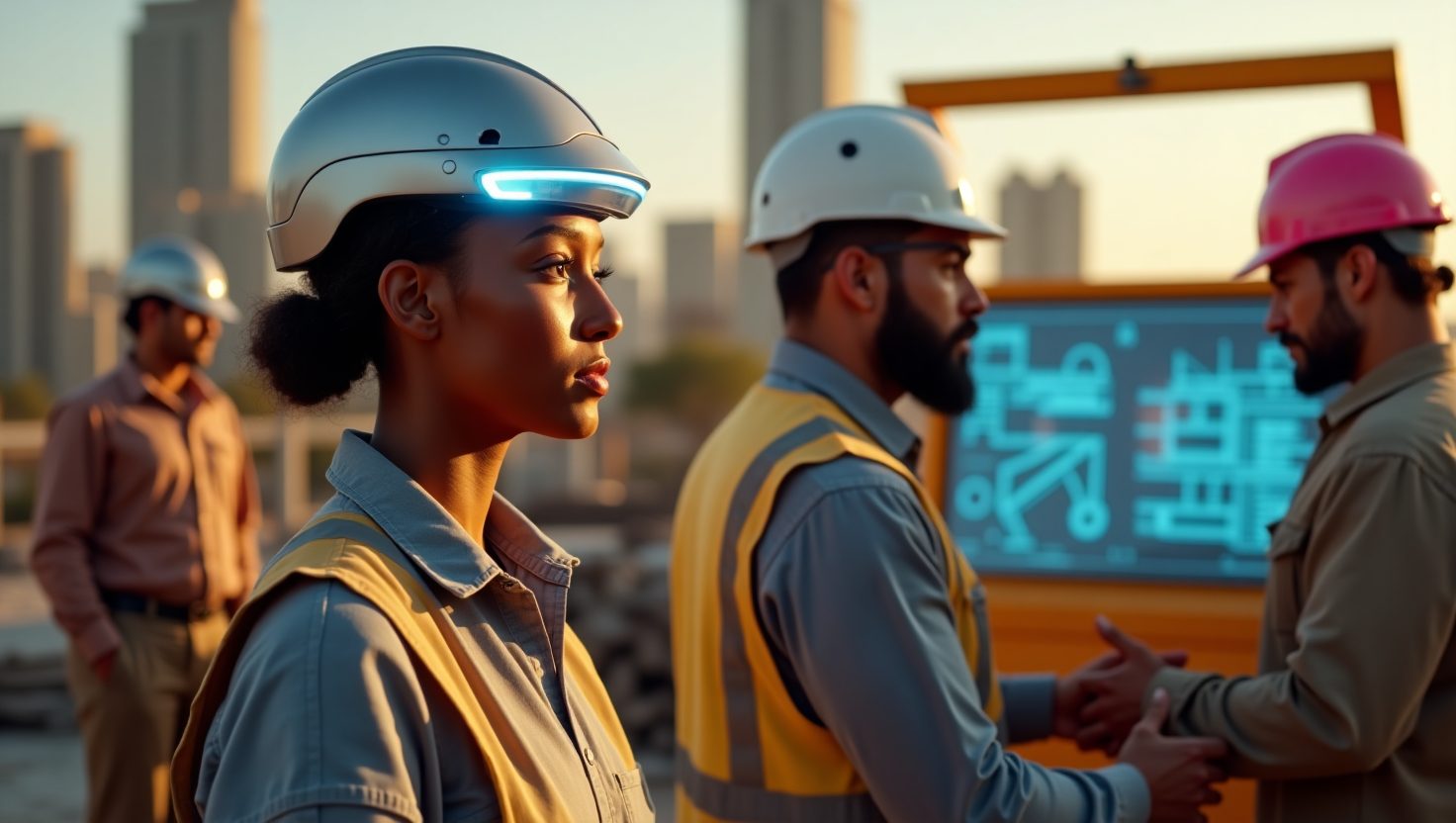
The most personal and immediate impact of AI is felt through wearable tech integration. Think of it as giving every worker a digital co-pilot, constantly checking their immediate surroundings and personal state. Smart helmets are a prime example. These aren’t just plastic shells anymore; they are packed with sensors. An accelerometer can detect a sudden fall and automatically send an alert with the worker’s exact location to the site manager. Some can even detect a minor impact that might not knock someone out but could lead to a concussion, prompting a mandatory check-up.
But it goes beyond helmets. We have smart vests with GPS trackers that can create virtual “no-go” zones, vibrating to warn a worker if they stray too close to heavy machinery or an open excavation. Biometric sensors woven into clothing or worn on the wrist can monitor for signs of heatstroke or fatigue—two massive contributors to on-site accidents. This real-time data flow is revolutionary. It transforms safety from a generic, site-wide policy into a personalised, dynamic shield for every single individual.
Hazard Detection Systems: Seeing Trouble Before It Starts
This is where things get really clever. Modern hazard detection systems are about proactive, not reactive, safety. Using a network of AI-powered cameras and sensors, the system can continuously scan the site for potential dangers. For instance, an AI model can be trained to recognise what a “safe” work area looks like. When it spots an anomaly—a misplaced ladder, a spillage, a tool left in a walkway, or a vehicle reversing without a spotter—it can flag it in real-time.
However, simply bolting a new AI system onto an old, creaking CCTV setup is a recipe for failure. As Jordan Shou, VP of Marketing at the security platform Lumana, aptly put it, “Adding AI on top of outdated infrastructure is like putting a smart chip in a rotary phone”. The insight is dead-on. You get a flood of false alerts, and soon enough, everyone starts ignoring them. True hazard detection requires an infrastructure built for the task. This means systems that can process information at the “edge”—right there on the camera—to provide instant alerts without having to send massive video files to a distant cloud server. This is critical for making the system genuinely useful rather than just another annoyance.
Project Management Automation: Safety Through Efficiency
At first glance, project management automation might not seem like a safety tool, but the link is incredibly strong. A disorganised site is an unsafe site. When project managers are buried under a mountain of paperwork—checking off safety briefings, tracking training certificates, filing incident reports—they aren’t out on the floor, where they can actually spot and prevent hazards.
AI-driven software can automate a huge chunk of this administrative burden. Imagine a system where workers scan a QR code with their phone to sign into a daily safety briefing, automatically creating a timestamped, unforgeable digital record. The system can flag when a worker’s forklift certification is about to expire or ensure that a required safety inspection has been completed and logged before a new phase of work begins. This not only frees up human expertise to be used more effectively but also creates a perfect audit trail, which is invaluable for both internal reviews and external compliance checks.
Compliance Documentation AI: Navigating the Red Tape
Finally, there’s the bureaucratic headache of compliance. Health and safety regulations are complex, vary by region, and are constantly being updated. Keeping up is a full-time job. Here, compliance documentation AI acts as a digital paralegal. These tools can scan and understand thousands of pages of regulations from bodies like the UK’s Health and Safety Executive (HSE).
When a new project plan is created, the AI can automatically cross-reference it against the relevant codes, flagging potential compliance issues before a single shovel hits the ground. It can automatically generate the correct forms for reporting, ensure they are filled out correctly, and maintain a secure, easily searchable archive of all compliance-related documents. This dramatically reduces the risk of costly fines and legal trouble, but more importantly, it ensures that the safety standards being followed are the correct and most current ones.
Case Study: How Modern AI Infrastructure Makes a Difference
To see the real-world impact, look at the work being done by companies like Lumana. As highlighted in a recent article from Artificial Intelligence News, they recognised the “rotary phone” problem and rebuilt their video surveillance platform from the ground up. By using a hybrid-cloud model and processing data at the edge, their system is designed for the demands of modern AI.
In one deployment at a manufacturing facility—an environment with many of the same risks as a construction site—their system led to 90% faster incident investigations. Instead of spending hours scrolling through footage, managers received instant, verified alerts showing them exactly what happened and when. The system delivered these critical alerts in under a second. This is the difference between stopping a dangerous situation as it unfolds and writing a report about it after the fact. It’s a powerful demonstration of how the right infrastructure for hazard detection systems can deliver tangible results.
The Future of Construction AI Safety: From Detection to Prediction
We are still in the early days of this revolution. The technology is impressive now, but what’s coming next is even more transformative. The industry is moving from hazard detection to hazard prediction. By analysing historical data from millions of hours of work across thousands of sites, future AI models will be able to forecast risk.
Imagine getting an alert on your tablet that says: “Warning: Based on tomorrow’s weather forecast, the current project phase, and the scheduled delivery of steel beams, there is an 85% increased likelihood of a slip-and-fall incident in Zone C between 2 PM and 4 PM.” This level of foresight will allow managers to take pre-emptive action, such as putting down extra matting or rescheduling the delivery.
We will also see a much deeper integration with digital twins—virtual replicas of the entire construction site. Before a complex crane lift is attempted in the real world, it can be simulated dozens of times in the digital twin under various weather and equipment conditions to identify every possible point of failure. Autonomous drones and robotic “dogs” will perform routine structural inspections in hazardous areas, keeping human workers out of harm’s way entirely.
However, a significant challenge remains. A study by F5, also cited by Artificial Intelligence News, found that only 2% of companies consider themselves “fully AI-ready.” This gap between the potential of construction AI safety and the industry’s current readiness is enormous. Bridging it will require not just investment in new technology, but a cultural shift towards embracing data-driven safety management.
Time to Build a Safer Future
The tools to radically reduce accidents in the construction industry are no longer theoretical. From wearable tech integration that protects individual workers to sophisticated hazard detection systems that watch over the entire site, the technology is here. By automating the drudgery of project management automation and compliance documentation AI, we can free up our best people to do what they do best: lead, manage, and build safely.
Adopting this technology isn’t a question of “if,” but “when.” The firms that embrace construction AI safety will not only protect their most valuable asset—their people—but will also build a reputation for efficiency, reliability, and excellence. They will be the ones that attract the best talent and win the most significant contracts. The hard hat and high-vis jacket aren’t going away, but they’re about to get a whole lot smarter.
What do you think is the single biggest barrier to adopting these technologies on your projects? Is it cost, culture, or something else entirely? I’d be keen to hear your thoughts in the comments below.



