

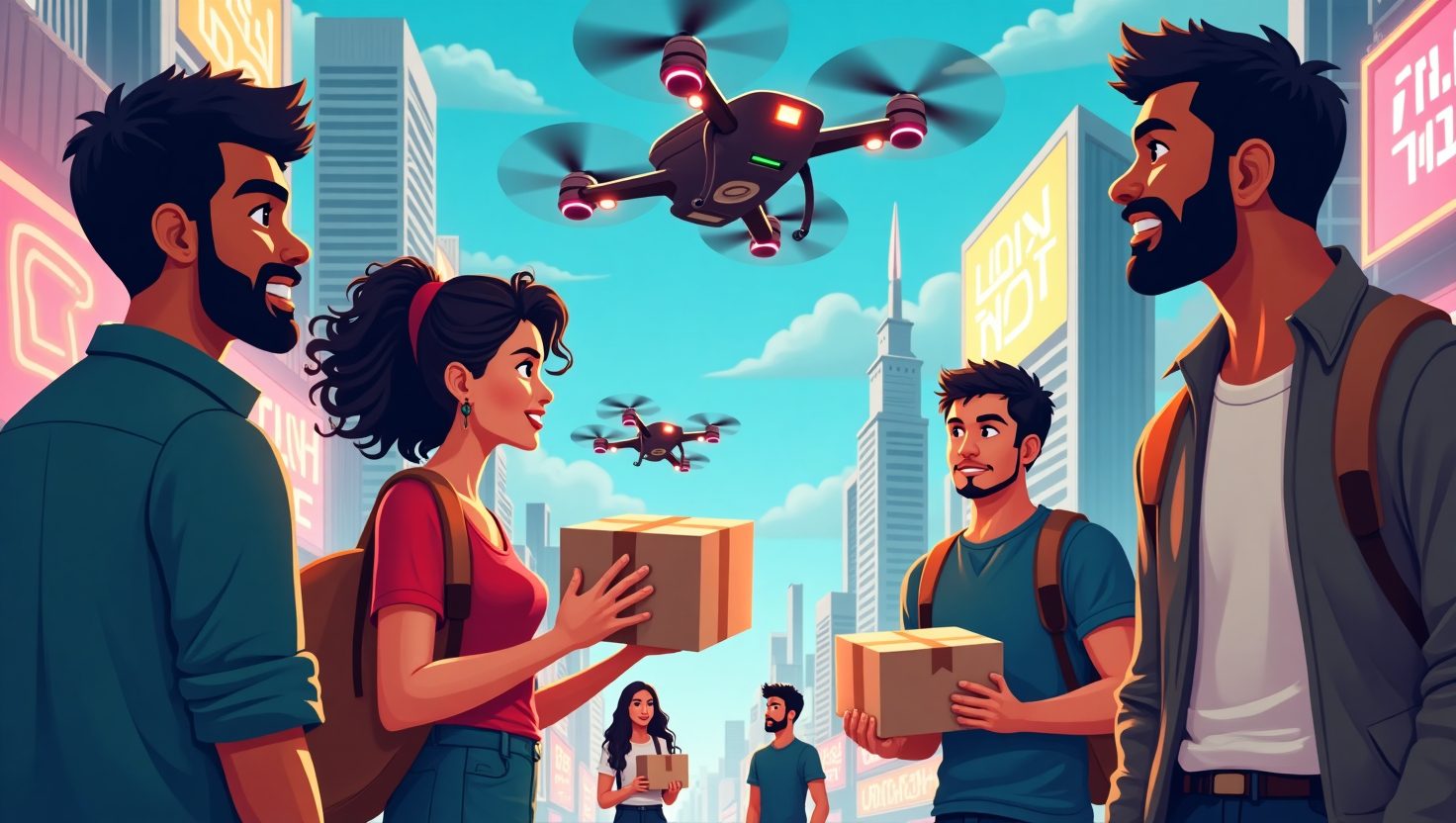
Let’s be blunt: when a company like Amazon gets into a new business, it’s not a hobby. It’s a calculated, all-out assault on the economics of an entire industry. For years, we’ve watched them build a logistics network to rival FedEx and UPS, but the final, most expensive piece of that puzzle has always been the “last mile”—that costly journey from a local warehouse to your front door. Now, with the whir of propellers and the brains of sophisticated AI, Amazon is making its move to conquer it.
This isn’t just about getting your new trainers delivered by a drone. This is about a fundamental shift in the machinery of commerce. We’re talking about a future dominated by autonomous delivery systems, a sprawling category that includes everything from those little six-wheeled robots trundling down the pavement to the delivery drones Amazon is so keen on. The goal is simple: remove the most expensive and unpredictable element from the delivery equation—the human.
So, What Are We Really Talking About?
When we say autonomous delivery systems, we mean machines that move goods from point A to point B with minimal to no human intervention. It’s a broad church, mind you. You have ground-based robots, larger self-driving vans, and the high-flyers of the bunch: delivery drones.
Each has its place. Robots are great for dense urban neighbourhoods or university campuses. Autonomous vans could handle suburban routes. But drones? Drones represent the tantalising possibility of bypassing ground-based chaos altogether. They offer a direct, point-to-point solution that could, in theory, be faster and cheaper than anything that has to stop at traffic lights.
The Brains Behind the Brawn: Route Optimisation
A drone is just a fancy remote-controlled toy without the software that tells it where to go. This is where route optimisation becomes the absolute linchpin of the whole operation. It’s the invisible intelligence that transforms a fleet of delivery machines from a chaotic swarm into a hyper-efficient delivery network.
Think of it like a grandmaster playing a thousand games of chess at once. AI-powered route optimisation algorithms process billions of data points in real-time. They account for weather, no-fly zones, battery life, delivery priority, and even the potential for a bird strike. The system doesn’t just find the shortest path; it finds the smartest path, dynamically re-routing its assets as conditions change. It’s this software layer that creates efficiency and, ultimately, profit.
Before the Flight: The Rise of Package Handling Robots
The journey to your doorstep doesn’t start in the sky; it starts on the floor of a cavernous fulfilment centre. Long before a drone takes flight, package handling robots are already doing the heavy lifting. Amazon’s Kiva robots are the stuff of legend, gliding across warehouse floors to bring shelves of products to human pickers, turning the traditional warehouse model on its head.
These robots are the first wave of logistics automation. They reduce errors, increase speed, and allow for a density of inventory that would be impossible in a human-only environment. They are the essential, ground-level foundation upon which the more futuristic delivery models are being built. You can’t have an efficient air fleet if your ground game is a mess.
The Sci-Fi Future: Is Urban Air Mobility a Dream?
This brings us to the grand vision: urban air mobility (UAM). The idea is a sky filled with autonomous vehicles, whisking people and parcels across cities, free from the gridlock below. It sounds like something straight out of Blade Runner, and frankly, we’re a long way from that reality.
The hurdles are immense. You’ve got a spaghetti junction of regulatory approvals to navigate, not to mention the small matter of public acceptance. Do you really want a constant stream of drones buzzing over your back garden barbecue? Yet, the economic incentive is so powerful that companies are pouring billions into solving these problems. UAM is the high-stakes bet on how our cities will function in the latter half of this century.
The Endgame: Delivery-as-a-Service
So, why is Amazon so obsessed with this? Are they just trying to shave a few quid off Prime deliveries? No. The real prize is much, much bigger. What they are building is a platform for Delivery-as-a-Service (DaaS).
Remember how they built Amazon Web Services (AWS) to run their own retail operation, and then turned around and started renting that computing infrastructure to the rest of the world? It became their most profitable division. The plan here is exactly the same, but for the physical world. First, build the world’s most efficient autonomous delivery system for yourself. Then, once it’s perfected, offer it as a service to every other business, from the local bakery to other large retailers. That is the endgame.
AI: The Ghost in the Machine
Underpinning all of this is artificial intelligence. AI is what powers the route optimisation. It’s what enables a drone’s computer vision to identify a safe landing spot. It’s what drives the predictive analytics that tells a warehouse what products to stock based on anticipated demand.
The recent news about a broad rise in U.S. business investment being driven by AI spending shows this isn’t just theory. As reported by 41NBC, companies are putting their money where the intelligence is. This technology is the engine of the entire autonomous revolution, making systems smarter, faster, and more adaptable.
The Elephant in the Room: Jobs and Other Hurdles
This all sounds wonderfully efficient, but there’s a serious social cost to consider. A recent study from the Massachusetts Institute of Technology (MIT), also referenced by 41NBC, suggests that AI could viably replace 11.7% of the U.S. labour market. Roles in logistics and administration are right in the crosshairs. That’s not a small number, and it represents a massive societal shift we are barely prepared to discuss, let alone manage.
Then there are the security implications. Amazon recently had to warn its 300 million customers about a surge in holiday-related cyber scams. Now imagine a fleet of thousands of flying delivery drones. What’s to stop hackers from trying to hijack them, divert them, or simply send them crashing to the ground? The technological and regulatory challenges are just as significant as the societal ones.
Ultimately, the story of autonomous delivery systems is the story of Amazon’s relentless pursuit of efficiency. They are systematically turning every piece of the logistics puzzle into a technology problem that can be solved with code and capital. They are building a new kind of infrastructure, one that could one day be as essential as the internet or the power grid.
The question is, are we ready for the world they’re building? What happens when the cost of delivering a parcel approaches zero, and what does that mean for everyone else? Let me know your thoughts.



