

The conversation around AI and jobs often gets bogged down in a binary debate: utopia or dystopia. Will AI free us all to become poets and philosophers, or will it render humanity obsolete? This misses the point entirely. The immediate reality is far more pragmatic and far more brutal. It’s about operational efficiency. It’s about balance sheets. And right now, the numbers are telling a very clear story.
The Real Reason the Robots Are Coming
So, why the sudden urgency? The technology, frankly, has been good enough for a while. The real catalyst isn’t a breakthrough in deep learning; it’s a shift in labor economics. For years, the cost of a human worker in certain roles was simply cheaper than the CAPEX and integration cost of an automated system. That equation is now flipping, and government policy is the finger on the scale.
Take the UK government’s recent policies. Increases in the national living wage and national insurance contributions, whilst noble in intent, have a direct and predictable consequence: they make human labour more expensive. For a business leader, this isn’t a moral dilemma; it’s a maths problem. If the cost of a human employee goes up by X per cent, and the cost of an automated solution remains static or decreases, the decision makes itself.
This is precisely the scenario playing out at the online retailer Buy It Direct. Its straight-talking CEO, Nick Glynne, isn’t whispering about this in a secretive boardroom. He’s saying it out loud. As reported by the BBC, Glynne has put a number and a timeline on the change: he expects to function with “two-thirds less people” within a startlingly short three years. Let’s be clear about what that means. For a company with over 800 staff, we’re talking about more than 500 jobs disappearing. This isn’t a trim. This is an amputation.
A Case Study in Calculated Disruption
Buy It Direct, the owner of familiar online storefronts like Appliances Direct and Furniture 123, is the perfect canary in the coal mine for retail AI. Glynne’s logic is cold, hard, and devoid of sentiment.
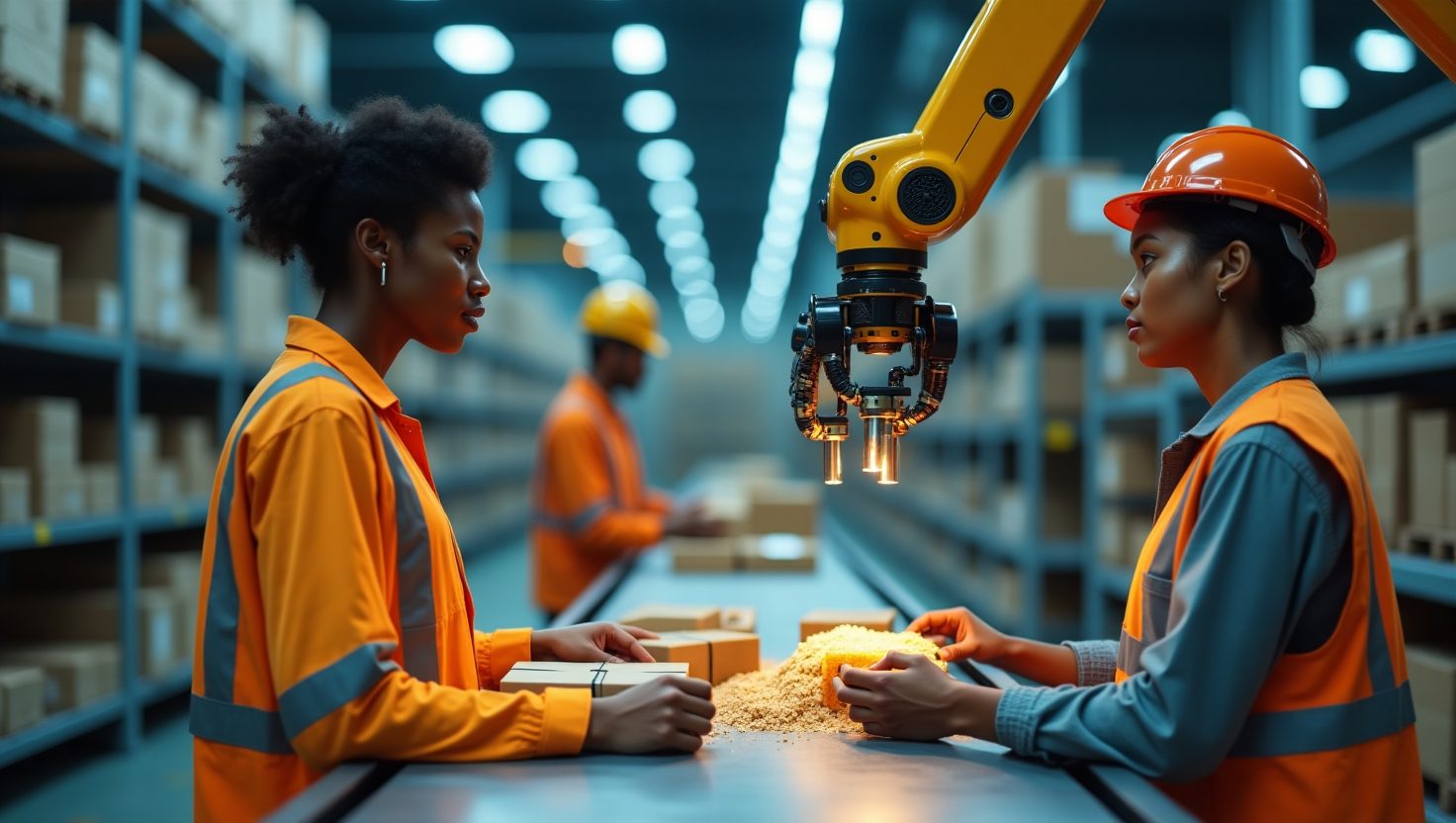
– Warehouse Automation: He explicitly stated he could run his warehouses with “two-thirds less” staff by investing in robotics. These are the entry-level, physical jobs that have long been the bedrock of employment in logistics and retail.
– Office Automation: The reckoning isn’t just for blue-collar roles. Glynne is also offshoring white-collar jobs. Accountants, managers, and other senior roles are now being hired abroad where, he notes, qualifications are comparable but labour costs are significantly lower.
– The Government’s Role: Glynne directly links this acceleration to tax policy. Think about it. An HR department is a cost centre. A robot is a capital investment, and as HM Treasury itself pointed out in response, recent budgets have created “one of the most generous capital allowance regimes of any major country”. You are, in effect, being given a tax incentive to buy the robot that replaces the person you’re being taxed more to employ.
This isn’t a bug in the system; it’s a feature. The government wants to encourage business investment, and automation is a form of investment. But are policymakers truly grappling with the second-order effect of actively incentivising a rapid AI workforce reduction? The evidence suggests they’re not connecting the dots.
The Futile Debate Over ‘Automation Taxes’
This brings us to the perennially debated idea of automation taxes. The concept is simple enough: if a company replaces a human worker (who pays income tax and national insurance) with a robot (which doesn’t), the government loses tax revenue. So, why not tax the robot to make up the difference and, perhaps, slow down the rate of automation?
It’s an elegant theory that completely falls apart in practice. Glynne’s actions at Buy It Direct show us why. He isn’t waiting for a hypothetical future tax on robots. He is reacting to existing taxes on people. The disincentive to employ humans is already in place. Adding a new tax on automation would simply be another factor in a complex calculation. Businesses would likely find ways around it, by offshoring to jurisdictions without such taxes or by investing in software-based automation, which is notoriously difficult to define and tax.
Think of it like this: imagine your office workflow is an old-fashioned assembly line. Each desk is a station where a person performs a task—processing an invoice, answering a customer query, updating a spreadsheet. Business process automation is like replacing each person on that line with a small, specialised robot. The ‘robot’ here isn’t a physical machine; it’s a piece of software, an AI script, working invisibly in the cloud. How exactly do you tax a script running on an Amazon Web Services server somewhere in Ireland? It’s a bureaucratic nightmare that would likely achieve little beyond punishing the most innovative firms.
The Chilling Economics of the New Workforce
What we’re witnessing is a fundamental restructuring of the labour market, and the implications are profound. This isn’t just about job displacement; it’s about the evaporation of the entry-level. The roles Glynne is automating—in warehouses and administrative departments—are the very jobs that have traditionally served as the first rung on the career ladder for millions of people without a university degree.
Where does a 19-year-old school leaver get their start when the stockroom is run by robots and the purchase orders are processed by an AI? This erodes the very foundation of social mobility. We risk creating a permanent economic chasm between those who can design and manage the automated systems and those who were supposed to be doing the jobs the systems now run.
The shift towards retail AI and automation forces a complete rethink of business strategy. The goal is no longer to manage a large pool of people but to orchestrate a suite of automated systems. This is a seismic shift towards maximising operational efficiency, where human capital becomes a specialised, high-cost resource rather than a general-purpose, scalable one. For businesses, the path is clear: automate or die. Competing with a rival like Buy It Direct, which will have slashed its labour costs by two-thirds, becomes impossible if you’re still running a legacy, human-powered operation.
The future for businesses isn’t about whether to adopt AI, but how to manage the transition without causing societal chaos. The future for workers is far less certain. The tired mantra of “reskilling” sounds hollow when the jobs being eliminated are not being replaced by an equivalent number of new, accessible roles. We can’t all become AI ethics consultants or machine learning engineers.
So, as we watch trailblazers—or perhaps provocateurs—like Nick Glynne re-engineer their businesses for a post-human workforce, we have to ask the difficult questions. Is this the inevitable price of progress? And if a business is incentivised by its own government to automate jobs out of existence, who is truly responsible for the people left behind? What’s your take on where that responsibility should lie?



