

Let’s get one thing straight. The “Will an AI take my job?” debate is tired. It’s a binary question in a world that operates in analogue. The real, more interesting question is, “Which parts of my job can an AI do, how much are those parts worth, and what does that mean for me, my company, and my country?” For the first time, we’re getting some properly juicy data to answer that, and it comes from a place that knows a thing or two about numbers: MIT.
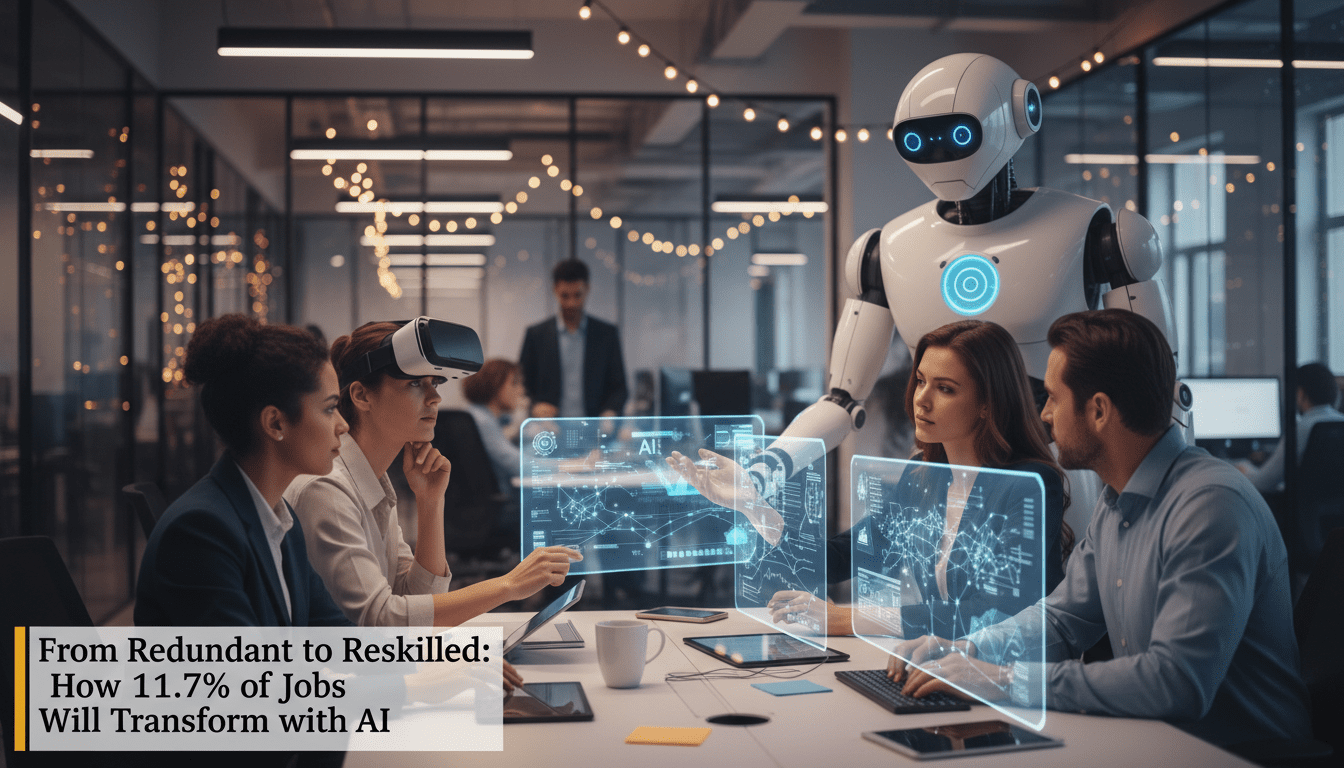
Researchers at the Massachusetts Institute of Technology, working with Oak Ridge National Laboratory, have built something they call the “Iceberg Index.” It’s a fascinating new way of looking at AI workforce displacement. Instead of making wild predictions about entire professions vanishing, it meticulously maps the capabilities of current AI systems against the specific tasks that make up every job in the US economy. Their conclusion? AI can already perform tasks equivalent to the work of 11.7% of the entire US workforce. Put a price on that, and you’re looking at a staggering $1.2 trillion in annual wages. Now that gets your attention, doesn’t it?
So, What Exactly Is This “Iceberg”?
Think of your job not as a single, solid block, but as a collection of different tasks. Some are creative, some are strategic, and some, let’s be honest, are repetitive and could probably be done by a well-trained parrot. The Iceberg Index is essentially a skill redundancy analysis on a national scale. It looks at all those tasks and asks, “Could a current AI system handle this?”
This is a fundamental shift in the conversation. It’s not about whether we need accountants anymore; it’s about how much of an accountant’s day is spent on automatable data entry versus strategic financial advice. As one of the project’s leaders, Prasanna Balaprakash, put it, they are essentially “building a digital twin for the U.S. labor market.” This allows them to see vulnerabilities not in job titles, but in the very fabric of the work itself.
What’s really telling is the monumental gap between what’s possible and what’s actually happening. According to the data cited by PYMNTS.com, while $1.2 trillion in wage value is exposed to automation, only about 2.2% of that, or $211 billion, is currently being adopted. Why the hesitation? Because replacing a human task with an AI isn’t like swapping a lightbulb. It requires investment, new workflows, and a management class that understands the technology. A recent survey found that while 60% of CFOs feel only ‘somewhat prepared’ for AI-driven change, the technology is pressing forward regardless. The potential is there, simmering just below the surface.
Your Postcode vs. The Algorithm
One of the most revealing parts of the MIT study is how these labor market shifts are not uniform. The impact of AI will feel very different depending on where you live and what your local economy does.
Let’s look at the data:
– In a tech-heavy state like Washington, the exposure is concentrated in specialised roles, accounting for about 4.2% of automatable work.
– Contrast that with a manufacturing state like Ohio, where the exposure is much broader at 11.8%.
Why the difference? It’s not that Ohio has more “automatable people.” It’s that the administrative and logistical tasks surrounding its core manufacturing industry are ripe for AI-led efficiency gains. The AI isn’t necessarily coming for the person on the factory floor, but it might be coming for the person scheduling their shifts, processing their invoices, or managing their supply chain. It’s a far more subtle and pervasive change. This is the new geography of work, drawn by algorithms rather than highways.
The Trillion-Dollar Reskilling Question
If $1.2 trillion worth of tasks are on the table, then reskilling priorities just became the most important economic conversation we’re not having properly. This isn’t a fuzzy, feel-good HR initiative anymore; it’s a core strategic necessity for individuals and governments alike. Losing a portion of your job to automation isn’t just an inconvenience; studies have consistently shown it can lead to significant, long-term wage loss if you’re displaced into a lower-skilled role.
The challenge is immense. Who foots the bill for this mass retraining? Is it up to individuals to spend their nights and weekends learning new skills? Or should the companies profiting from this automation be responsible for upskilling their workforce? This is the policy minefield that politicians seem terrified to step into. We need clear, funded pathways for people in exposed roles to pivot towards the tasks AI can’t do: complex problem-solving, empathetic communication, and high-level strategy. Without it, we risk creating a new class of economically displaced workers.
What are your thoughts on who should lead the charge on reskilling—companies, the government, or individuals themselves?
Economic Singularity or Just Better Spreadsheets?
This brings us to the spectre of economic singularity—the hypothetical future where AI becomes so capable that human labour is rendered obsolete. It’s a great concept for science fiction, but it’s not the reality we’re facing right now.
The more likely future is one of augmentation, not annihilation. As MIT economist David Autor, a leading voice in this field, often argues, AI will “likely augment human expertise more frequently than replace it.” Think of it like this: AI is the ultimate intern. It can sift through mountains of data, draft reports, and spot anomalies in seconds, freeing up the human expert to do the one thing the AI can’t: exercise judgement. The doctor isn’t replaced by an AI that reads scans; she’s augmented by it, allowing her to see more patients and focus on diagnosis and treatment plans.
The real risk isn’t a world without jobs. It’s a world where the gains from this incredible productivity boom flow only to the owners of the technology, while the rest of the workforce sees their most valuable skills devalued. Balancing the immense power of AI with human expertise is the central challenge of our time.
Ultimately, the MIT Iceberg Index isn’t a prophecy; it’s a map. It shows us the terrain ahead. It highlights where the ground is shaky and where it’s firm. For 11.7% of the workforce, the ground is starting to shift. Sticking your head in the sand is not a strategy. The smart move is to look at your own job, identify the tasks the iceberg might hit, and start building the skills that will keep you safely on solid ground. So, what parts of your job are uniquely human?



