

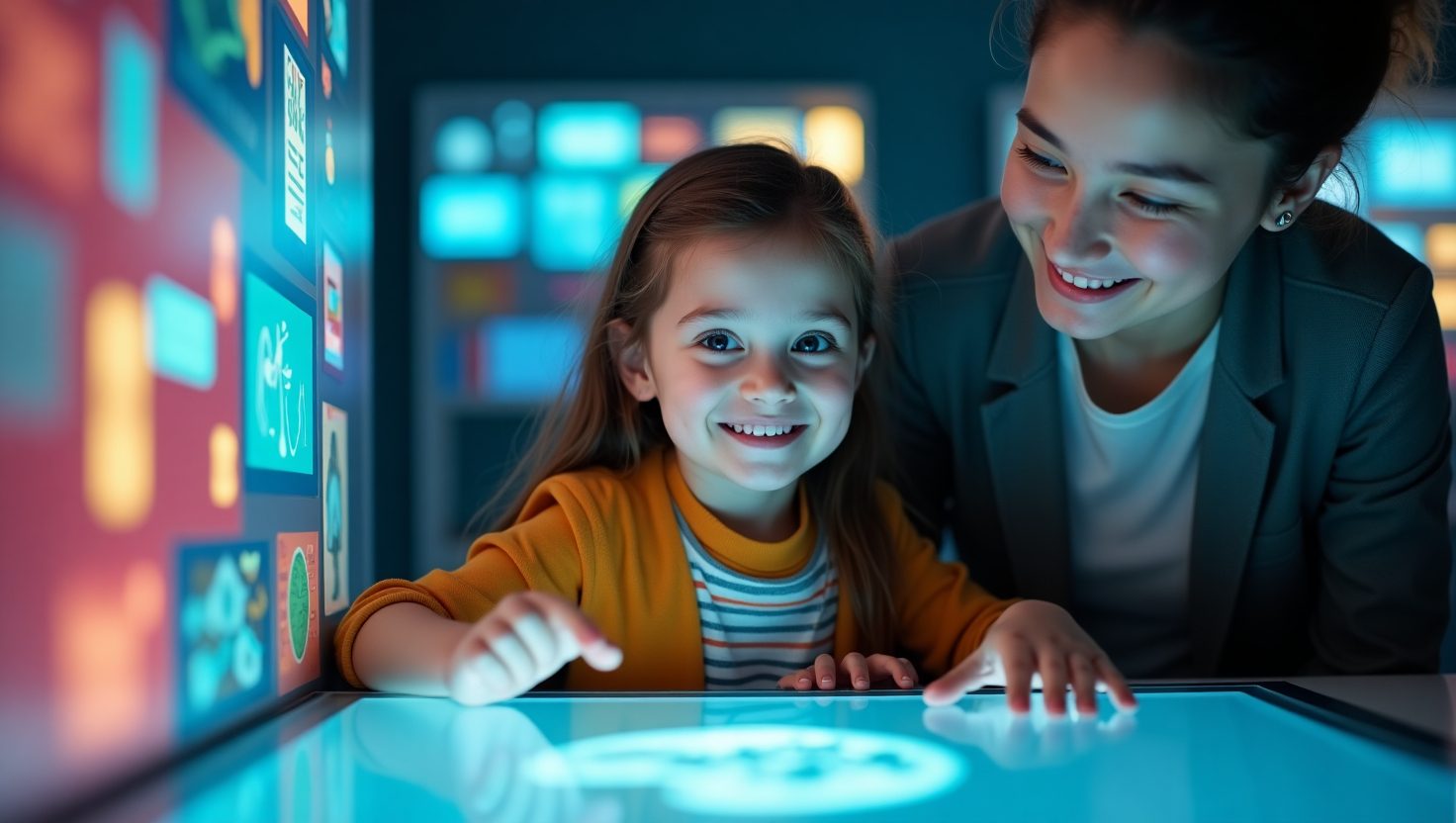
The conversation around AI in education often gets stuck on dystopian fears of robot teachers or simplistic homework helpers. But that’s missing the point entirely. The real revolution isn’t about replacing humans; it’s about augmenting them with tools of almost unbelievable precision. It’s about delivering a level of individual attention that even the most dedicated teacher with a class of 30 simply cannot manage. This isn’t a far-off dream; as a recent Scientific American article highlighted, it’s happening right now, in living rooms, driven by parents who are tired of waiting for the system to catch up.
So, What Are We Actually Talking About?
When we talk about AI special education tools, we’re not talking about a simple app that flashes digital cards. Think of them as adaptive, intelligent partners in a child’s learning process. These are sophisticated platforms that use machine learning to understand how a specific child learns, what they find interesting, and, crucially, when they are becoming frustrated.
These tools come in various flavours:
* Diagnostic Tools: Some platforms, like Amira Learning, listen to a child read aloud and can pinpoint specific reading challenges with the accuracy of a trained specialist.
* Adaptive Practice Platforms: Others, like Microsoft’s Reading Coach, provide real-time feedback and encouragement, adjusting the difficulty of texts based on performance.
* Hyper-Personalised Tutors: And then there are the truly bespoke solutions, built from the ground up to serve a single child’s unique brain.
The core idea uniting all of these is the power of personalized learning algorithms. Instead of a one-size-fits-all curriculum, these algorithms create a unique educational path for every user. For a child with dyscalculia, the system might present maths problems using visual blocks instead of abstract numerals. For a student with ADHD, it might break lessons into shorter, gamified chunks. The potential for these custom-built dyslexia support systems and other targeted aids is nothing short of transformative.
A Mother, Her Son, and a Little Bit of ‘Vibe Coding’
This brings us to the story of Arlyn Gajilan and her son, Tobey. Gajilan is not an AI researcher or a Silicon Valley engineer; she’s the digital news director for Reuters. Faced with her son’s struggles with dyslexia and his heart-wrenching-yet-profound question—”I’m slower than everybody else. Why is it so hard for me?”—she didn’t just hire another tutor. She decided to build one.
Using OpenAI’s custom GPT models, she created Tobey’s Tutor. What she did is a perfect example of a nascent concept called ‘vibe coding’—using natural language to instruct an AI to build a programme. You don’t need to write complex Python; you describe the feeling, the experience you want to create. It’s a bit like being an orchestral conductor instead of a first-chair violinist. You guide the overall performance without having to play every single note yourself. This is a game-changer, especially when you consider a recent JetBrains study indicated that a staggering 85% of developers are already using AI tools in their work. Gajilan just took it one step further.
But here’s where Tobey’s Tutor moves from a clever project to a potential blueprint for the future of special education.
Personalised to the Core: Gajilan fed the AI everything about her son’s interests—Minecraft, Star Wars, dragons. The result? Maths problems weren’t about abstract numbers; they were about calculating the materials needed to build a Nether portal in Minecraft*. The lesson content was intrinsically motivating because it was woven from the fabric of his own world.
* The Frustration Algorithm: This is the masterstroke. Gajilan programmed the system to detect when Tobey was getting overwhelmed. If he got too many answers wrong or his response time slowed, the AI wouldn’t just plough ahead. It would pause the lesson and initiate a ‘wellness break’, suggesting he get a drink of water, do some stretches, or tell a joke. It taught him not just maths, but self-regulation—a skill far more valuable than long division.
This isn’t just a tutoring app; it’s an emotionally intelligent learning companion. Gajilan has now moved to commercialise the platform, with a beta offering 30-minute sessions for $29 a month. This isn’t about creating a unicorn startup overnight. It’s about solving a real, painful problem in a way that large, lumbering institutions haven’t managed to.
More Than Just One Clever Mum
While Gajilan’s story is remarkable, it’s part of a broader wave of accessibility tech innovations. We’re seeing a strategic shift towards tools that don’t just teach but actively engage. Take the NWEA MAP Reading Fluency test, which uses AI to assess young readers, or Google’s Read Along, which provides real-time verbal feedback. These aren’t just incremental improvements; they represent a new philosophy of educational technology.
A key part of this is gamification. Making learning feel like a game isn’t about dumbing it down; it’s about tapping into the brain’s natural reward systems. When a child earns points for correctly spelling a word or unlocks a new level in a story, dopamine is released. This makes the learning process enjoyable and, more importantly, sustainable. It transforms “I have to do my homework” into “I want to beat my high score.” This is the secret sauce that keeps kids coming back for more, willingly.
The Thorny Question of Ethics
Of course, with great power comes great responsibility. The rush to implement these platforms raises critical questions about educational AI ethics. Are we comfortable with private companies holding vast amounts of data on how our children learn, think, and even feel? How do we ensure the algorithms themselves aren’t biased, perhaps favouring one learning style over another or reflecting the cultural biases of their creators?
Gajilan herself has a clear-eyed view of this, stating, “This change is as profound, if not more profound, than when the Internet took over”. She’s right. And just as with the early internet, we need a robust public conversation about the guardrails. We need transparency in how these algorithms work, strong data privacy regulations, and a commitment to ensuring these tools reduce inequality, not amplify it. The goal is empowerment, not just efficiency.
What happens if an AI incorrectly flags a child as ‘frustrated’ or ‘uncooperative’? Who is liable? The school? The software company? These are not trivial legal and ethical minefields we need to navigate, and we need to do it now, not after the technology is already deeply embedded in our schools.
Where Do We Go From Here?
The context for this innovation couldn’t be more urgent. According to the National Center for Education Statistics, a jaw-dropping 74% of public schools reported struggling to fill vacancies for special education teachers in recent years. At the same time, student performance is alarming, with a 2024 report showing only 22% of 12th graders achieving proficiency in maths. The system is stretched thin, and teachers are burning out.
This is where AI special education tools find their true strategic purpose. They aren’t here to take jobs. They are here to make the jobs of our heroic, overworked teachers manageable. Imagine a teacher armed with a dashboard that provides a detailed, AI-generated report on each student’s progress, pinpointing exact areas of struggle from the previous night’s homework. The teacher can then use their precious class time not for rote instruction, but for targeted, human-to-human intervention where it’s needed most. The AI handles the personalised practice; the teacher handles the mentoring, encouragement, and inspiration.
This is the future: a symbiotic relationship between human educator and artificial intelligence. The growth of bespoke tools like Tobey’s Tutor, alongside broader platforms from giants like Google and Microsoft, signals a market that is finally waking up to the power of true personalisation. The technology, as Gajilan has proven, is already here. The challenge is no longer technical; it is one of imagination, implementation, and—most importantly—ethics.
So, as we look at this new frontier, we have to ask ourselves: are we ready to move beyond the industrial-age model of education? Are we willing to embrace these powerful new tools to finally deliver on the promise of an education that adapts to every child, not the other way around? What steps should school districts and parents be taking today to prepare for this shift?



