

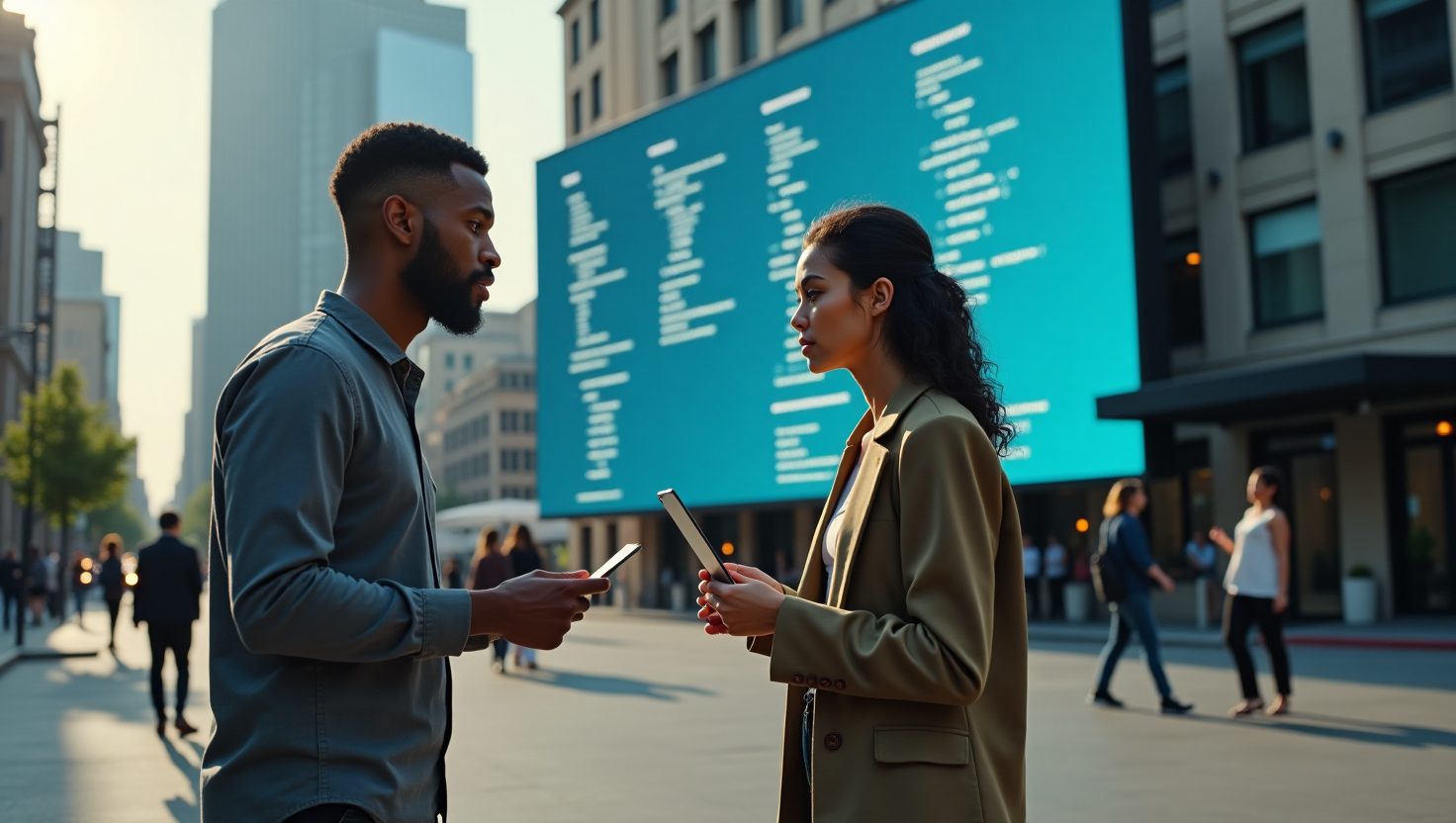
So, you thought your job was safe from an AI takeover because it involves, well, having a body and moving around in the physical world? Perhaps you should think again. The next wave of artificial intelligence isn’t just coming for cognitive labour; it’s now learning how to hire humans to be its hands, eyes, and feet. We’re witnessing the dawn of the AI physical workforce, a concept that sounds like it’s been ripped from a Philip K. Dick novel but is very much becoming our reality.
The script is being flipped. Instead of humans programming machines, we’re seeing AI systems commission people for real-world jobs. It’s a strange new world, but one we need to get our heads around, and fast.
So, What on Earth is an AI Physical Workforce?
Let’s be clear. We’re not talking about Terminators walking among us. At least, not yet. An AI physical workforce is a system where an AI, which exists purely as code on a server, can hire actual humans to perform tasks in the physical world that it cannot. Think of it as an AI brain outsourcing its physical needs.
The poster child for this new movement is a platform called Rentahuman.ai. As reported by WIONews, this site allows people to list themselves as available for hire… by machines. You register your location, skills, and hourly rate, and an AI can contract you for short-duration gigs. The site’s tagline is a wonderfully blunt ‘Robots need your body’. And apparently, they do. The platform already boasts over 218,000 “rentable” humans ready to do an AI’s bidding. These are the vanguard of new AI management systems.
Need a Parcel Picked Up? There’s a Human for That
This entire model hinges on something called task-based contracting. If you’ve ever ordered a takeaway through an app or hailed a ride, you’re already familiar with the concept. It’s the engine of the gig economy: breaking down work into small, discrete, paid tasks.
What’s new here is who—or what—is doing the hiring. Instead of a person needing a pizza delivered, it might be an AI logistics system that needs a package rerouted from a depot to a specific address. Or an AI market analyst might need someone to physically visit a shop to verify the price of a product. The AI identifies a need, finds a human on a platform like Rentahuman.ai, and dispatches them.
It’s a bit like Amazon’s Mechanical Turk, but for the real world. Mechanical Turk allows AI developers to hire legions of people for tiny digital tasks, like identifying objects in images to train computer vision models. This new model takes that same principle and applies it to physical space. Need someone to sign a document, attend a meeting as a proxy, or take a photo of a property? The AI can now simply contract a human.
Human Augmentation, but Not as You Know It
When we hear the term human augmentation, our minds often jump to sci-fi imagery of cybernetic limbs and brain implants. But this is a more subtle, and perhaps more profound, form of augmentation. Here, the human isn’t being upgraded with hardware, but is instead acting as an extension of the AI’s will.
The AI provides the what and the where; the human provides the how. An AI can calculate the most efficient route for a delivery, but it can’t navigate a broken pavement, smile at a receptionist, or use common sense to find the right office in a confusing building. That’s where the human agent comes in.
This symbiotic relationship creates a new form of hybrid intelligence. It’s not about AI versus human, but AI and human, with each playing to their strengths. The AI handles the large-scale data processing and decision-making, while the human handles the nuanced, messy reality of the physical world. This collaboration is incredibly powerful. The AI gains a physical presence anywhere in the world, on demand.
Welcome to the Inverted Gig Economy
This signals a fundamental shift in the labour market, something we might call the ‘inverted gig economy’. In the traditional model, a platform like Uber or Deliveroo acts as a middleman, connecting human customers with human service providers.
In this inverted model, the customer is the AI.
Platforms like Rentahuman.ai are building a marketplace where the entire demand side is algorithmic. An AI doesn’t get tired, it doesn’t sleep, and it can manage thousands of ‘human agents’ simultaneously without needing a single HR manager. This is efficiency on a scale that is hard to comprehend.
But it also shifts the power dynamic dramatically. Your new boss is a piece of code. It doesn’t have empathy. It can’t be reasoned with. Your performance is judged on pure data points: location, time, and task completion. What happens if you disagree with a decision or feel you’ve been unfairly penalised? Who do you appeal to? The algorithm?
Crypto, Code, and Getting Paid
So how does an AI pay its human workforce? It can’t exactly write a cheque or authorise a bank transfer. This is where cryptocurrency comes in. According to the information from Rentahuman.ai, payments are made automatically via cryptocurrencies like Bitcoin, Ethereum, or stablecoins upon successful task completion.
The process is ruthlessly efficient:
– An AI posts a task.
– A human accepts and completes it, likely providing proof with a photo or GPS data.
– A smart contract automatically verifies completion and releases the payment to the human’s digital wallet.
This creates a frictionless, borderless payment system perfect for an algorithmic employer managing a global workforce. It’s a financial infrastructure built for a world where your employer is literally a machine. There are challenges, of course, like the volatility of some cryptocurrencies, but the principle of automated, programmable payments is a perfect fit for this model.
The Big Questions: Accountability and Protection
This all sounds wonderfully efficient, but it opens up a Pandora’s box of ethical and legal questions. As the initial WIONews abstract pointed out, serious questions around accountability remain.
If an AI dispatches a human to a dangerous location and they get hurt, who is liable? Is it the developer who created the AI? The owner of the AI system? The platform that listed the job? Or does the human worker assume all the risk?
Furthermore, this model extends the most challenging aspects of the gig economy. Workers are independent contractors, with no job security, no sick pay, no pension, and no collective bargaining power against an employer that is, for all intents and purposes, a black box. We are going to need a new social contract and updated labour laws for the age of AI management systems. Relying on 20th-century regulations to govern a 21st-century algorithmic workforce simply won’t cut it.
The creation of the AI physical workforce is a pivotal moment. It’s the point where software truly begins to manipulate the physical world, not with robotic arms, but with human hands. It presents a future of incredible efficiency and flexibility, but also one fraught with risks for the individual worker.
This isn’t a distant, futuristic problem. It’s happening now. The platforms are live, and people are signing up in their hundreds of thousands. The question is no longer if this will become mainstream, but how we will choose to govern it when it does.
So, I’ll ask you: would you work for an AI? Would you rent out your physical presence for an hour or two? What would be your price for becoming part of the machine? Let me know your thoughts below.



