

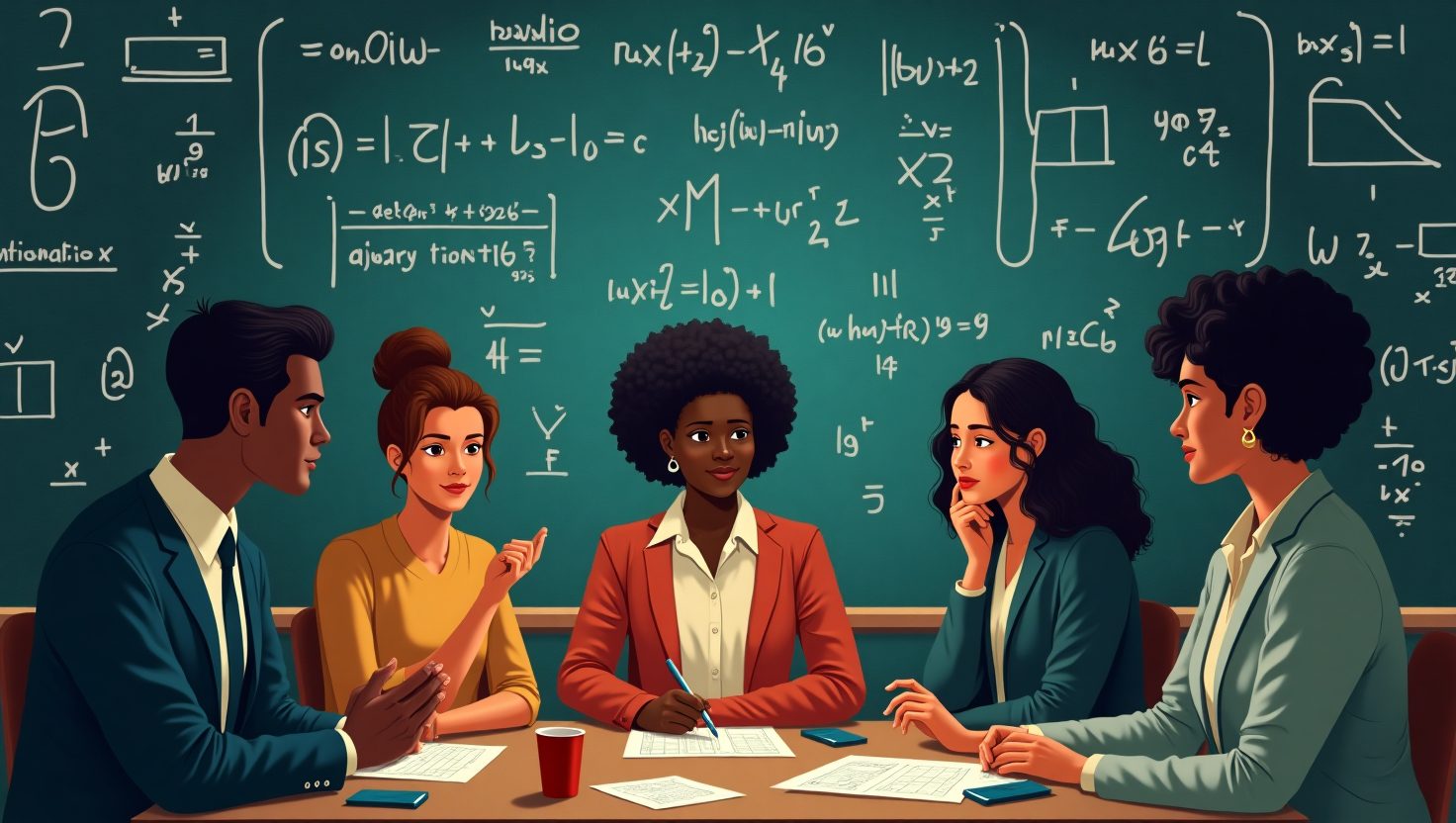
For years, we’ve been hearing the same old song: AI is all about probabilities, a sophisticated mimic that predicts the next word in a sentence. It’s been fantastic for writing poetry or summarising your emails, but pure, logical reasoning? That was still supposedly the exclusive playground of the human mind. Well, it seems someone forgot to send the machines the memo. A startup named Axiom has just strolled onto the scene and casually announced its AI has solved four mathematical problems that have stumped human brains for years. This isn’t just another incremental step; it’s a profound development in AI mathematical reasoning, one that hints at a dramatic acceleration across every field of science and technology.
So, What on Earth is Automated Theorem Proving?
Let’s be honest, the term automated theorem proving doesn’t exactly set the pulse racing. It sounds like something you’d find in a dusty textbook. But stick with me, because this is where the magic happens.
Think of a traditional mathematical proof like a detective’s case file. A human mathematician, our Sherlock Holmes, gathers clues (axioms), follows leads (lemmas), and eventually constructs a narrative (the proof) that logically points to the culprit (the solution). It’s brilliant, creative, and sometimes, a bit messy. The detective might miss a clue or make a logical leap that feels right but isn’t rigorously documented.
Automated theorem proving is like having an entire police force of methodical, tireless inspectors who check every single step of Sherlock’s work. Better yet, they can even build the entire case from scratch. They start with the basic rules of the game and then, step-by-logical-step, build an unbreakable chain of reasoning until they arrive at the truth. This is a core part of the symbolic AI resurgence, a move back towards systems that can manipulate rules and symbols with absolute precision, not just guess patterns in data.
The Axiom Method: Where LLMs Meet Pure Logic
This brings us to the Axiom case study, which is frankly astonishing. Their system, AxiomProver, isn’t just one single technology. It appears to be a clever fusion of two distinct AI worlds. On one hand, you have the generative power of Large Language Models (LLMs), great for brainstorming ideas and spotting patterns across vast amounts of text. On the other, you have that rigorous, symbolic reasoning engine we just talked about.
Axiom’s method seems to work like this:
– It ingests decades, even centuries, of mathematical knowledge.
– The generative part of the AI acts as a scout, suggesting potential pathways and connections that a human might not see. Ken Ono, a mathematician collaborating with the project, told WIRED, “What AxiomProver found was something that all the humans had missed.”
– The symbolic engine then takes over, attempting to build a formal, verifiable proof based on those suggestions.
– Crucially, every line of the final proof is checked using a system called Lean, a formal mathematical language. This isn’t AI saying “trust me”; it’s AI presenting a perfectly auditable receipt for its logic.
It’s this ability to not just find an answer but to prove it with absolute certainty that makes Axiom’s work so significant.
Cracking Conjectures from Ramanujan’s Lost Notebook
Now for the headline act. One of the problems AxiomProver tackled is the Chen-Gendron conjecture, a knotty problem in algebraic geometry. The AI didn’t just solve it; it found a novel connection between this modern problem and mathematical formulae jotted down over a century ago by the legendary, self-taught Indian mathematician Srinivasa Ramanujan in his famous notebooks.
Imagine a modern engineer struggling with a complex structural problem, and their AI assistant says, “Have you considered looking at Leonardo da Vinci’s sketches from the 1500s? There’s a principle there that applies.” That’s the level of creative and historical connection we’re talking about. Scott Kominers, an associate professor at Harvard Business School, commented on the breakthroughs, saying, “Even as someone who’s been watching the evolution of AI math tools closely for years… I find this pretty astounding.”
It’s a beautiful example of how this technology isn’t just a calculator on steroids. It’s a research partner, one capable of seeing the entire tapestry of mathematical history and finding threads that connect seemingly unrelated areas.
Beyond Maths: Why This Matters for Security and Science
Okay, so AI is good at maths. Why should anyone outside of an ivory tower care? Because the same logic that proves a mathematical theorem can be used to prove that a piece of software is secure.
Think about the software that runs our banks, our power grids, and our security systems. It’s millions of lines of code, and a single error can open the door to catastrophic failure or a devastating cyber-attack. We currently rely on testing and human code reviews, which are like spot-checking a skyscraper’s blueprints. AI mathematical reasoning offers the chance to formally verify the code, proving with mathematical certainty that it will do exactly what it’s supposed to do and nothing else. It’s the difference between hoping a bridge will hold and knowing it will.
This has monumental implications for STEM research acceleration. In fields from drug discovery to materials science, researchers are often held back by the sheer complexity of the underlying mathematics. An AI that can act as an infinitely patient, brilliant, and creative mathematical partner could unlock discoveries at a pace we can barely imagine. As Carina Hong of Axiom puts it, “Math is really the great test ground and sandbox for reality.” If we can master the sandbox, we can start building some truly remarkable things in the real world.
So, is this the end of the human mathematician? Dawei Chen, one of the authors of the original conjecture, doesn’t think so. “Mathematicians did not forget multiplication tables after the invention of the calculator,” he wisely notes. “I believe AI will serve as a novel intelligent partner.”
This feels right. We’re not witnessing the replacement of human intellect but the dawn of its amplification. We’re handing our brightest minds a new kind of tool, one that doesn’t just perform calculations but actively participates in the dance of discovery. The real question now is, what other “unsolvable” problems are about to be solved? What do you think will be the next major field to be transformed by this new partnership between human and machine intelligence?



