

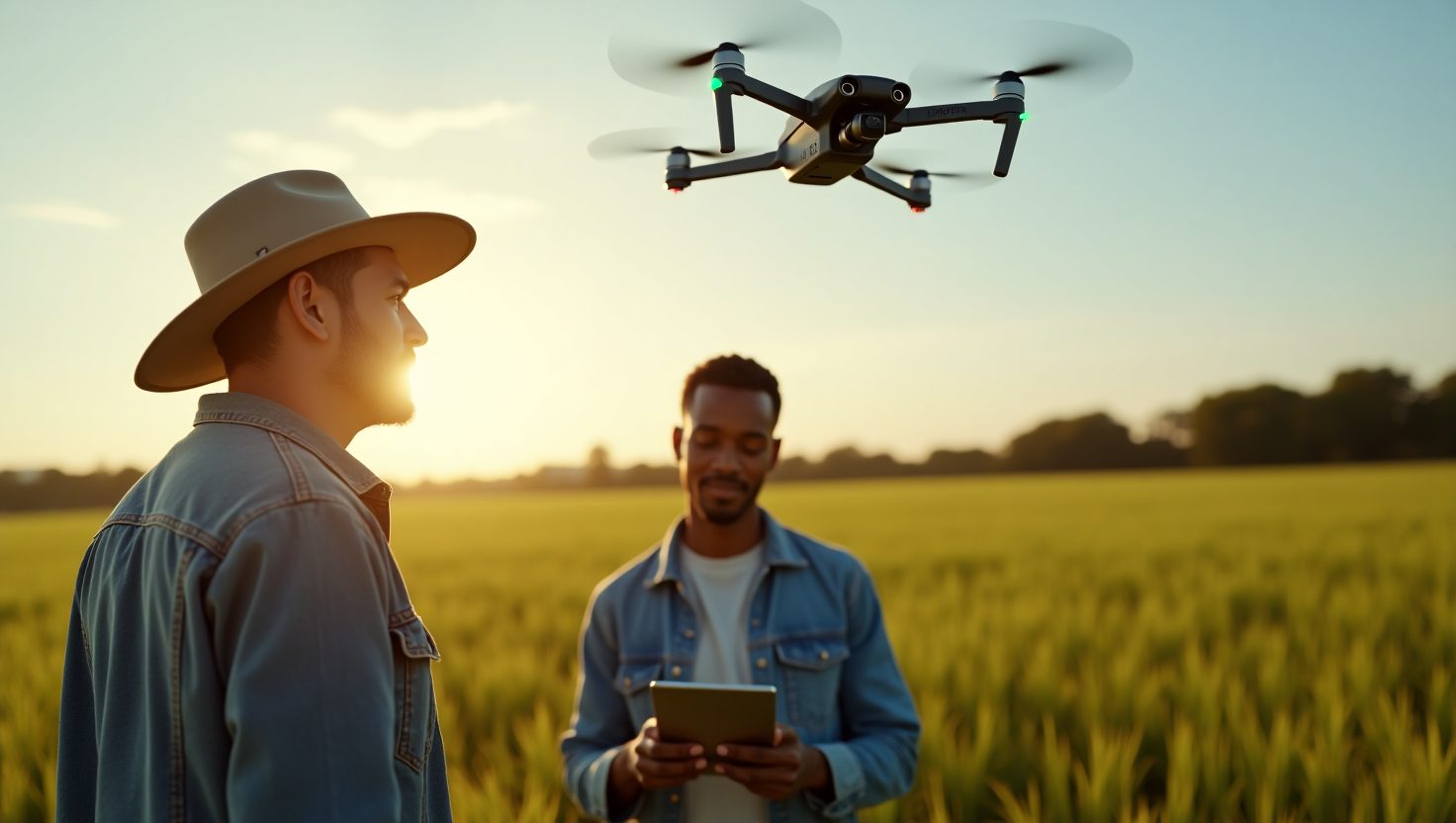
The question isn’t whether AI will replace the farmer. As Andrew Knowles, CEO of the agricultural co-operative Fram Farmers, rightly points out, that’s a red herring. The real story, as detailed in a recent opinion piece for the East Anglian Daily Times, is how AI is becoming an indispensable tool. It’s an expert consultant that never sleeps, constantly analysing data to help human experts make better, faster, and more profitable decisions. It augments human intelligence; it doesn’t make it obsolete. We’re seeing the dawn of a new era, one where intuition and experience are supercharged by powerful algorithms.
What Does AI in the Fields Actually Look Like?
Forget the sci-fi. AI in Agriculture usually means a network of sensors, drones, and sophisticated software working in concert. Think of it like a seasoned doctor monitoring a patient’s vitals. The AI is the suite of monitors and diagnostic tools, constantly gathering data points—soil moisture, nitrogen levels, leaf colour, weather patterns. But it’s the farmer, the doctor in this analogy, who interprets the charts, considers the patient’s history (the farm’s unique conditions), and ultimately decides on the treatment plan.
This is where the concept of precision nutrient management comes into play. For generations, farming has operated on averages. A farmer might treat an entire 50-hectare field with the same amount of fertiliser because, on average, that’s what was needed. It was an effective but blunt instrument, a bit like prescribing the same dose of medicine to everyone in a hospital ward, regardless of their individual needs. The result? Some parts of the field get too much fertiliser, which runs off into waterways and contributes to pollution, while other parts get too little, capping the potential crop yield. It’s both economically inefficient and environmentally damaging. AI promises to change that by turning the sledgehammer into a scalpel.
Smart Farming: More Than Just a Catchphrase
“Smart farming” has been buzzing around for years, but with AI, it’s finally living up to its name. It’s the umbrella term for a suite of technologies that brings the data-driven precision of the tech world to the muck-and-nettles reality of agriculture. We aren’t just talking about automated tractors that can plough a straight line. We are talking about an integrated system where every action is informed by data.
Some of the most compelling examples are already in use:
– Hyper-local Weather Prediction: AI models can now process vast amounts of atmospheric data to provide forecasts for a specific farm, or even a specific field, telling a farmer the optimal window to plant, spray, or harvest.
– Machinery Optimisation: At pioneering operations like Dyson Farming, AI is used to analyse telematics from tractors and harvesters. It optimises routes to save fuel, schedules maintenance before a part fails, and ensures the machinery is operating at peak efficiency, trimming costs and reducing carbon emissions.
– Livestock Health Monitoring: In the world of animal husbandry, AI is making huge strides. Systems now use cameras and sensors to monitor pigs or cattle, identifying subtle changes in behaviour or movement that are early indicators of illness. One application has been shown to detect early signs of disease in pigs, leading to a 15-20% reduction in the use of medication. This is a massive win for animal welfare, food safety, and the fight against antibiotic resistance.
These applications aren’t gimmicks. They represent a fundamental shift in how a farm is managed—from a business based on historical patterns and gut feelings to one driven by real-time data and predictive analytics.
The Scalpel Arrives: AI in Precision Nutrient Management
This brings us back to the fertiliser problem. How exactly does AI enable precision nutrient management? It starts with data collection. A drone equipped with a multispectral camera flies over a crop, capturing images that go beyond what the human eye can see. The AI software analyses these images, detecting minuscule variations in the colour of the crop’s leaves, which indicate different levels of nutrients like nitrogen. It can then create a detailed ‘prescription map’ of the field, colour-coded down to a few square metres.
This map is fed directly into the software of a high-tech spreader or sprayer. As the tractor traverses the field, its GPS system knows its exact location. The AI cross-references this with the prescription map and adjusts the rate of fertiliser application in real-time. A nitrogen-rich patch gets little to no fertiliser, while a deficient patch gets exactly the dose it needs. This is the heart of sustainable agriculture tech in practice. It’s about applying inputs only where they are needed, in the precise quantity required.
The benefits are threefold. First, the farmer saves a significant amount of money on fertiliser, a major and increasingly expensive input cost. Second, the crop yield is optimised across the entire field, boosting productivity and profitability. Third, the environmental impact is drastically reduced by minimising nutrient runoff, which is a major cause of water pollution in agricultural regions.
Finding the Balance: Sustainable Tech and Human Wisdom
This move towards sustainable agriculture tech is critical. The world needs to produce more food for a growing population, but it must do so with a smaller environmental footprint. AI offers a pathway to solving this paradox, allowing for intensification without the associated ecological damage. It’s about producing more with less: less fertiliser, less water, less fuel, less waste.
However, the enthusiasm for technology must be tempered with a healthy dose of realism. As Fram Farmers’ Andrew Knowles suggests, AI is a powerful ally, but it is not a panacea. The technology is only as good as the data it’s fed and the algorithms that process it. And sometimes, it gets things spectacularly wrong.
The cautionary tale here is the £216,000 fine levied against the professional services firm Deloitte. As reported by the Financial Reporting Council, the fine was related to failures in an audit where the firm’s AI-driven system made significant errors. While this happened in an Australian accounting context, not a Suffolk field, the principle is universal: over-reliance on an automated system without robust human oversight is a recipe for disaster. What happens if a sensor malfunctions and tells the AI a field is parched, causing it to over-water and ruin a crop? What if a software bug misreads the nitrogen map, leading to a massive over-application of fertiliser?
### The Real Benefits (and the Real Risks)
When implemented correctly, with a “human in the loop,” the advantages are undeniable. We’re seeing tangible, quantifiable improvements. The claim that AI-driven predictions are improving crop yield forecasts by 25% accuracy is a game-changer. For a farmer, knowing with greater certainty what your harvest will be allows for better planning, more strategic marketing, and stronger negotiating power with buyers. It transforms farming from a reactive to a proactive enterprise.
These benefits—improved efficiency, higher productivity, and enhanced forecasting—are the core value proposition of AI in Agriculture. It allows farmers to de-risk their operations in an industry famously at the mercy of weather, pests, and volatile markets. It provides a layer of intelligence that can help buffer against uncertainty.
But the risks remains. Beyond simple errors like the Deloitte case, there are concerns about data security, the high cost of entry for smaller farms, and the potential for a ‘digital divide’ in agriculture. Who owns the vast amounts of data being generated on farms? How do we ensure that these powerful tools don’t just benefit the largest corporate farming operations, leaving family farms behind? These are not just technical questions; they are profound strategic and ethical ones that the industry must grapple with.
### The Farmer of the Future: Coder, Analyst, and Agronomist
So, where does this leave the humble farmer? The role isn’t disappearing; it’s evolving. The farmer of the future will need to be part agronomist, part data analyst, and part IT manager. They will need the skills to interpret the AI’s recommendations, spot anomalies, and make the final call. The invaluable knowledge of a specific piece of land, passed down through generations, won’t be replaced by code. Instead, it will be the critical context that makes the AI’s output truly powerful.
The rise of smart farming and AI in Agriculture is not a story about technology erasing tradition. It’s a story of integration. It’s about blending deep-rooted agricultural wisdom with the analytical power of machine learning to create a more productive, profitable, and sustainable agriculture tech ecosystem. We are just at the beginning of this transformation, and while there will be bumps in the road, the direction of travel is clear.
The ultimate challenge lies in thoughtfully managing this integration. How do we build systems that empower farmers rather than alienating them? How do we ensure technology serves agriculture’s core mission of feeding the world responsibly? Let me know your thoughts in the comments below.



