

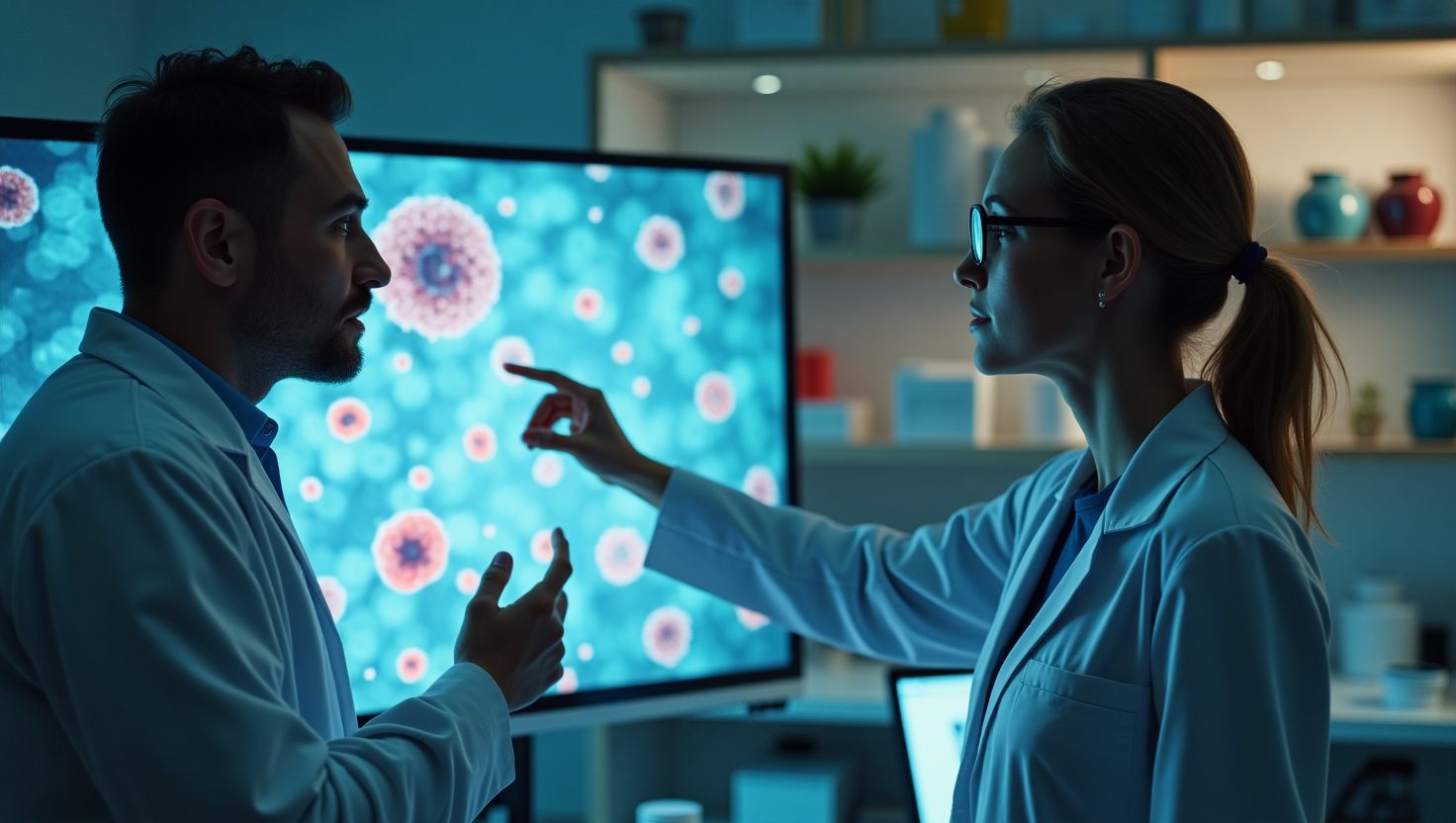
Right, let’s talk about blood. For decades, the process of diagnosing something as devastating as leukaemia has relied on the highly trained eye of a pathologist staring down a microscope. It’s a process that’s part science, part art—a subjective skill honed over years of practice. But what happens when that ‘art’ gets a jolt of pure, unadulterated computational power? We’re seeing a profound shift in medicine, and at its heart is AI hematology diagnostics. This isn’t just about making things faster; it’s about making them fundamentally better.
The story isn’t about replacing our brilliant pathologists. Honestly, that’s a tired and frankly daft narrative. The real story is about pathologist workflow augmentation. Think about the sheer volume of work. A single pathologist might review hundreds of blood smears, looking for a handful of abnormal cells among millions of healthy ones. It’s a monumental, often exhausting, game of ‘Where’s Wally?’.
This is where AI steps in, not as a replacement, but as the world’s most diligent, eagle-eyed assistant. It automates the gruelling, repetitive part of blood smear analysis. By scanning and flagging cells of interest, it frees up the human expert to focus on what they do best: complex interpretation, differential diagnosis, and patient care. It’s like giving a master chef a sous-chef who can perfectly chop every vegetable, every single time, allowing the chef to focus on creating the final masterpiece. The result? A reduction in diagnostic subjectivity and a huge boost to efficiency.
Precision Oncology’s New Best Friend
This evolution goes far beyond simply speeding up old processes. We are entering an era of genuine precision oncology integration. For years, a leukemia diagnosis was a broad label. Now, knowing the exact subtype of the disease is absolutely critical for choosing the right treatment. This is where AI truly begins to shine.
So, how does this digital magic actually work? The engine driving much of this is a technology called a Convolutional Neural Network (CNN). In simple terms, you can think of a CNN as a pattern-recognition savant. It’s trained on vast libraries of medical images—hundreds of thousands of them—learning to distinguish the subtle morphological differences between a healthy blood cell and a malignant blast cell with astonishing accuracy.
A recent analysis in the American Journal of Managed Care highlights just how powerful this approach can be. It points to studies where models using pre-trained networks, like AlexNet, achieved up to 100% correct classification in identifying leukemic cells. Other hybrid systems, which combine the pattern-spotting power of a CNN with other machine learning classifiers, have reached accuracy levels of over 97%. These aren’t just incremental improvements; they are transformative leaps in diagnostic capability.
The Pipeline: From A Glass Slide to a Clinical Insight
To understand its strategic value, you have to look at the entire pipeline. It’s a beautifully logical, multi-stage process that turns raw visual data into actionable medical intelligence.
– Image Acquisition: It all starts with a good picture. High-resolution digital scanners capture images of the blood smear. The quality here is non-negotiable—garbage in, garbage out. The consistency of staining techniques and imaging hardware is paramount, a point we’ll return to.
– Pre-processing and Segmentation: The AI then cleans up the image and isolates individual cells. It’s the digital equivalent of putting each cell under its own tiny microscope.
– Feature Extraction and Classification: Here’s where the CNN does its heavy lifting. It analyses the features of each cell—its size, shape, nuclear texture—and classifies it. Is it a lymphocyte? A neutrophil? Or, crucially, is it a myeloblast, a tell-tale sign of acute myeloid leukaemia?
The end result isn’t a simple ‘yes’ or ‘no’. The system can provide a probabilistic assessment, highlighting suspicious cells and even suggesting potential leukaemia subtypes. This information is then presented to the pathologist, who makes the final call. The AI provides the data; the human provides the wisdom.
Are We Swapping a Human Eye for a Black Box?
Now, here comes the healthy dose of skepticism. Whenever we talk about AI in a high-stakes field like medicine, the question of trust immediately surfaces. Are we asking doctors to blindly follow the recommendation of a mysterious algorithm? This is where the push for explainable AI in medicine becomes so vital.
A doctor, quite rightly, isn’t going to trust an AI that just spits out an answer. They need to know why the algorithm thinks a particular cell is malignant. The new frontier is developing AI systems that can “show their work,” highlighting the specific visual features that led to their conclusion. This transparency is the key to building trust and fostering true collaboration between clinician and machine.
The Gritty Reality: Hurdles on The Road to The Clinic
For all its incredible promise, the path to widespread adoption of AI hematology diagnostics is littered with very real challenges.
First, there’s the data problem. These models are data-hungry beasts. They need massive, diverse, and meticulously annotated datasets to learn effectively. A recent synthesis of literature cited by the American Journal of Managed Care makes it clear that these datasets are not evenly distributed. Most high-quality data comes from high-income regions. An AI trained exclusively on data from a London hospital may not perform as well when faced with samples from a patient in a different demographic, prepared with different techniques.
This leads directly to the issue of performance variability. As the article notes, results can differ significantly between institutions due to variations in staining protocols and imaging hardware. This isn’t a simple ‘plug-and-play’ technology. Standardisation will be a major hurdle.
Finally, and perhaps most importantly, there are profound ethical questions. Will this technology widen the existing chasm in healthcare access? Developing regions, which already face delayed diagnoses and higher mortality from leukaemia, may be the last to access these expensive systems. We must be vigilant to ensure that innovation doesn’t become another tool for reinforcing global health inequality.
The Next Act: Connecting Diagnosis to Treatment
So, what’s next? The ultimate goal is not just to build a better microscope. The true revolution lies in closing the loop between detection and therapy. As one expert put it, “the future of AI in leukaemia lies not in producing isolated classification accuracies but in providing clinically relevant decision support.”
Imagine a system that not only identifies a specific subtype of leukaemia with high confidence but also integrates that finding with the patient’s genomic data and the latest clinical trial results to recommend a personalised treatment plan. That is the holy grail of precision oncology integration. It moves AI from being a diagnostic tool to being a core component of the clinical decision-making engine.
The technology is nearly there. The accuracy is astounding, and the potential is undeniable. But the leap from a powerful algorithm to a trusted, equitable, and integrated clinical tool is not a technical one. It’s a human one. It will require intense collaboration, thoughtful regulation, and a relentless focus on bridging gaps, not creating new ones.
The question is no longer if AI will change haematology, but how we will guide that change. What are your thoughts on ensuring these powerful tools are used for the benefit of all patients, not just a select few?



