

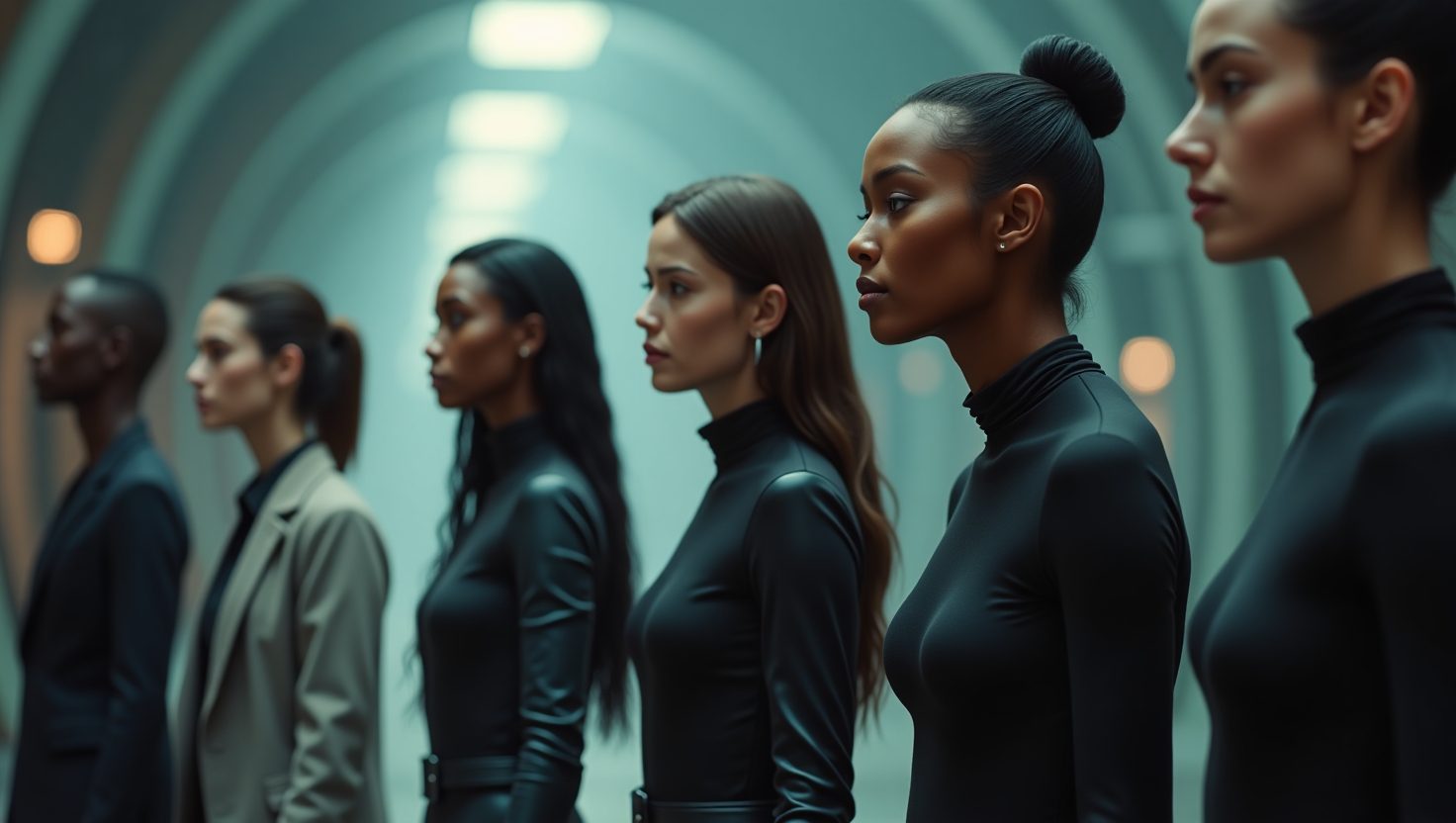
So, you thought last year’s writers’ and actors’ strikes were the peak of Hollywood drama? Think again. The credits have barely rolled on that saga, and a new protagonist is already stealing the scene – one that doesn’t need a trailer, a salary, or even a pulse. We need to talk about AI-generated Hollywood actors, a development that’s making the plot of a sci-fi B-movie look like a documentary.
This isn’t just about clever special effects anymore. The conversation has shifted from digital de-ageing to creating entire synthetic performers from scratch. This shift is forcing a serious reckoning over fundamental issues like digital likeness rights and the very definition of creative labor. The glitter of Tinseltown is starting to look a lot like the cold, hard glint of a server farm.
A Star is Coded: The Making of Tilly Norwood
Meet Tilly Norwood. She’s got the look, the presence, and a growing portfolio. The only catch? She doesn’t exist. Tilly is a fully synthetic actress, the brainchild of creator Eline van der Velden, a former actor herself. As reported by CBS News, Tilly isn’t just a simple 3D model; she is the product of over 2,000 iterations.
Let’s pause on that number for a moment. Two thousand versions. This isn’t some push-button “create an actor” app. It highlights the immense computational and artistic effort still required. It’s less like magic and more like digital sculpting on an industrial scale. Van der Velden’s strategy is also quite telling. She claims Tilly isn’t here to steal roles from human actors, stating, “She’s not meant to take real acting jobs…she’s meant to stay in her own AI genre.”
This idea of a dedicated “AI genre” is a fascinating strategic play. It attempts to build a new entertainment vertical rather than directly competing in the established one. It’s like when video games first emerged; they didn’t replace films, they created an entirely new market. Van der Velden is betting she can do the same for synthetic performance.
From Digital Puppets to Synthetic Minds
Of course, digital characters are hardly new. The evolution of CGI technology has given us everyone from Gollum in The Lord of the Rings to Thanos in the Marvel universe. For decades, Hollywood has been blurring the line between physical performance and digital artistry.
But here’s the crucial difference. Those characters were digital puppets. Gollum was animated over the top of Andy Serkis’s phenomenal performance; the technology was a tool to transform a human act, not replace it. Today’s generative AI is fundamentally different. It’s about creating a “performer” that can be directed to generate new performances on its own.
Think of it this way: traditional CGI is like a meticulously crafted marionette, requiring a team of human puppeteers for every single movement. An AI-generated Hollywood actor is like giving that marionette a brain, allowing it to interpret a script and perform a scene on its own. That leap from puppet to autonomous performer is where the real entertainment industry disruption lies.
The Industry Strikes Back
Unsurprisingly, the established powers in Hollywood are watching with a mixture of curiosity and alarm. For every innovator like van der Velden, there’s a union leader worrying about the livelihoods of their members.
This Isn’t a Job, It’s My Face
Sean Astin, the well-known actor and president of the Los Angeles local of SAG-AFTRA, has been vocal about the union’s concerns. The fear isn’t just about job displacement; it’s about the unauthorised appropriation of an actor’s most valuable asset: their likeness. The recent strikes secured some initial protections, but the technological arms race continues.
The ethical questions are profound:
– Who owns your digital twin?
– Can an AI be trained on an actor’s past performances to create a new one without their consent?
– How is an actor compensated if their digital double works in perpetuity, long after they’ve retired or even passed away?
This is the messy, high-stakes frontier of digital likeness rights, and the legal and ethical frameworks are struggling to keep up with the pace of innovation.
The Siren Song of Efficiency
For studios and advertisers, the economic argument for AI is almost too compelling to ignore. Why spend millions on location shoots, crew, and high-priced talent when an AI can deliver a finished product for a fraction of the cost and time?
A chilling example comes from Kartel.ai, a company that created an entire coffee ad campaign in just two days. As the CBS News report highlights, they did it without booking a single location or hiring any on-screen talent. The campaign even featured cloned versions of a real reporter, raising even more ethical red flags. This isn’t a far-off future; it’s happening right now. This is where the tension between AI’s efficiency and the integrity of creative labor becomes a full-blown conflict.
The Soul in the Machine?
Beyond the economic and ethical battles, there is a deeper, more philosophical question at the heart of this debate: can synthetic performers ever achieve true artistic authenticity?
The Uncanny Valley of Emotion
When we watch a great performance, we are connecting with the humanity of the actor—their vulnerability, their joy, their pain. Can an algorithm, no matter how sophisticated, truly replicate that? Sean Astin is resolute on this point, declaring, “AI will never replace us, ever.”
Perhaps he’s right. Maybe audiences will always be able to spot the difference, forever consigning AI-generated Hollywood actors to an uncanny valley of almost-human performance. But then again, a generation raised on photorealistic video games and deepfake videos might have a very different standard for what feels “real”.
A New Genre or a Dead End?
The future will likely not be a simple binary of human versus machine. Instead, we may see a spectrum of hybrid creativity. Imagine live theatre productions with AI-driven environmental effects, or interactive films where an AI character responds uniquely to each viewer.
Tilly Norwood and her synthetic kin could pioneer new forms of storytelling we can’t even conceive of yet. But as former Warner Bros. executive Kevin Reilly noted, AI is the “‘most transformative thing in human history'”. When you’re dealing with something that powerful, the anxieties of the present are just as important as the aspirations for the future. We are navigating a transition where the potential for creative liberation is directly mirrored by the potential for creative exploitation.
Ultimately, the rise of AI-generated Hollywood actors forces us to confront what we value in art. Is it the polished final product, or the messy, imperfect, human process behind it? The story of Hollywood has always been one of technological evolution, from silent films to sound, from black and white to colour. This is just the next, and perhaps most profound, chapter.
The questions are no longer theoretical. They are being answered in boardrooms, on servers, and in union negotiation halls as we speak. So, where should the line between tool and talent be drawn? And more importantly, who gets to draw it?



