

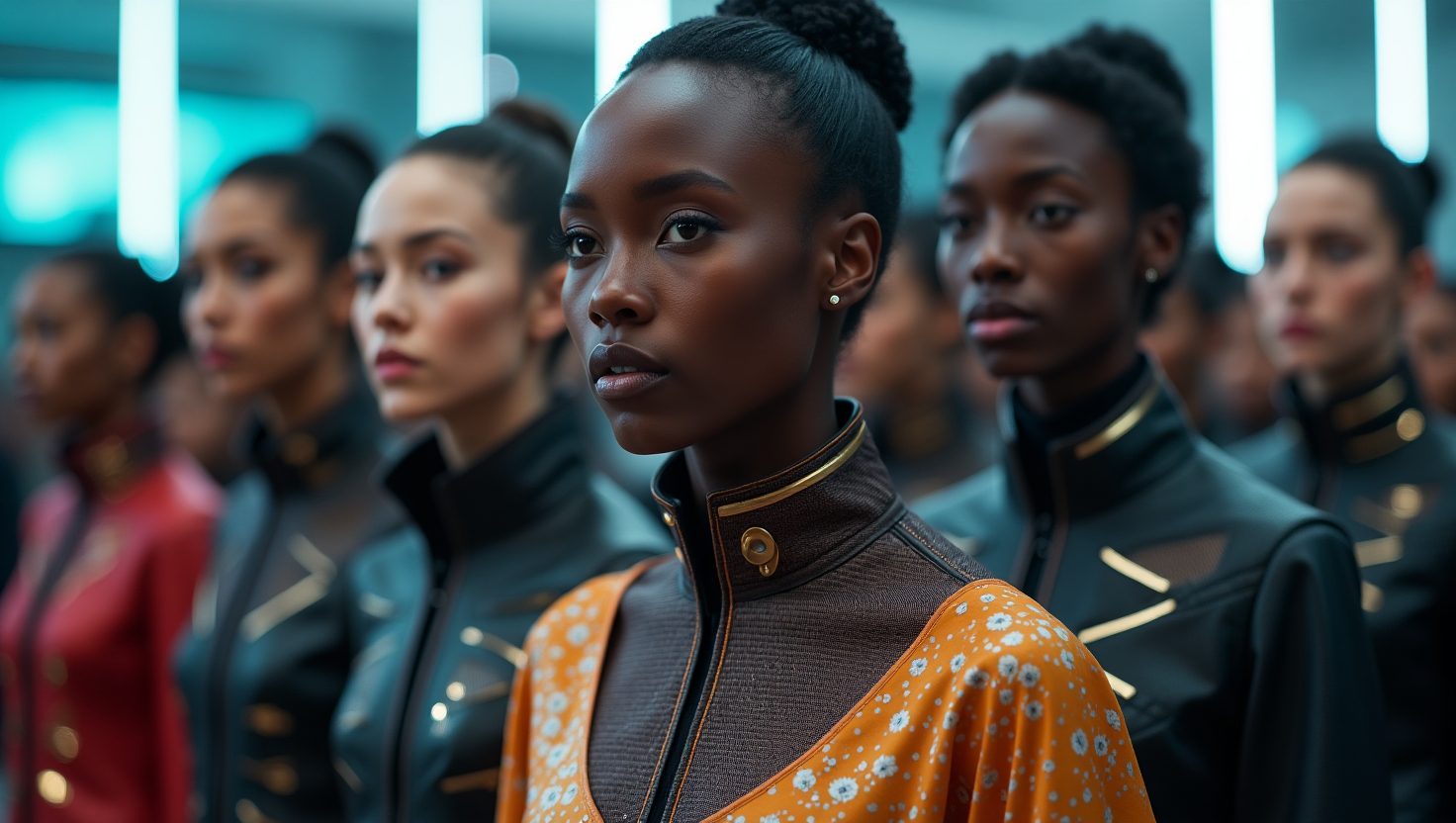
The worlds of high fashion and high tech have often eyed each other with suspicion. Fashion prides itself on human touch, intuition, and a certain je ne sais quoi that can’t be coded. Tech, on the other hand, runs on logic, data, and efficiency. For years, they’ve been like two acquaintances at a party, standing on opposite sides of the room. But what if they started talking? What if they actually collaborated? Well, that’s precisely what’s happening, and the result is a fascinating new world of AI fashion design.
This isn’t about a robot sketching a dress. It’s far more nuanced and, frankly, more interesting. We’re witnessing the rise of computational creativity as a powerful new tool in a designer’s arsenal, leading to a new wave of tech-enhanced couture that’s changing everything from the initial sketch to the final runway show.
The AI Co-pilot in the Design Studio
So, what exactly is AI fashion design? Think of it less as an automated designer and more as an exceptionally brilliant co-pilot. It’s a system trained on vast archives of imagery, patterns, textiles, and trends. A human designer can then use this system as a creative sparring partner. Stuck for a sleeve design? The AI can generate a hundred variations in seconds, based on anything from 18th-century French court attire to the architecture of Zaha Hadid.
This process is the essence of computational creativity. It’s not about replacing the spark of human genius but about feeding it with an almost infinite amount of stimuli. It’s like giving a painter a new set of colours that they never knew existed. The painter still has to decide what to paint and how to compose the piece, but their creative palette has just expanded exponentially.
Giving Creativity a Nudge
The real magic happens when designers use these tools to break out of their creative ruts. AI can spot connections and patterns that a human might miss, blending aesthetics in unexpected ways. Imagine an AI suggesting a fabric pattern inspired by the microscopic structure of a butterfly’s wing, or a silhouette derived from sound waves. It pushes the boundaries of what’s considered possible and serves as an endless well of inspiration.
Tech-Enhanced Couture: More Than Just Gadgets
When people hear about technology in fashion, they might picture clunky, light-up garments better suited for a sci-fi convention than a catwalk. But tech-enhanced couture is an entirely different beast. It’s the subtle integration of technology to augment the artistry and experience of high fashion. This isn’t just about the final product; it’s about the process and the presentation.
The fusion of tech and fashion is creating a new language for designers. It allows them to tell deeper stories and engage with their audience in ways that were unimaginable a decade ago. It’s here that we see true fashion show innovation.
A New York Fashion Week Revolution
Look no further than designer Kate Barton’s recent collaboration with Fiducia AI and IBM for her New York Fashion Week presentation. As reported by TechCrunch, instead of a traditional runway, Barton created an interactive experience powered by a multilingual AI agent built on IBM’s watsonx. Guests could use this AI to get information about the pieces and, most impressively, virtually try on the collection.
This is a game-changer. It democratises the exclusive front-row experience. As Barton puts it, “Today, tech is a tool for expanding the world around the clothes, how they are presented, and how people enter the story.” The AI didn’t design the clothes; it built a bridge between the designer’s vision and the audience. It made the story accessible.
The Promise of Generative Design Clothing
This leads us to one of the most exciting frontiers: generative design clothing. This is where a designer sets the parameters—the desired fit, material properties, aesthetic constraints—and the AI generates design solutions that meet those criteria. The most fascinating part? It often produces results the designer would have never conceived of on their own.
– Unmatched Customisation: Generative design could finally deliver on the promise of truly bespoke clothing at scale. Imagine an item of clothing that is generated to fit your exact measurements and style preferences.
– A Leap in Sustainability: The process can optimise for minimal material waste, generating cutting patterns that use fabric far more efficiently than a human could. This addresses one of fashion’s biggest environmental headaches.
Where Wearable Tech Becomes Art
As this technology matures, the line between clothing and device will continue to blur, giving rise to wearable technology art. This isn’t just about function; it’s about expression. The garment itself becomes an interactive medium, capable of changing colour, pattern, or even shape in response to its environment or the wearer’s biometric data. Generative design clothing is the key to unlocking this, creating forms that are both beautiful and technologically integrated from their very inception.
The Quiet AI Adoption
Despite these incredible innovations, why aren’t more fashion houses shouting about their use of AI from the rooftops? According to Fiducia AI’s CEO, Ganesh Harinath, many brands are using AI behind the scenes for logistics and trend forecasting but are hesitant to do so publicly due to “reputational risks.” The fear is that customers will perceive AI-touched products as soulless or that it will fuel anxieties about job replacement.
Harinath astutely observed that the biggest challenge in the Kate Barton project wasn’t the AI model itself but the “orchestration”—making different technological systems work together seamlessly to create a fluid human experience. This is the crucial, and often overlooked, part of implementation.
Keeping the Human in the Loop
This brings us to the central debate: will AI replace human designers? Kate Barton’s answer is a firm “no.” “If the technology is used to erase people, I am not into it,” she stated in the TechCrunch piece. This sentiment is crucial. The goal isn’t automation for automation’s sake. It’s about augmentation.
As Barton eloquently concludes, “The most exciting future for fashion is not automated fashion. It is fashion that uses new tools to heighten craft, deepen storytelling, and bring more people into the experience.” The human element—the taste, the narrative, the cultural context—remains irreplaceable. The AI is a powerful instrument, but the designer is, and must remain, the conductor.
The Road Ahead to 2030
So, what’s next? Harinath offers a compelling timeline. He predicts that the use of AI in fashion will be normalised by 2028, and by 2030, it will be deeply embedded into the operational core of the retail industry. This suggests a future where AI isn’t just a flashy feature at a fashion show but a fundamental part of how clothes are designed, manufactured, and sold.
We’re talking about supply chains that anticipate demand with uncanny accuracy, personalised marketing that feels genuinely helpful rather than intrusive, and design processes that are faster, more sustainable, and more creative than ever before.
Ultimately, the integration of AI into fashion is not a threat but an evolution. It’s forcing the industry to ask profound questions about creativity, craftsmanship, and the very nature of a garment. The brands that succeed will be those that, like Kate Barton, see technology not as a replacement for humanity, but as a powerful new way to amplify it.
What do you think? Is an AI-assisted design more or less creative than one made by a human alone? The floor is yours.



