

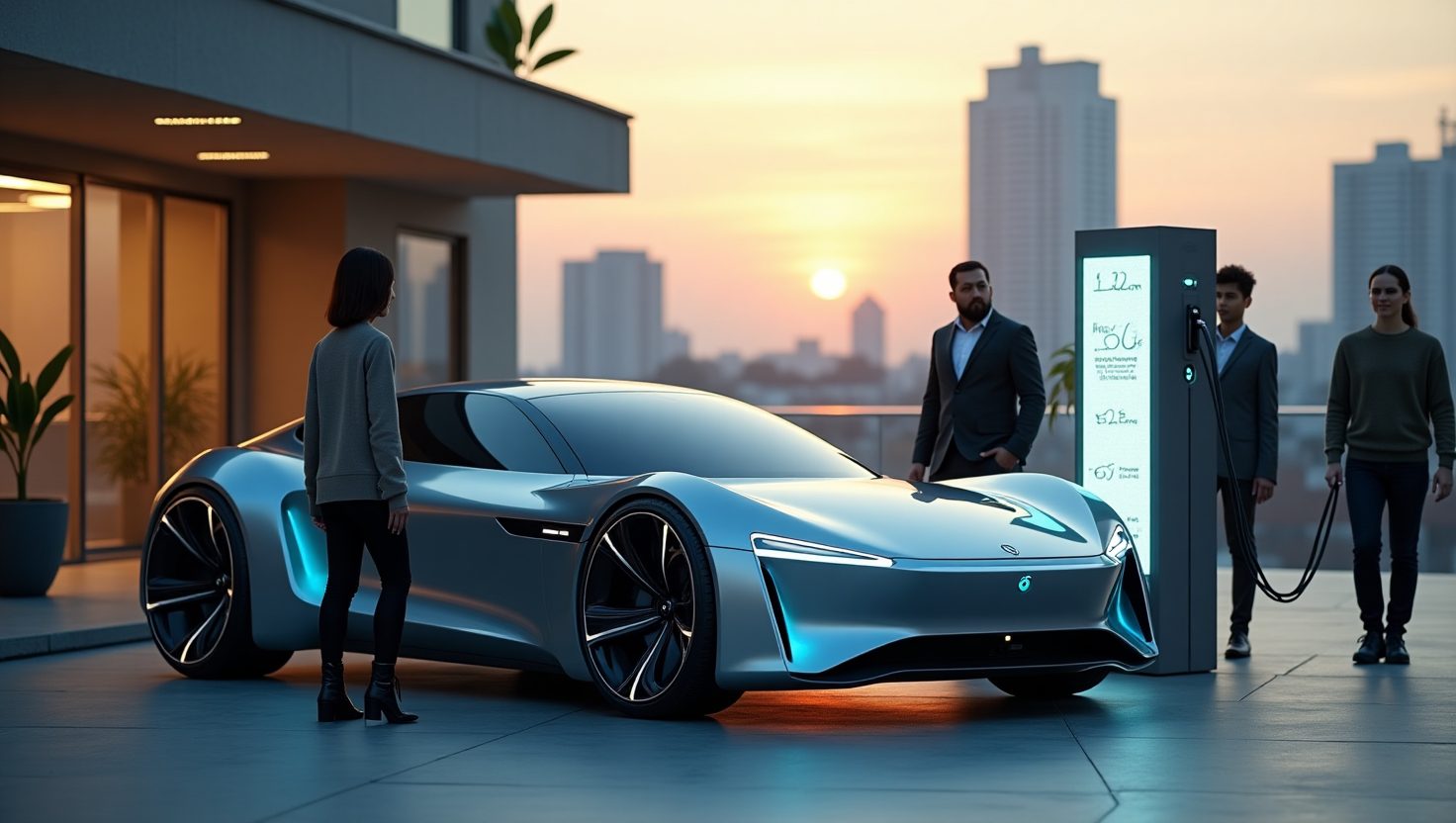
The Silent Conductor: AI’s Role in Battery Management
Imagine an orchestra without a conductor—musicians playing out of sync, melodies collapsing into chaos. Traditional battery systems in EVs aren’t much different. Cells degrade unevenly, charging cycles strain components, and drivers play guessing games with longevity. Enter AI. By analysing battery management systems in real time—tracking temperature, voltage, and even driving habits—AI acts as that conductor, harmonising performance.
Take Nvidia’s collaborations with BYD and Xiaomi EV. Their DRIVE Orin processors don’t just crunch data; they anticipate stress points in lithium-ion cells, adjusting energy distribution to squeeze out extra miles and extend battery life. The result? A 15-20% reduction in degradation rates, according to industry trials. For drivers, this means fewer “range anxiety” nightmares and more confidence in their EV’s lifespan. It’s like having a personal mechanic embedded in your car’s DNA—one that never sleeps.
Smart Charging: When Your Car Outthinks the Grid
Here’s a dirty secret: today’s charging networks are about as smart as a toaster. Plug in during peak hours, and you’re either waiting hours for a spot or stressing local power grids. But smart charging networks, turbocharged by AI, are flipping the script. These systems don’t just react—they predict.
Using weather patterns, historical usage data, and even electricity pricing trends, AI schedules charging sessions for optimal efficiency. In California, platforms like Electrify America’s AI-backed network have slashed average charging times by 30% during peak demand. For energy providers, this isn’t just convenient—it’s existential. With global EV adoption projected to triple grid load in urban areas by 2030, AI’s ability to balance supply and demand could prevent infrastructure meltdowns.
And let’s talk scalability. Legacy systems crumble under mass adoption; AI-driven networks thrive on it. Think of it as the difference between a single-lane road and a self-organising highway: one jams up, the other adapts.
Your Car as a Power Plant: The V2G Revolution
Now for the plot twist: vehicle-to-grid (V2G) AI turns your EV into a two-way energy pipeline. When the grid’s overloaded, your car feeds power back. When demand drops, it recharges. This isn’t sci-fi—it’s already rolling out in pilot projects from Oslo to Osaka.
Nvidia’s partnership with Rivian highlights the stakes. Their bidirectional charging systems, powered by neural networks, manage energy flow with surgical precision. During Texas’ 2026 heatwave crisis, a fleet of Rivian trucks supplied emergency power to 12,000 homes. The AI didn’t just coordinate charging; it prioritised hospitals, then homes, then businesses—all while ensuring drivers had enough juice for their morning commutes. The takeaway? EVs are morphing from energy consumers into dynamic grid stakeholders.
Beyond Guesswork: How AI Masters Range Prediction
“Will I make it?” That sweating moment when your EV’s range estimate plummets isn’t just annoying—it’s a barrier to mass adoption. Traditional algorithms rely on static metrics: battery level, speed, terrain. Range prediction algorithms infused with AI add layers: live traffic, driving style, even the weight of your luggage.
Mercedes’ collaboration with Google Cloud uses machine learning to refine range estimates by up to 40%. The system cross-references millions of data points—from road gradients in Barcelona to Berlin’s stop-and-go traffic—adjusting predictions in real time. For the driver, it’s like swapping a paper map for a live GPS that learns.
The Nvidia Playbook: Profits, Partnerships, and Processor Power
No discussion of AI electric vehicles is complete without unpacking Nvidia’s chess moves. The chipmaker’s automotive revenue surged 69% year-over-year to £456 million (around $586 million) in Q2 2025, fueled by deals with BYD, GM, and Xiaomi EV. Their DRIVE platform isn’t just hardware; it’s a full-stack ecosystem for autonomy.
BYD’s Seagull hatchback, for instance, uses Nvidia’s tech to run advanced driver-assistance systems (ADAS) priced under £18,000—a milestone for affordability. But the real jab? Nvidia CEO Jensen Huang’s bet on a £768 billion ($1 trillion) self-driving market by 2030. With over 20 automakers now embedded in their ecosystem, they’re not selling chips—they’re building the language of future mobility.
What’s Next? The Road to a $2.6 Trillion Junction
The numbers don’t lie: the global autonomous vehicle platform market is set to balloon to £2 trillion ($2.6 trillion) by 2030. But success hinges on two hurdles: trust and infrastructure.
Trust: Will drivers embrace AI’s decisions during split-second emergencies? Tesla’s “shadow mode”—where AI silently learns from human drivers—offers a bridge, but regulatory frameworks lag behind tech.
Infrastructure: Smart charging and V2G require a grid overhaul. The UK’s £1.2 billion pledge for AI-integrated charging hubs signals progress, but scalability remains fragmented.
Yet the trajectory is clear. As Ali Kani, Nvidia’s VP of automotive, bluntly put it: “The car is now a data centre on wheels.” And in this new paradigm, the winners won’t just make vehicles—they’ll orchestrate ecosystems.
Final Thoughts
The marriage of AI and electric vehicles isn’t a incremental upgrade—it’s a renaissance. We’re witnessing the birth of cars that think, adapt, and even power our homes. But as applaud-worthy as this tech is, it raises thorny questions: Who controls the data these vehicles generate? How do we prevent AI-driven energy markets from exacerbating inequality?
One thing’s certain: the companies solving these puzzles—Nvidia, Tesla, Rivian—aren’t just shaping the automotive sector. They’re redefining how humanity moves, consumes energy, and interacts with machines. And if that doesn’t make you rethink your next car purchase, I’ll eat my wireless charging pad.
For deeper insights into Nvidia’s automotive strategy, check out this analysis from The Motley Fool.
So, what’s your take—will AI’s role in EVs accelerate adoption, or will growing pains stall the revolution?



