

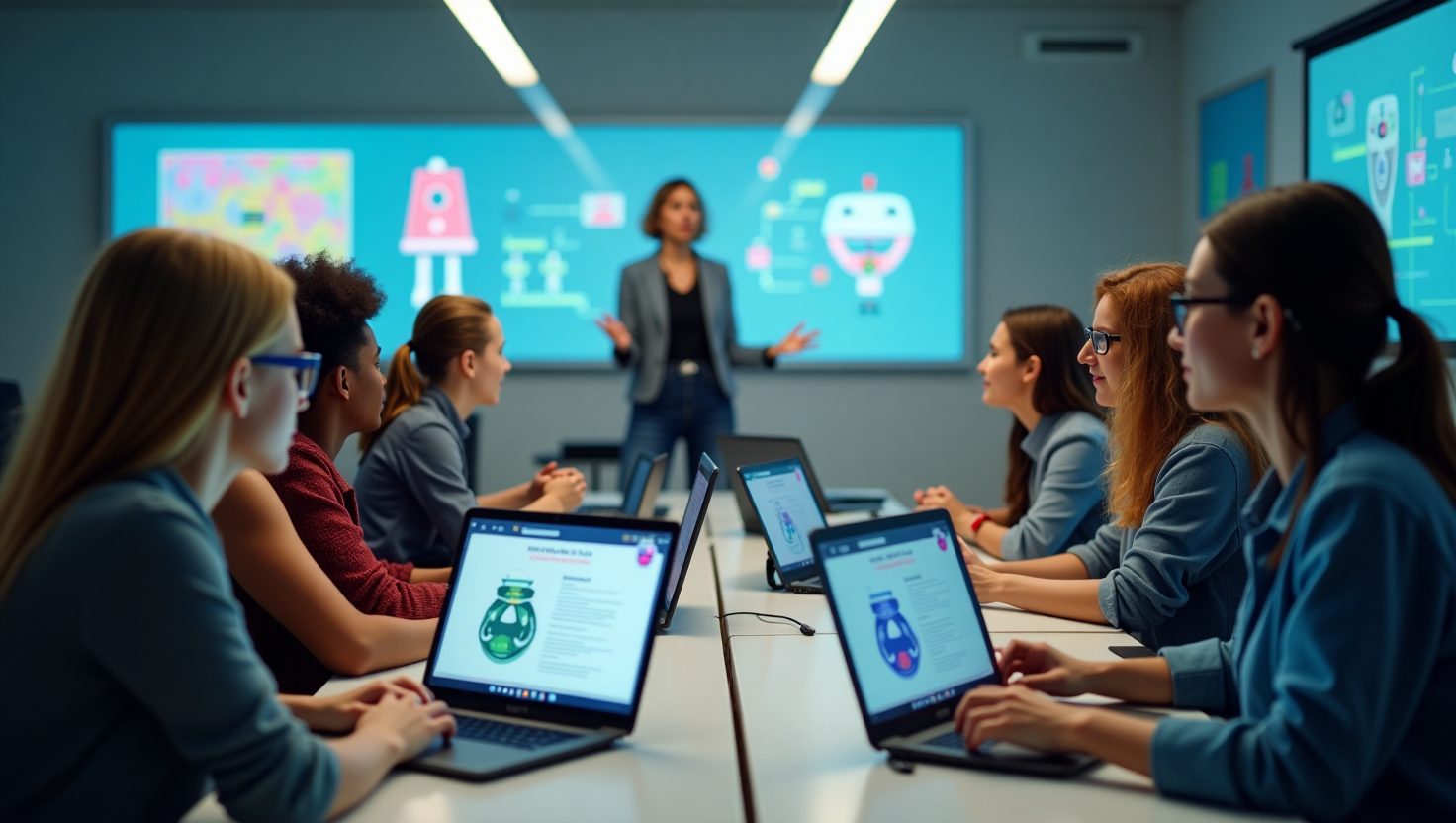
At the heart of this commotion is the creation of a coherent AI education policy. This isn’t just another bit of administrative paperwork; it’s the new rulebook for a game whose very foundations have been shaken. And right now, there’s no better place to watch this play out than at Yale University, where the economics department has decided to stop fighting the tide and instead learn how to surf it. It’s a move that is less about surrendering to technology and more about a calculated, strategic pivot that other institutions would be wise to study.
The Inevitable Collision: AI Meets the Classroom
Let’s be blunt. The old way of teaching, especially in introductory courses, often resembled a game of memory and regurgitation. You memorise the formula, you apply it to the problem set, you repeat it on the exam. Did you actually understand the underlying economic theory? Maybe. Maybe not. The grade often depended more on getting the right answer than on the intellectual struggle to get there. This model was already creaking under its own weight, but problem-solving AI has smashed it to pieces.
Why would a student spend three hours wrestling with a supply and demand curve when a machine can spit out a perfect answer in thirty seconds? This is the question that keeps professors up at night. The knee-jerk reaction from many corners of academia has been prohibition. Lock down the networks, use AI detection software, threaten expulsion. But this is a losing battle. It’s like trying to ban the calculator in a maths class in the 1980s. You can try, but you’ll only succeed in creating a black market and punishing the honest whilst the resourceful find a way.
The real challenge isn’t stopping the use of AI; it’s redesigning education so that using AI to simply get the answer becomes pointless. This requires fundamental pedagogical shifts—a fancy term for changing how we actually teach. It means moving the goalposts from “What is the answer?” to “Is the AI’s answer correct? Why or why not? What are its limitations? How can we improve upon it?”. This shift transforms students from passive receivers of information into active critics and editors, a skill that is, frankly, far more valuable in the modern world than memorising formulas.
Yale’s Big Experiment: Can You Grade Effort, Not Answers?
This brings us to the Yale curriculum for introductory economics, which has become a fascinating real-world laboratory for this new educational model. As reported by the Yale Daily News, professors in the foundational ECON 115 (Microeconomics) and ECON 116 (Macroeconomics) courses are now explicitly permitting students to use AI for their problem sets. This isn’t some reluctant concession; it’s a core part of their strategy. Macroeconomics professor Michael Peters stated it plainly: “We explicitly embrace the use of AI.”
So, what’s the catch? There are two, and they are brilliant.
First, the problem sets, once a hefty part of a student’s final grade, are now graded purely on completion. You did it? Full marks. You didn’t? Zero. This instantly removes the incentive to use AI simply to cheat for a better grade. The points are for showing up and engaging, not for acing the questions. The pressure to get the “correct” answer is gone, replaced by the space to learn, experiment, and, yes, even fail without penalty.
Second, the professors aren’t naive. They know AI is a double-edged sword. The syllabus for Microeconomics, taught by Cormac O’Dea, comes with a stark warning: ‘You won’t have AI in the exam room.’ This is the crucial backstop. It’s a direct message to the 528 students in Microeconomics and the 81 in Macroeconomics: use the AI as a sparring partner, a co-pilot, or a tutor, but don’t you dare use it as a crutch. If you rely on it to do all your thinking, you will be exposed when it matters most—during the invigilated exams that still determine your fate.
Think of it like this: A professional chef might use a food processor to chop vegetables. It’s efficient and frees them up to focus on the more complex parts of cooking, like balancing flavours or perfecting the sauce. The processor is a tool, not a replacement for their skill. However, if a culinary student only knows how to use a food processor and has never learned basic knife skills, they aren’t a chef. They’re just someone who can press a button. Yale’s professors are telling their students: Learn to cook. We’ll let you use the food processor for the boring prep work, but when we test you, we expect you to know how to handle a knife.
Walking the Tightrope of Academic Integrity
Of course, this is where the sceptics—and I count myself among them—raise a very important question. Is this approach truly fostering learning, or is it just creating a generation of students who are experts at prompt engineering but novices at economic reasoning? The risk is real. The policy hinges on students being mature enough to use the tool responsibly.
The first major challenge is academic integrity. Even with completion-based grading, what stops a student from simply copy-pasting the problem into ChatGPT, pasting the answer back into their homework, and calling it a day? They’d get full marks for “completion” without having engaged their brain for a single second. This is where the professors’ guidance becomes critical. They’re not just permitting AI; they are attempting to teach a methodology for using it. The idea is to use it to check your work, explain a concept you’re stuck on, or generate practice questions. The tool’s value is in the dialogue, not the monologue.
The second, and perhaps more insidious, risk comes from the AI itself. The Macroeconomics syllabus explicitly warns students that AI can “hallucinate and provide inaccurate answers.” We’ve all seen it: a chatbot confidently delivering a completely fabricated fact, complete with fake citations. If students blindly trust these outputs, they aren’t just failing to learn; they are actively learning things that are wrong. This is why the development of independent reasoning is so crucial. The new core skill isn’t finding the answer; it’s verifying the answer.
This forces a major shift in what we value. The old system valued the student who could reproduce the textbook’s conclusion. The new system must value the student who can look at an AI-generated conclusion and say, “Hold on, that doesn’t make sense because it ignores the principle of diminishing marginal utility.” That is a far deeper and more useful form of knowledge.
Rewriting the Blueprint for Higher Education
What’s happening in Yale’s economics department isn’t just an isolated experiment. It’s a preview of the difficult conversations that every single department in every university will need to have. The response from the Yale economics department’s leadership, as noted in the Yale Daily News, has been to allow individual instructors like Giovanni Maggi and Ray Fair to set their own AI education policy. This flexibility is key. What works for an introductory course with 500 students may not work for a graduate seminar with ten. A one-size-fits-all ban is as useless as a one-size-fits-all mandate.
The implications for curriculum design are enormous. We are likely to see a two-pronged evolution:
* Problem sets and homework will increasingly become low-stakes, AI-permissive environments designed for practice and exploration. The focus will shift to process over product.
* Assessments will bifurcate. There will be a greater emphasis on in-person, closed-book exams that test core knowledge, alongside more project-based assessments that require students to use AI but then defend, critique, and expand upon its output in presentations or written analyses.
The enrollment figures at Yale—528 in Micro, 81 in Macro—show just how many students are immediately affected by these pedagogical shifts. This isn’t a niche issue. It’s a mainstream reality. The institutions that adapt will thrive. They will attract students who want to learn skills relevant to a world where AI is ubiquitous. Those that cling to the old ways, fighting a rearguard action against technology, will find their classrooms feeling increasingly empty and their curriculum increasingly irrelevant.
So, is Yale’s approach the perfect solution? Probably not. It’s a bold first draft, an iteration in a process of discovery. There will be students who game the system. There will be moments where it fails. But the alternative—pretending ChatGPT doesn’t exist—is a guaranteed path to obsolescence. Yale has correctly identified that the role of an educator is no longer to be the sole source of information, but to be the expert guide who teaches students how to navigate a world of infinite information.
The real question is not if other universities will follow, but when. And for the students, the challenge is clear: are you going to let these powerful tools think for you, or are you going to use them to learn how to think better? The answer to that question will define the next generation of leaders, thinkers, and innovators.
What do you think? Is this the right way to integrate AI into education, or is it a slippery slope towards devaluing true expertise?



