

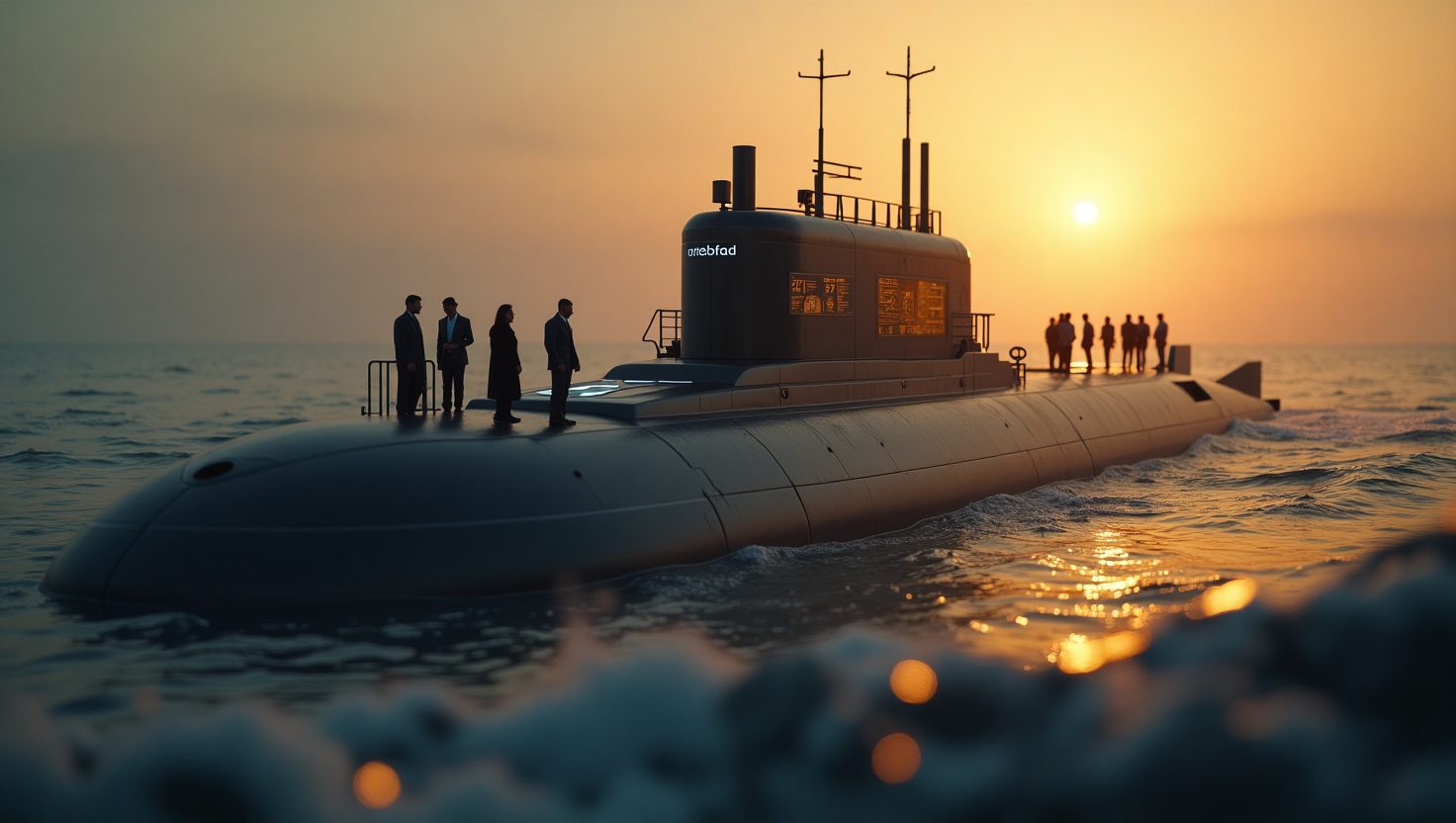
Forget the clichéd image of smugglers in go-fast boats. The new face of narco-capitalism looks less like a character from Miami Vice and more like a robotics engineer from Silicon Valley. While the tech world has been busy debating chatbot ethics, a far more tangible and troubling application of AI has been quietly taking to the high seas. The game has well and truly changed.
Last April, off the coast of Colombia, authorities intercepted something they’d never seen before. It wasn’t just another of the semi-submersible “narco subs” they’ve been finding for decades. This one was different. It was empty. No crew, no drugs, just a 40-foot fibreglass shell packed with off-the-shelf tech: a satellite antenna for Elon Musk’s Starlink, a collection of remote cameras, and a commercially available autopilot system. This was a ghost ship, a prototype for the next generation of AI drug trafficking.
The Dawn of the Drone Submarine
Let’s be clear about what we’re talking about. AI drug trafficking isn’t about some sentient computer deciding where to ship cocaine. It’s the application of automation and remote-piloting technology to create crewless smuggling vessels. Think of it like this: for years, companies like Amazon have dreamt of a fleet of autonomous drones delivering packages to your doorstep. The cartels just built the illicit, naval version first.
The vessel discovered by Colombian authorities, believed to be the work of the infamous Clan del Golfo, represents a quantum leap. Crewed narco subs are risky. They require skilled operators willing to spend weeks in a cramped, fume-filled coffin, and if caught, the human cost is high. This new breed of vessel eliminates that problem entirely.
As outlined in a recent MIT Technology Review investigation, these autonomous subs change the entire risk calculus. Suddenly, as naval analyst Henry Shuldiner points out, “If you don’t have a person on board, transoceanic routes become feasible.” The journey from Colombia to Spain or West Africa becomes a simple logistics problem, not a life-or-death gamble for a crew.
Off-the-Shelf Mayhem
What’s truly striking is how accessible this technology is. The cartels aren’t developing their own proprietary AI. They’re simply shopping.
– Connectivity: Starlink smuggling provides a robust, high-speed connection almost anywhere on the planet, allowing for real-time monitoring and control.
– Navigation: The autopilot processor found on the Colombian sub, the NAC-3, costs around £1,800. It’s “plug-and-play” technology.
– Vision: A network of simple remote cameras gives a pilot, sitting comfortably thousands of miles away, a complete view of the vessel’s surroundings.
As researcher Wilmar Martínez noted in the same aformentioned report, “Midcareer students could install them.” This isn’t the work of a state-level actor; it’s the result of clever engineering by a well-funded criminal enterprise. This is the dark side of tech democratization.
The Sobering Economics of Autonomous Smuggling
Why go to all this trouble? The answer, as always, is money. The economics of autonomous smuggling are brutally effective.
Building a typical semi-submersible costs between $1 million and $2 million. That sounds like a lot, until you consider the cargo. A single submarine can carry around three tonnes of cocaine, which has a street value north of $160 million in Europe. That is an astronomical return on investment.
By removing the crew, cartels remove the single biggest operational risk. If a vessel is about to be intercepted, the remote pilot can simply scuttle it. The hardware is lost, which is a manageable business expense, but the personnel and the precious cargo are safe from the authorities. You can’t interrogate a circuit board. This makes maritime robotics not just a tool, but a core part of the business model.
The High-Tech Game of Cat and Mouse
So, what are authorities doing to fight back? This is where the story enters the murky world of electronic warfare and counter-narcotics tech.
The obvious answer is to jam the satellite signals these subs rely on. But that’s easier said than done. It requires sophisticated hardware, and there’s always the risk of collateral damage to legitimate communications. Another strategy involves deploying a new generation of surveillance tools, from drone swarms that can patrol vast areas of the ocean to partnerships with satellite monitoring companies. It’s becoming a robot-on-robot conflict, fought in secret over the open seas.
But law enforcement faces an uphill battle. As analyst Juan Pablo Serrano bluntly puts it, “A ship can carry 5,000 containers. Good luck finding the right one.” The ocean is vast, and these low-profile, semi-submersible drones are incredibly difficult to spot. While seizures of traditional narco subs have tripled in the last 20 years, this new autonomous threat requires a complete rethink of interdiction strategy.
The unavoidable truth is that criminal organisations are often more agile than bureaucratic government agencies. They don’t have to worry about procurement rules or international law. They innovate at the speed of the market.
This evolution in AI drug trafficking is more than just a new smuggling technique; it’s a strategic shift. We are witnessing criminal enterprises adopt the mindset and methods of tech start-ups, using readily available technology to create a more efficient, scalable, and resilient business model.
The question we must now ask is a deeply uncomfortable one. As the line between consumer technology and a tool for global criminal enterprise continues to blur, how can our institutions possibly hope to keep up? When a drug lord’s logistics network starts to look more sophisticated than that of many legitimate companies, what happens next?



