

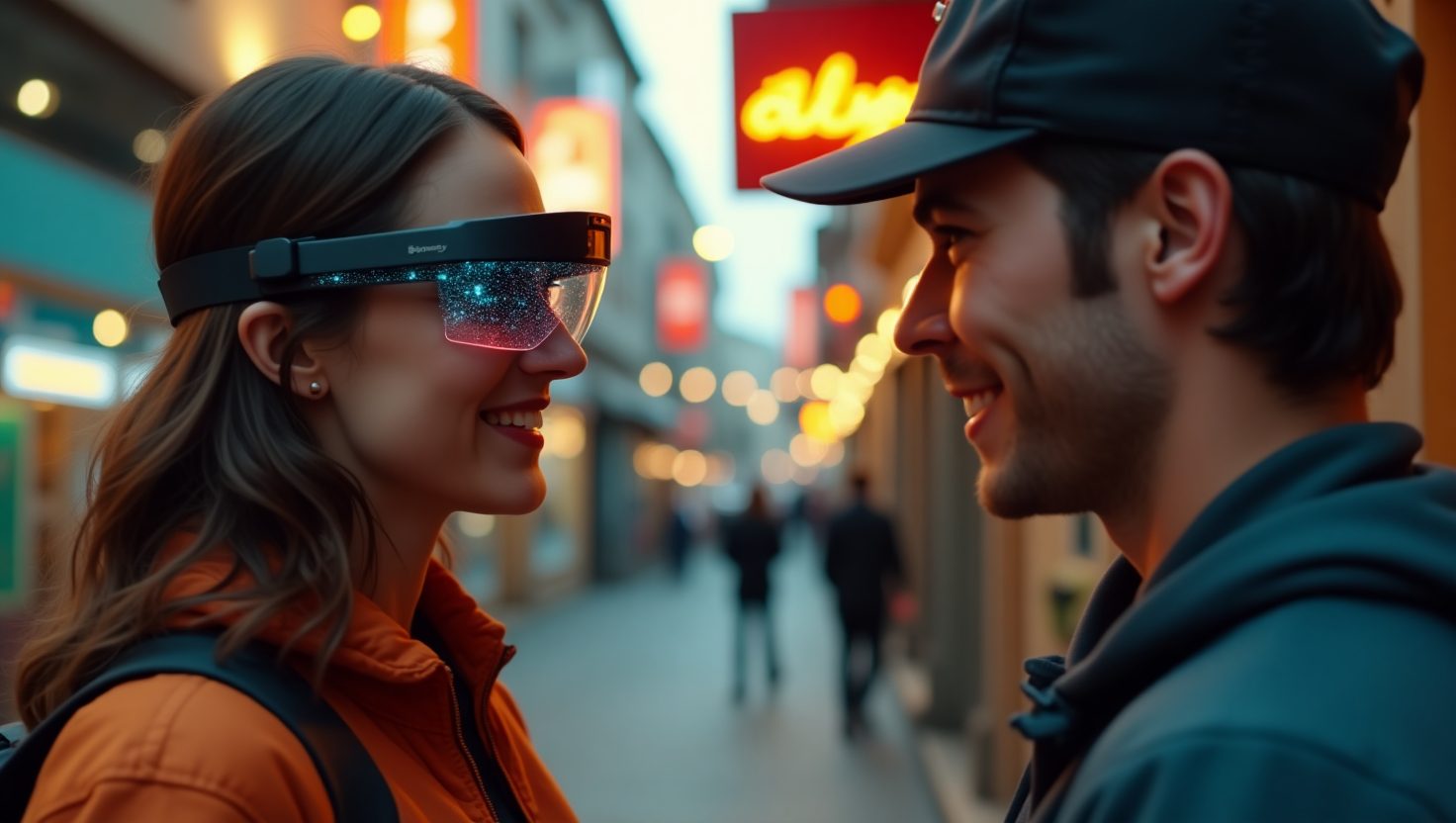
So, Why Are We Putting Computers on Delivery Drivers’ Faces?
Let’s be clear, the logistics industry has been quietly undergoing an AI revolution for years. It’s the silent, algorithmic brain that decides the most efficient route for a fleet of lorries, predicts demand to manage stock levels, and powers the robots whizzing around cavernous fulfilment centres. The goal has always been the same: shave off seconds, reduce errors, and squeeze every last drop of efficiency out of the system. In this industry, seconds are pounds, and mistakes are costly.
The “last mile”—that final, chaotic journey from the local depot to your front door—has always been the trickiest, most expensive part of the equation. It’s stubbornly resisted full automation. Why? Because it’s messy. It involves navigating unpredictable traffic, finding obscure house numbers, and dealing with, well, humans. This is where Amazon’s new strategy comes into play. Instead of trying to replace the human (for now), they are augmenting them. Bolting a computer vision system onto a person is the next logical step toward perfecting smart logistics 2025.
More Than Just a Pair of Specs
So, what exactly is this AI delivery eyewear? Forget Google Glass and its ill-fated foray into consumer tech. This is a purpose-built tool for a very specific job. Imagine a lightweight pair of glasses that projects a digital overlay onto the driver’s real-world view. Think of it like the head-up display in a modern fighter jet or a high-end car, but for navigating cul-de-sacs and finding parcel number 37B.
The technology behind it is a potent mix of several key ingredients:
Computer Vision: A tiny camera on the frame constantly analyses what the driver sees, identifying obstacles, reading text, and recognising objects.
Augmented Reality (AR): This is what projects the information—like navigation arrows or package details—into the driver’s line of sight, making it appear as if it’s floating in the real world.
AI and Machine Learning: The software that makes sense of it all, learning from past deliveries to improve route suggestions and hazard warnings.
It’s a wearable command centre, designed to get the right box to the right door faster and safer than ever before. But does it actually work?
The Superpowers it Grants a Delivery Driver
Amazon’s official news release on the glasses highlights several key features, each designed to tackle a specific pain point in a driver’s day. It’s not about bells and whistles; it’s about ruthless optimisation.
Hands-Free Navigation
Any delivery driver will tell you their most-used tool, after the van itself, is their smartphone. It’s their map, their scanner, and their communication device. It’s also a massive distraction. Constantly looking down at a phone while walking up a garden path, trying to find a house, is a recipe for a twisted ankle, or worse. These glasses aim to kill that problem dead.
By using AR navigation systems, directions appear directly in the driver’s field of view. An arrow might hover over the correct driveway, or the correct front door might be highlighted with a subtle glow. This hands-free approach means drivers can keep their eyes up and on their surroundings, and their hands free for what they’re paid to do: carry parcels.
Seeing Danger Before it Happens
The onboard computer vision system isn’t just for finding your door. It’s also a second pair of eyes looking out for the driver’s safety. The system is being trained to identify and flag potential hazards in real time. We’re talking about things like:
– Uneven pavement or potholes
– Trip hazards like garden hoses or children’s toys
– Poorly lit areas at night
The idea is to provide a subtle alert, a gentle nudge to the driver’s awareness, preventing accidents before they happen. Kaleb M., a Delivery Associate (DA) from Maddox Logistics Corporation who tested the device, was quoted saying, “I felt safer the whole time because the glasses have the info right in my field of view.” That’s a powerful endorsement, but it also hints at the high-pressure environment these drivers operate in daily.
The Magic of Instant Scanning
Here’s where the system connects back to the mothership. The efficiency gains from this technology are most obvious when you consider its integration with warehouse automation. Each parcel has a unique barcode, and finding and scanning the right one at the doorstep can be a fiddly process.
With the AI delivery eyewear, the driver simply looks at a pile of parcels in their van. The glasses can identify the correct package for the current stop and confirm it’s been selected, all without the driver needing to pick up a separate handheld scanner. This seamless flow of information—from the automated picking systems in the warehouse, to the driver’s field of view, and back to Amazon’s central servers upon delivery—is the holy grail of logistics. It closes the data loop entirely.
Amazon’s Playbook: Invest, Iterate, Dominate
This initiative isn’t some weekend skunkworks project. It’s part of a monolithic strategic investment. Amazon has poured a staggering $16.7 billion into its Delivery Service Partner (DSP) programme since 2018. That’s the ecosystem of independent courier companies that handle a huge chunk of their deliveries. A portion of a more recent $1.9 billion investment was specifically targeted at safety initiatives and AI tools like these glasses.
What’s telling is the development process. According to Amazon, they worked with “hundreds of DAs” to design and refine the eyewear. This is classic Amazon: framing a top-down efficiency drive as a bottom-up, worker-centric innovation. Whether it feels more like empowerment or surveillance likely depends on which side of the management-driver divide you sit on. Still, by incorporating feedback on everything from the swappable battery system to the user interface, Amazon is ensuring the tool is actually usable, not just a technological marvel that gathers dust.
The Future Through the Looking Glass
So where is this heading? The launch of AI delivery eyewear is not the end game; it’s a stepping stone. As we look towards smart logistics 2025 and beyond, this technology lays the groundwork for an even more automated future.
The sheer volume of data these glasses will collect is mind-boggling. Amazon won’t just know the most efficient route to your door; they’ll have a 3D map of the pathway, they’ll know about the loose paving slab, and they’ll know exactly where drivers leave parcels to keep them out of the rain. This data is gold. It can be used to train better AI models, refine delivery instructions down to the centimetre, and ultimately, feed the algorithms that will one day guide autonomous delivery robots. The AR navigation systems of today are the training wheels for the fully autonomous delivery bots of tomorrow.
These glasses are a bridge technology. They augment the human worker, making them as efficient as a machine, while still retaining the adaptability and problem-solving skills that robots currently lack. But for how long?
This technology signals a future where the line between human worker and data-collecting node becomes increasingly blurred. It promises efficiency and safety, but at what cost to privacy and autonomy? The glasses are a tool to help the driver, but they are also a tool to monitor the driver with unprecedented granularity. It’s a trade-off that we’ll see more of as AR and AI move from the lab into the workplace.
What do you think? Is this the perfect fusion of human and machine, or a worrying step towards a totally surveilled workforce?



