

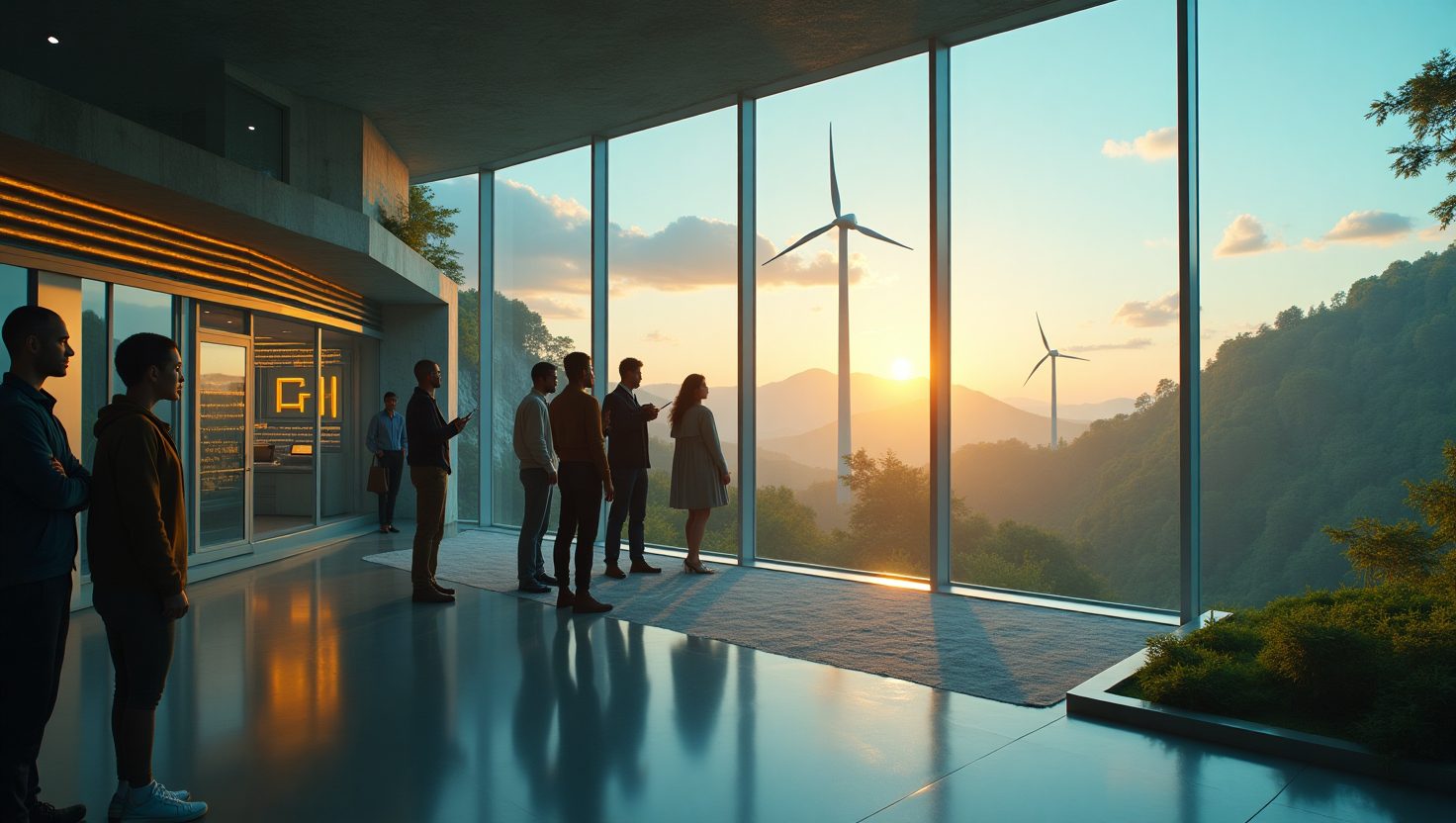
The question isn’t whether artificial intelligence will transform how we power our digital world – it’s whether we can do so without cooking the planet in the process. As AI workloads surge and data centres multiply like digital mushrooms after rain, the tech industry faces a delicious irony: the very technology that could help solve our climate crisis might also accelerate it, unless we get sustainability right from the ground up.
Think of it this way: if traditional data centres are like gas-guzzling lorries hauling our digital lives across the information superhighway, AI data center sustainability represents the shift to electric vehicles – but only if we’re smart about where the electricity comes from. The stakes couldn’t be higher, with data centres already consuming roughly 1% of global electricity and AI workloads threatening to send that figure into orbit.
The Role of AI in Data Center Sustainability
Here’s where things get properly interesting. AI isn’t just the problem – it’s potentially the solution wearing a very clever disguise. When deployed thoughtfully, artificial intelligence can transform data centres from energy-hungry beasts into lean, green computing machines that would make an environmental activist weep tears of joy.
The magic lies in AI’s ability to predict, optimise, and adapt in real-time. Traditional data centre management is a bit like trying to conduct an orchestra whilst blindfolded – you know roughly what should happen, but you’re missing crucial information about what’s actually going on. AI removes the blindfold, providing unprecedented visibility into energy consumption patterns, workload distribution, and system performance.
Google’s DeepMind, for instance, has demonstrated how AI can reduce cooling costs by up to 40% in data centres. That’s not just impressive – it’s revolutionary. When you consider that cooling typically accounts for 40% of a data centre’s energy consumption, we’re talking about transformative efficiency gains that ripple through the entire operation.
But the benefits extend far beyond cooling. AI-driven workload scheduling can shift computational tasks to times when renewable energy is most abundant, essentially teaching data centres to dance with the rhythms of wind and solar generation. It’s like having a supremely intelligent butler who knows exactly when to run the dishwasher to catch the cheapest, cleanest electricity.
Green Computing Initiatives
Green computing initiatives represent the industry’s collective awakening to its environmental responsibilities. These aren’t just feel-good programmes designed to placate activists – they’re hard-nosed business strategies that recognise sustainability as a competitive advantage.
The concept encompasses everything from energy-efficient hardware design to sophisticated software optimisation. Companies like Microsoft have committed to being carbon negative by 2030, whilst Amazon’s Climate Pledge aims for net-zero carbon emissions by 2040. These aren’t modest tweaks to existing operations – they’re fundamental reimaginings of how technology companies operate.
One particularly clever initiative involves liquid cooling systems that use significantly less energy than traditional air cooling. Imagine dunking your overheating laptop in a perfectly calibrated bath – that’s essentially what these systems do, but with industrial-grade precision and environmental benefits that make traditional cooling look positively medieval.
The most successful green computing strategies share common characteristics: they’re data-driven, iterative, and integrated into core business operations rather than bolted on as afterthoughts. Companies that treat sustainability as a compliance exercise tend to achieve compliance-level results. Those that embed it into their DNA tend to discover competitive advantages they never knew existed.
Thermal Management Solutions in AI Data Centers
If energy consumption is the headline challenge of AI data centres, thermal management solutions represent the subplot that could determine the entire story’s outcome. Heat is the silent enemy of computational efficiency – let it build up, and you’re not just wasting energy on cooling; you’re throttling performance and shortening hardware lifespans.
Traditional thermal management is reactive – sensors detect rising temperatures, and cooling systems respond accordingly. It’s like waiting until you’re sweating bullets before thinking about opening a window. AI-powered thermal management, by contrast, is predictive and proactive.
These systems can anticipate thermal loads based on incoming workloads, ambient conditions, and historical patterns. They pre-emptively adjust cooling distribution, shift computational loads to cooler zones, and even recommend optimal server configurations. It’s thermal management with a crystal ball, and the results are genuinely impressive.
Liquid cooling represents one of the most promising innovations in this space. Rather than fighting heat with energy-intensive air conditioning, these systems embrace thermodynamics more directly. Some implementations capture waste heat for other purposes – warming office buildings, for instance, or contributing to district heating systems. Why waste what you can reuse?
Incorporating Renewable Energy with AI
The marriage between renewable energy AI and data centre operations represents one of the most compelling developments in sustainable computing. This isn’t just about buying renewable energy certificates and calling it a day – it’s about fundamentally rethinking how and when computational work gets done.
Imagine a data centre that breathes with the wind. When turbines spin faster, it processes more intensive workloads. When solar panels peak at midday, it tackles energy-hungry AI training runs. When renewable generation drops, it shifts to maintenance tasks and lighter operations. This isn’t science fiction – it’s happening right now.
The integration goes deeper than simple scheduling. AI systems can predict renewable energy availability days in advance, allowing data centres to pre-position workloads geographically. A training job might start in Ireland when Atlantic winds are strong, continue in Spain when solar peaks, and finish in Denmark when offshore wind picks up in the evening.
National Grid Partners recently announced a $100 million commitment to AI energy solutions, recognising that 96% of utility leaders view AI as a strategic focus. This investment signals a fundamental shift in how utilities approach grid management and renewable integration.
Achieving Carbon-Neutral Cloud Infrastructure
Carbon-neutral cloud infrastructure isn’t just an environmental aspiration – it’s rapidly becoming a business imperative. Customers increasingly scrutinise the carbon footprint of their digital services, and regulators are paying closer attention to scope 3 emissions that include cloud computing.
The path to carbon neutrality involves multiple strategies working in concert. First, maximising energy efficiency through AI-driven optimisation. Second, transitioning to renewable energy sources. Third, investing in carbon capture and offset projects. Fourth, designing systems for longevity and recyclability.
Microsoft’s approach provides a compelling case study. The company has committed to being carbon negative by 2030 and removing all historical emissions by 2050. Their strategy includes direct air capture investments, renewable energy procurement, and efficiency improvements driven by AI. They’re essentially betting that being environmental leaders will create lasting competitive advantages.
The statistics are encouraging. Companies implementing comprehensive AI-driven sustainability programmes report emissions reductions of 20-30% within the first two years. That’s not incremental improvement – it’s transformation at scale.
Challenges and Solutions in Implementing AI for Sustainability
Of course, implementing AI for sustainability isn’t without its challenges. The irony is delicious: using energy-intensive AI to reduce energy consumption. It’s like using a petrol-powered chainsaw to clear land for solar panels – the short-term costs need to justify the long-term benefits.
The talent gap represents perhaps the biggest obstacle. A recent survey found that 66% of utility leaders cite talent gaps as the primary barrier to AI implementation. The skills required – combining deep technical AI knowledge with domain expertise in energy systems and environmental science – are rare and expensive.
Financial constraints add another layer of complexity. Sustainability initiatives often require significant upfront investments with payoffs that materialise over years or decades. That’s a tough sell in quarterly-focused business environments, even when the long-term business case is compelling.
The solution involves a combination of education, incentives, and pragmatic implementation strategies. Start with pilot projects that demonstrate clear ROI. Build internal expertise gradually rather than expecting transformation overnight. Partner with specialists who can provide domain knowledge and proven implementations.
Industry collaboration is crucial. The 42% increase in utility-startup partnerships demonstrates growing recognition that innovation often comes from unexpected places. Sometimes the best solutions emerge from small, focused teams rather than massive corporate research departments.
The Road Ahead: Where Do We Go From Here?
Looking forward, the convergence of AI and sustainability in data centres feels inevitable rather than optional. The question isn’t whether this transformation will happen, but how quickly and how completely.
The near-term outlook suggests rapid acceleration. Edge computing will bring AI processing closer to renewable energy sources. Quantum computing might eventually reduce the energy requirements for certain computational tasks. Advanced materials could revolutionise thermal management and energy efficiency.
But perhaps the most significant development will be cultural. As sustainability moves from nice-to-have to business-critical, we’ll see more aggressive innovation, more creative partnerships, and more systematic approaches to environmental challenges.
The data centre industry stands at a crossroads. Down one path lies continued growth at the expense of environmental sustainability – a route that leads to regulatory restrictions, customer backlash, and ultimately, business failure. Down the other lies a future where computational power and environmental responsibility reinforce each other, creating competitive advantages that compound over time.
The choice seems obvious when framed that way. The challenge lies in execution – transforming good intentions into measurable results, pilot projects into scalable solutions, and individual company initiatives into industry-wide transformation.
What role will your organisation play in this transformation? Will you be among the leaders defining what sustainable AI infrastructure looks like, or will you be scrambling to catch up as environmental requirements reshape the competitive landscape? The window for choosing is closing, but for those ready to act, the opportunities have never been more compelling.



