

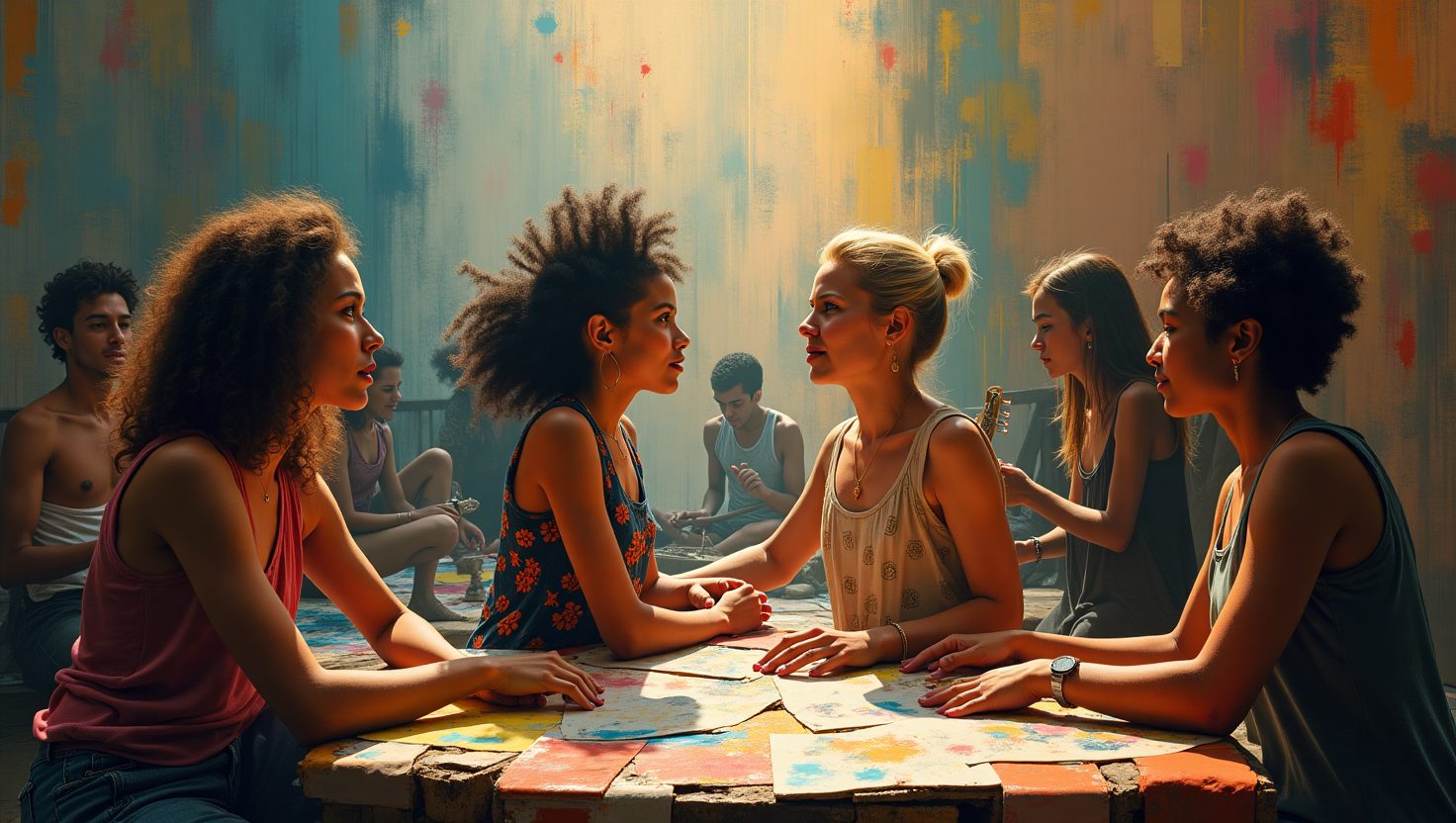
Let’s get one thing straight: the robots are no longer just building cars or trading stocks. They’ve picked up a paintbrush, a guitar, and a pen. And frankly, they’re getting unnervingly good. For years, we’ve been told creativity was the last bastion of humanity, the one thing automation couldn’t touch. Well, that fairy tale is over. The AI creative labor impact isn’t a future problem for a sci-fi novel; it’s happening right now on laptops and in studios around the world, forcing a brutal reckoning within our creative industries. We need to hear the artist perspectives, get to grips with the gnawing automation anxiety, and ask a very simple question: what is the human creativity value when an algorithm can produce a masterpiece in seconds?
The Creative Tsunami is Here
Make no mistake, this isn’t some niche tech trend. Generative AI is being woven into the very fabric of creative work. It’s writing advertising copy, designing logos, and composing background music. For every breathless press release about a new AI model, there’s a quiet panic spreading through the creative class. This isn’t a gentle wave of change; it’s a tsunami.
An Industry Gripped by Automation Anxiety
If you think this is hyperbole, the numbers paint a stark picture. As reported by the BBC, a staggering two-thirds of creative workers believe AI has already undermined their job security. This isn’t a vague fear of being replaced in ten years. It’s the copywriter Niki Tibble returning from maternity leave to find her role absorbed by an AI, who told the BBC, “AI had taken my role.” It’s the palpable dread that your skills, honed over a lifetime, could be made obsolete by a software update.
Voices from the Front Line: Artist Perspectives on the AI Invasion
Talk to the people on the ground, and the strategic analysis gives way to raw, human emotion. This isn’t about efficiency; it’s about identity and livelihood. Take illustrator Aisha Belarbi, who feels her craft is under direct assault. “I really hate AI,” she told the BBC. “It really goes against everything that I do.” For her, AI isn’t a tool; it’s a plagiarist that devalues the painstaking process of human creation. “This is my livelihood at stake,” she added, “and a lot of other people’s livelihoods.”
Then you have musicians like Ross Stewart, who discovered AI-generated albums being promoted on streaming platforms, directly competing with human artists. He calls the idea of using AI to write lyrics “sacrilege.” This isn’t just about economic competition. It’s an almost spiritual objection to outsourcing emotion and experience to a machine. Can an algorithm truly understand heartache, joy, or loss? Or is it just a clever mimic, a parrot squawking lines it doesn’t comprehend?
What’s a Human Worth? The Value of Creativity in an Automated World
This brings us to the core of the issue. When content becomes infinitely abundant and virtually free to produce, what exactly are we paying for? Ross Stewart puts it best: “People crave authenticity.” This is the strategic crux of the matter.
Think of it like this: you can buy a mass-produced, machine-made print for your wall, and it might look perfectly fine. But it will never hold the same value—emotional or financial—as an original painting with visible brushstrokes, a signature, and the story of the artist’s struggle and inspiration embedded within it. The AI-generated content is the print; the human work is the original painting. The question is, can most people tell the difference, and more importantly, will they care enough to pay for it?
The Battle for Authenticity
The market will inevitably split. One side will be dominated by fast, cheap, “good enough” content churned out by AI. The other, more premium market will be built on the very human elements AI can’t replicate: vulnerability, lived experience, a unique point of view, and a genuine connection between the creator and the audience. The entire value proposition for human artists is shifting from technical execution to authentic expression.
The Wild West of Copyright Concerns
Of course, this whole mess is unfolding in a legal vacuum. The current intellectual property laws were written for a world of human authors, not for algorithms trained on a dataset of basically the entire internet. This is where the copyright concerns become a five-alarm fire.
When an AI generates an image in the style of a specific artist, was that artist’s work stolen? Who owns the copyright to the AI’s output—the user who wrote the prompt, the company that built the AI, or nobody at all? These aren’t theoretical questions. As highlighted in the BBC’s recent investigation, court cases are already piling up as artists and companies like Getty Images sue AI developers for allegedly scraping their content without permission. Our legal system is trying to referee a game of 3D chess using the rules for checkers. It’s simply not equipped for the “velocity of change,” as one executive put it. New frameworks are needed, and they are needed yesterday.
Adapting or Drowning: The Future of Creative Work
So, what’s a creative to do? Stick their head in the sand and hope it all goes away? That’s not a strategy; it’s a surrender. The reality is that adaptation is necessary, but it’s not as simple as “learning to code.”
Some, like videographer JP Allard, are diving in headfirst. His company, MirrorMe, now uses AI to generate ad campaigns and create “digital twin” avatars, slashing production time and costs. He argues this is just the next evolution of tools, boldly telling the BBC that even Michelangelo “would be dabbling in AI right now.” He has a point; technology has always changed art. The problem, as Allard himself admits, is the speed. “In the past, we had five or six years to take typewriters out… Now it’s happening in months.”
This rapid shift demands not just new skills, but a new mindset. Creatives may need to become curators, prompt engineers, or collaborators with AI, using it as a hyper-fast assistant rather than a replacement. The focus may shift from creating every element from scratch to guiding a powerful tool toward an authentic vision.
The Reckoning
The uncomfortable truth is that the AI creative revolution will have winners and losers. The AI creative labor impact will be messy and profound. Some jobs will vanish, new ones will be created, and the very definition of “artist” will be stretched and redefined. The romantic notion of the solitary genius is being challenged by the reality of human-machine collaboration.
We must protect the value of human expression and address the legitimate copyright concerns with updated laws. But we can’t ignore the technology. The genie isn’t going back in the bottle. The real challenge is to steer this powerful force in a way that augments human creativity rather than obliterating it.
But let me ask you this: when you can have a million synthetic Mona Lisas, what does that do to the value of the original? And are we prepared for the answer?



