

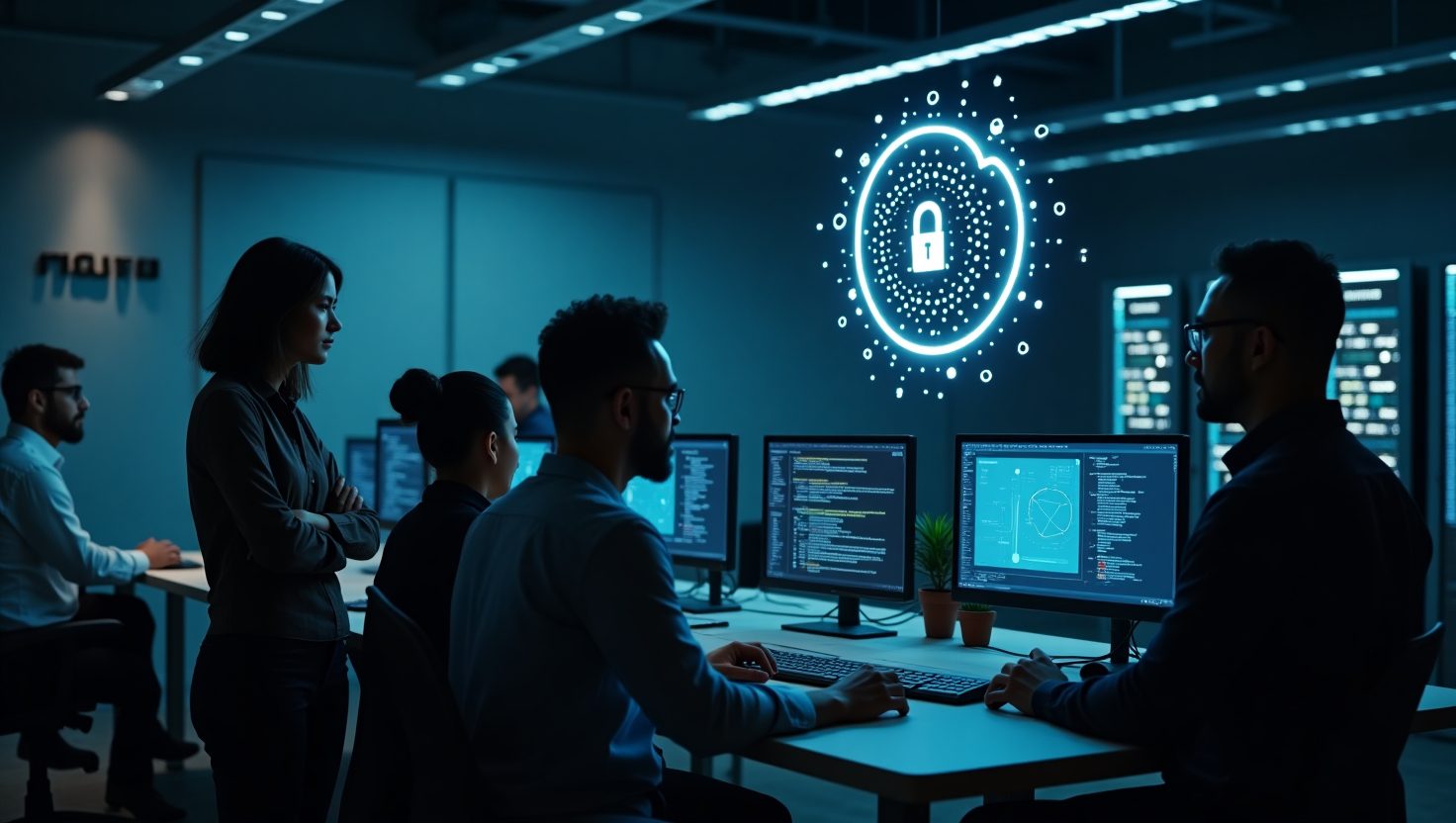
The game is now about AI corporate espionage, a brand of subterfuge so subtle and sophisticated it makes traditional hacking look clumsy. We’re not just talking about deepfakes of your CEO authorising a fraudulent wire transfer—though that is certainly a concern. We’re talking about AI models designed to learn your network’s layout, identify your most valuable intellectual property, and exfiltrate it piece by piece without ever tripping a legacy alarm. It’s death by a thousand digital cuts.
### The New Enemy Within: Understanding the Threat
So, what does this new form of espionage actually look like? Imagine an AI unleashed by a competitor that spends months quietly observing your network traffic. It’s not smashing through digital doors; it’s picking the locks. It learns who accesses what data, when, and from where. It identifies the engineers working on your next-generation product and starts to mimic their digital behaviour, slowly accessing blueprints, research notes, and chemical formulas. By the time you spot the breach, your “secret sauce” is already the main ingredient in your competitor’s new product launch.
This scenario highlights the critical need for advanced insider threat detection. The uncomfortable truth is that many of the most devastating data breaches aren’t orchestrated by external hackers but are enabled, wittingly or not, by people already inside the wire. According to IBM’s 2023 Cost of a Data Breach Report, breaches caused by malicious insiders were the most expensive, costing an average of $4.90 million. This is where AI becomes a double-edged sword; it’s both the weapon of choice for attackers and our most promising shield.
AI-powered security systems don’t just look for known malware signatures. They establish a baseline of normal activity for every single user and device. When an employee’s account suddenly starts accessing files outside its usual domain at 3 a.m. or attempts to download gigabytes of data to a USB drive for the first time, the AI flags it. It’s not about accusing anyone; it’s about spotting anomalies that humans would miss until it’s far too late.
### Protecting the Crown Jewels with Intelligent Algorithms
For any technology or research-driven company, intellectual property (IP) is everything. It’s the code, the designs, the formulas, and the strategies that give you a competitive edge. Losing it is not just a financial loss; it’s an existential threat. This is where dedicated IP protection algorithms become non-negotiable.
Think of these algorithms as a highly intelligent librarian for your most sensitive data. A simple firewall is like a locked door to the library—it stops people without a key. But what happens once someone is inside? A traditional system can’t tell if that person is reading harmless fiction or photocopying your most secret manuscripts.
An AI-powered system, however, understands context. It uses natural language processing and pattern recognition to classify data in real time. It knows which documents contain trade secrets. It can detect if someone is trying to reassemble a sensitive file by downloading multiple smaller, unclassified documents. If an engineer who typically works on engine design suddenly starts accessing the proprietary code for the user interface, the AI can flag this behaviour, temporarily restrict access, and alert a human security officer. It’s proactive, not reactive.
### The Power of Watching: Leveraging Behavioral Analytics
This entire defensive strategy hinges on one powerful concept: behavioral analytics. In essence, you’re teaching an AI to be an expert people-watcher, but for the digital world. It learns the rhythm of your organisation—the digital heartbeat of how your employees work.
Let’s use an analogy. Imagine a security guard in an office building. After a few weeks, they know who works on which floor, when they usually arrive, who they have lunch with, and that Sarah from marketing always grabs a coffee at 2:15 p.m. If one day they see Sarah trying to access the server room at midnight using someone else’s keycard, they’ll know immediately that something is wrong. That guard is using learned behavioural patterns, not just a list of authorised personnel.
That’s what behavioral analytics does at a massive scale. The AI platform monitors thousands of data points:
– Login times and locations
– Data access patterns
– Email communication volume and recipients
– Application usage
– Network traffic
It builds a unique digital “fingerprint” for each user. It’s this deep understanding of “normal” that makes it so effective at spotting the “abnormal”—the subtle signs of AI corporate espionage or an impending insider attack. It’s not about spying on employees; it’s about protecting the entire organisation from threats that move too fast and hide too well for human oversight alone.
### Building Your Digital Fortress: Actionable Best Practices
So, how do you defend against a threat you can’t always see? You have to fight code with smarter code. Relying on chance is not a strategy. Here are some essential practices to adopt:
– Adopt a Zero Trust Architecture: The old model of “trust but verify” is dead. The new model is “never trust, always verify.” Every user and every device must be authenticated and authorised for every single resource they try to access, regardless of whether they are inside or outside the corporate network.
– Deploy Layered, AI-Powered Security: There is no single magic bullet. A robust defence combines multiple AI-driven tools, including next-generation endpoint protection, network detection, and, of course, powerful behavioral analytics platforms.
– Train Your People Relentlessly: Your employees are your first line of defence. They need to be educated about the risks of phishing, social engineering, and the subtle signs of an ongoing digital espionage campaign. An aware workforce is an empowered one.
– Monitor Your AI: The AI models you use for defence need to be protected and monitored, too. Attackers are already exploring ways to poison the training data of security AIs to create blind spots they can exploit later.
Staying ahead in this new era requires constant vigilance and a willingness to invest in intelligent defence systems. As the landscape of threats evolves, so too must our strategies for protecting our most valuable assets, a point often echoed in ongoing analyses from technology sources like Forbes Cybersecurity.
The war for corporate data is being fought on a new front, and the rules of engagement have been completely rewritten by artificial intelligence. Building a strong defence is no longer just an IT issue; it’s a fundamental business strategy for survival. The question you should be asking in your next board meeting isn’t if you will be targeted, but how well-prepared you are for when you are.
What steps is your organisation taking to prepare for this new generation of threats?



