

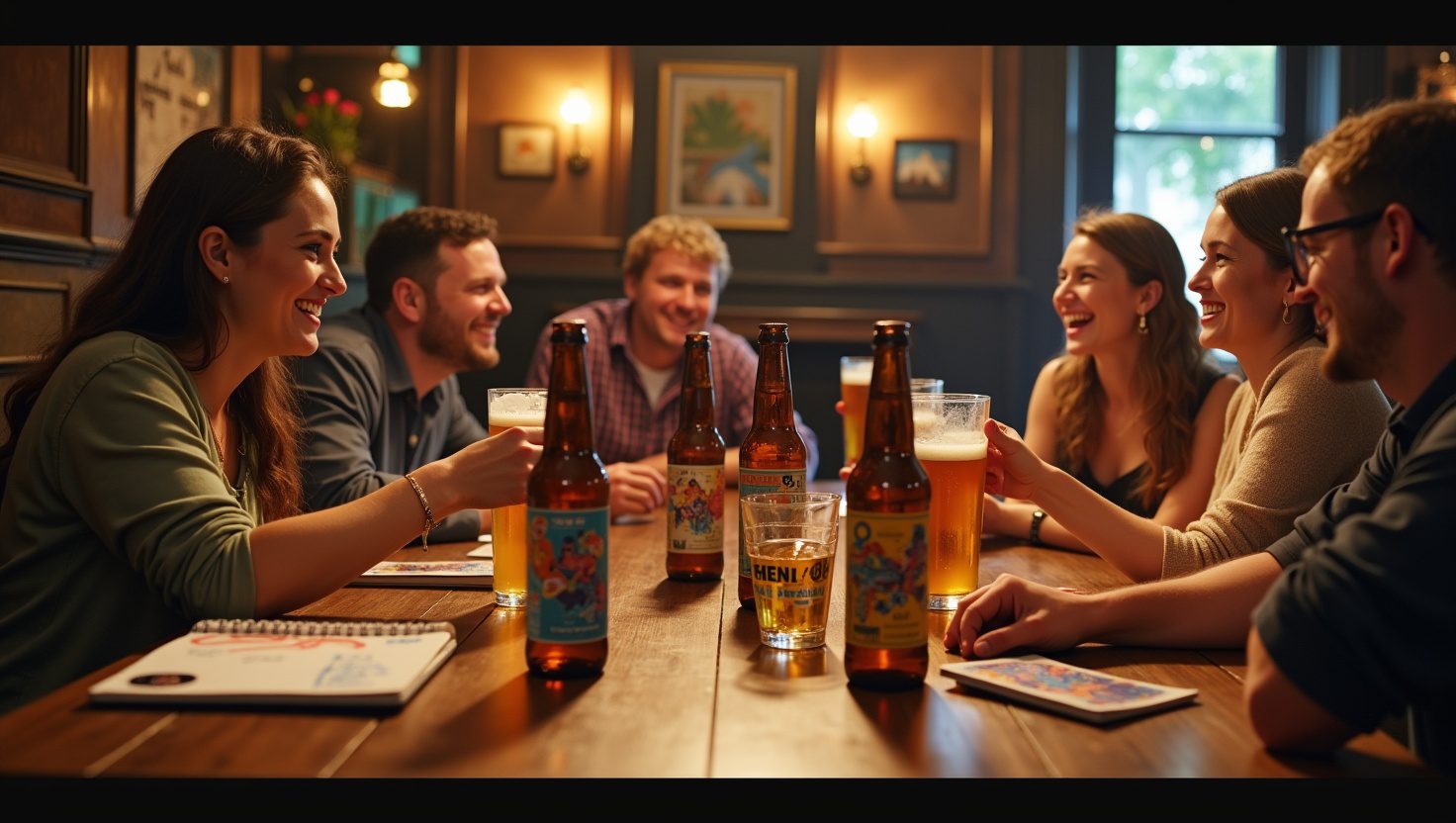
The battle over artificial intelligence isn’t just happening in the hallowed halls of Westminster or the gleaming campuses of Silicon Valley. It’s happening on beer pump clips in Newcastle. Yes, you read that correctly. Two pubs, The Mean Eyed Cat and Free Trade Inn, have drawn a line in the sand, banning AI-generated artwork from their establishments. This might seem like a small, localised skirmish, but it’s a perfect microcosm of the much larger, messier war over the future of the creative economy.
What we’re seeing is the frontline pushing back. Pub owner Simon Hubbard, as reported by the BBC, noticed a worrying trend of what he bluntly calls “dreadful AI slop” appearing on beer labels. This isn’t just an aesthetic complaint. It’s an economic and ethical siren call. The core of the issue? These AI models are trained on vast datasets of images, many of which are scraped from the internet without the original artist’s permission or compensation. It’s a digital land grab, and artists are the ones losing their territory.
The Great Digital Art Heist?
When you hear an artist like Drew Millward say, “Call it what it is, stolen artwork,” it’s not hyperbole. It’s a fundamental accusation about the business model of many generative AI companies. Imagine a machine that has scanned every book in a library, learned to mimic the style of every author, and can now produce novels that are 90% as good, for a fraction of the cost, without paying a single royalty. That’s essentially the predicament facing visual artists today.
This isn’t just about jobs, although as Hubbard rightly points out, “People are going to be put out of work because of it.” It’s about the very definition of creation and ownership. The argument that AI is just a ‘tool’ like Photoshop wears thin when the tool itself contains the intellectual property of millions. This is where the desperate need for clear AI art regulation becomes glaringly obvious. Without it, we’re in a digital Wild West where the biggest data hoarders make the rules.
The current system essentially outsources the ethical dilemma to the end-user. A brewery might think it’s saving a few quid by using a mid-journey prompt instead of hiring a local designer. But as Reece Hugill of Donzoko brewery astutely observes, this decision has a clear financial trajectory. “That is removing value from the local community and local artists [and] into the hands of some of the richest people in the world.”
Why Human ‘Imperfection’ is the Killer App
So, is human creativity doomed? Not so fast. The pushback in Newcastle isn’t just about economics; it’s about value. Lettering artist Ashley Willerton pinpoints the achilles’ heel of generative AI: “It will always lack a human touch.” She argues that while an AI might create something technically perfect, “it doesn’t mean it’s going to be as meaningful.”
This is the key. Art isn’t just about pixels arranged in a pleasing order. It’s about intent, story, happy accidents, and the shared cultural context between the creator and the audience. It’s the slight wobble in a hand-drawn line, the specific choice of colour palette inspired by a local landmark, the in-joke hidden in a design. AI can replicate the ‘what’, but it struggles with the ‘why’.
By choosing to support local artists, these pubs and breweries are doing more than just commissioning a design. They are investing in their community’s cultural fabric. They are reinforcing a network of creators, suppliers, and patrons that defines a local scene. As Hugill questioned, if a company is “cutting corners in how things are presented, where else are you cutting corners?” It’s a proxy for quality and integrity.
The Patchwork Quilt of Policy
The grassroots action in Newcastle highlights a massive void at the national and international levels. Where are the grown-ups? The current landscape for AI art regulation is a confusing mess of proposals, lawsuits, and inaction. Governments are playing catch-up, struggling to define copyright in an age of infinite, machine-generated content. We need robust policy frameworks that provide genuine artist protections.
What could this look like?
– Mandatory Data Transparency: AI companies must declare what copyrighted material their models were trained on. No more hiding behind proprietary datasets.
– Opt-In, Not Opt-Out: The default should be that an artist’s work cannot be used for training unless they explicitly grant permission. This flips the current model on its head.
– Clear Labelling Standards: AI-generated content should be clearly and unmistakably labelled as such. This allows consumers to make informed choices, just as the pubs in Newcastle are trying to do.
Without these foundational rules, we risk devaluing the entire creative economy. It becomes a race to the bottom, where speed and cost trump originality and skill. The human artists who remain will be forced into a luxury niche, creating bespoke pieces for the wealthy, while the mainstream is flooded with that “dreadful AI slop”.
This is not a uniquely British problem. The EU’s AI Act is a step in the right direction, but even that has been criticised for not going far enough on copyright. In the US, a series of court cases are attempting to set precedents, but legal battles are slow and expensive. What the Newcastle pubs have done is implement their own simple, immediate, and effective policy. They’ve shown that regulation doesn’t just have to come from the top down.
The stand taken by these small businesses is more than a feel-good story; it’s a template. It’s a market-based demand for authenticity and a protest against the faceless aggregation of a tech-driven monoculture. We are at a critical juncture where the choices we make—as consumers, business owners, and policymakers—will determine whether art remains a human endeavour or becomes another asset class optimised by algorithms.
So, the next time you see a quirky, interesting beer label, it’s worth asking: was this made by a person with a story, or a prompt with a subscription fee? And more importantly, what are you going to do about it?



