

Let’s be honest, when you think of groundbreaking AI, your mind probably jumps to chatbots arguing about their own consciousness or some algorithm in Silicon Valley optimising ad clicks with terrifying precision. You’re likely not picturing a robot trawling the freezing, dark seabed at the bottom of the world. But perhaps you should be. Because while we’ve been distracted by generative art, the most impactful AI Antarctic research is quietly unfolding, and it’s about to change how we understand our planet’s last true wilderness.
Antarctica isn’t just a vast, empty expanse of ice. It’s a continent of secrets, particularly beneath the waves where the Southern Ocean harbours life forms so uniquely adapted they might as well be from another planet. In fact, a staggering 94% of the known species in the Southern Ocean live on the seafloor, a realm known as the benthos. For decades, studying this ecosystem has been a painstakingly slow, almost monastic, process. Scientists would send down cameras, collect thousands of images, and then spend months, sometimes years, hunched over screens, manually identifying every starfish, sea sponge, and coral. It was vital work, but a logistical nightmare.
Now, that’s all changing. The British Antarctic Survey (BAS) has developed a new AI tool that is doing for marine biology what the spreadsheet did for accounting. It’s a profound shift in capability, turning a data bottleneck into a firehose of information. But with this incredible new speed comes a new set of questions. When you automate discovery, what do you risk losing?
Why We Bother Looking at the Bottom of the Ocean
Before we get into the nuts and bolts of the AI, let’s be clear about the stakes. Why is biodiversity monitoring in this specific, remote corner of the world so critical? Think of the Antarctic seafloor as the foundational layer of a Jenga tower. The corals, sponges, and other stationary creatures create complex habitats—a city of life—that support everything else, from tiny crustaceans to the fish that feed penguins and seals. If that foundation crumbles due to warming waters, ocean acidification, or destructive fishing practices, the entire tower comes crashing down.
To protect it, you first have to know what’s there. This is where the old-school method hit a wall. A single research cruise on a vessel like Germany’s RV Polarstern—a key partner in this research—can generate over 30,000 images. Dr. Cameron Trotter of the BAS laid out the grim maths of the old process: it could take a trained biologist up to eight hours to meticulously analyse a single complex photograph. Now, do that 30,000 times. You see the problem. The data was piling up faster than it could ever be processed, leaving crucial insights for conservation locked away on hard drives.
Effective biodiversity monitoring isn’t just about making lists of animals. It’s about building a map of life, identifying hotspots of vulnerability, and giving policymakers the concrete evidence they need to draw a line on a map and say, “This area is too important to touch.” Without that data, conservation is just guesswork.
The AI That Never Sleeps
Enter the real star of the show: a piece of software that essentially gives marine biologists superpowers. The team at the British Antarctic Survey trained a machine learning model on a vast library of these seafloor images, teaching it to recognise and classify the key organisms that make up these vulnerable marine ecosystems. The result? As Dr. Trotter puts it, “This new AI technology will massively speed up how marine biologists analyse the data they collect… from eight hours per photo to a few seconds.”
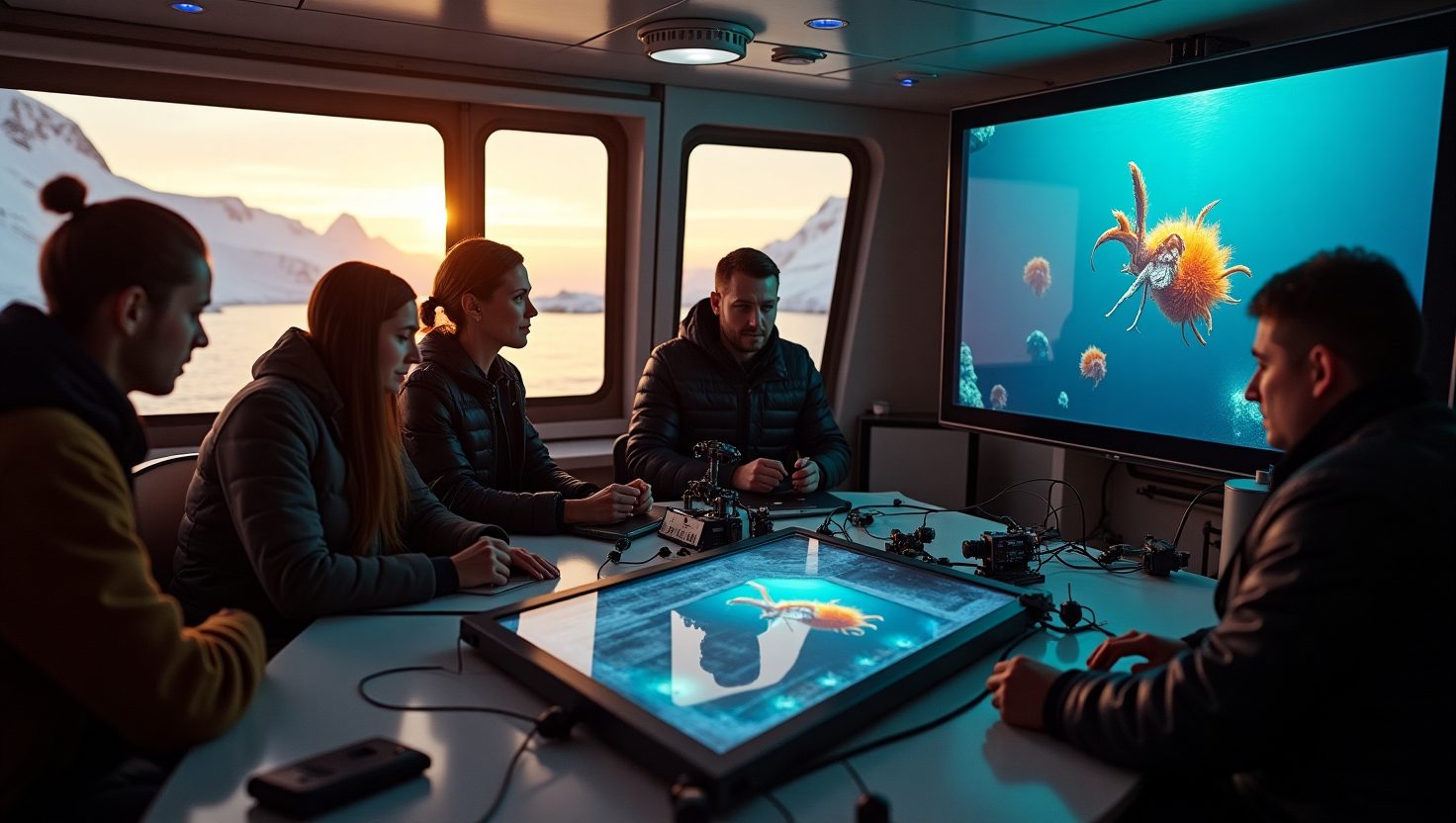
Let that sink in. A task that took a full workday can now be done in the time it takes to refresh your email. This isn’t just a minor improvement; it’s a fundamental transformation of the scientific process. According to the team’s findings, recently published and detailed on Phys.org, this allows for real-time analysis right there on the ship. Scientists can see what the cameras are seeing almost instantly, allowing them to adjust their survey on the fly to investigate a particularly dense patch of coral or an unusual formation. It’s like switching from developing film in a darkroom to seeing the photo appear on your digital camera’s screen the moment you take it.
Dr. Rowan Whittle, a marine biologist at BAS, didn’t mince words about the impact: “This is a game-changer… unlocking vast quantities of data crucial for conservation.” The AI is already being put to work on those 30,000 images from the Weddell Sea and Antarctic Peninsula, a dataset that would have previously represented years of labour. This acceleration is the key to unlocking the secrets hidden in the vastness of the Southern Ocean.
Robots, Cameras, and the Deep Dark
Of course, this clever AI would be sitting idle without its partners in crime: the deep sea robotics that actually capture the images. The AI is the brain, but the Autonomous Underwater Vehicles (AUVs) and Remotely Operated Towed Camera Systems (ROTCs) are the eyes. These rugged machines are designed to withstand the crushing pressure and near-freezing temperatures of the Antarctic deep, systematically flying just metres above the seafloor, their lights cutting through the perpetual darkness to capture images in stunning high resolution.
The integration of AI directly onto these platforms is the next logical step. Imagine a sub that doesn’t just blindly follow a pre-programmed path but can use AI to recognise an ecosystem of interest—say, a rare cold-water coral reef—and decide on its own to spend more time exploring it, collecting more detailed data. This creates a powerful feedback loop, making each expensive and carbon-intensive day a research vessel spends at sea exponentially more productive. It’s the difference between mowing your lawn in straight lines and having a smart Roomba that knows to spend extra time on the muddy patches.
Automation’s Ethical Icebergs
Here’s where the story gets more complicated. With great computational power comes great responsibility, and the rise of scientific automation ethics is a field scientists are now forced to navigate. Is the AI perfect? Of course not. An AI model is only as good as the data it was trained on. What if it’s biased towards more common, easily identifiable species and consistently overlooks a rarer, more cryptic creature?
The BAS team is keenly aware of this. Their process isn’t about replacing human experts but augmenting them. The AI performs the initial, gruelling pass, flagging and classifying the obvious things. A human biologist then validates the results, focusing their expert eye on the ambiguous cases and ensuring the AI’s conclusions are sound. It’s a human-machine partnership, designed to preserve scientific rigour while obliterating the time-consuming grunt work.
This approach is also fundamentally about preserving the ecosystem itself. For a long time, the only way to be certain about the species in an area was to dredge the seafloor, dragging up samples in a highly destructive process. Photographic surveys, enhanced by AI, are non-invasive. They allow scientists to look without touching, to catalogue life without destroying it—a core principle of modern conservation science.
Turning Data into Designated Protection
So, what’s the endgame for all this high-tech AI Antarctic research? It’s not just about publishing papers. It’s about policy. The ultimate goal is to use this rapidly generated data to support the designation of Marine Protected Areas (MPAs) in the Southern Ocean.
For years, efforts to create new, large-scale MPAs in areas like the Weddell Sea and East Antarctica have been stuck in a political quagmire at the Commission for the Conservation of Antarctic Marine Living Resources (CCAMLR). As detailed by organisations like The Pew Charitable Trusts, progress is often stalled by a few nations, demanding ever more data before they will agree to protections. This AI-powered approach provides exactly that: overwhelming, evidence-based maps of vulnerable ecosystems that become impossible for policymakers to ignore. It systematically dismantles the excuse of “not enough information.”
By clearly identifying where these fragile, biologically significant habitats are, scientists can provide a clear, data-driven argument for closing them off to potentially harmful activities like industrial krill fishing. This is where science has its most potent impact, translating pixels from the bottom of the ocean into tangible protection for our planet’s most fragile environments.
The Future Is Coded…and Cold
The work being done by the British Antarctic Survey is more than just a clever application of machine learning. It’s a template for the future of environmental science. The same principles could be applied to monitoring coral reefs in the tropics, tracking deforestation in the Amazon from satellite imagery, or counting whale populations from acoustic recordings. We are generating data about our planet at an unprecedented rate, and without AI, we’d be drowning in it.
This technology gives us the power to see and understand our world in near real-time. But it doesn’t make the hard decisions for us. The AI can show us exactly where a priceless ecosystem is, but it can’t imbue us with the political courage to protect it. It can analyse the data, but it can’t create the collective will to act.
So, as this remarkable tool gets to work charting the hidden depths of Antarctica, the real question shifts back to us. Now that we can see what’s down there with such incredible speed and clarity, what are we prepared to do about it?



