

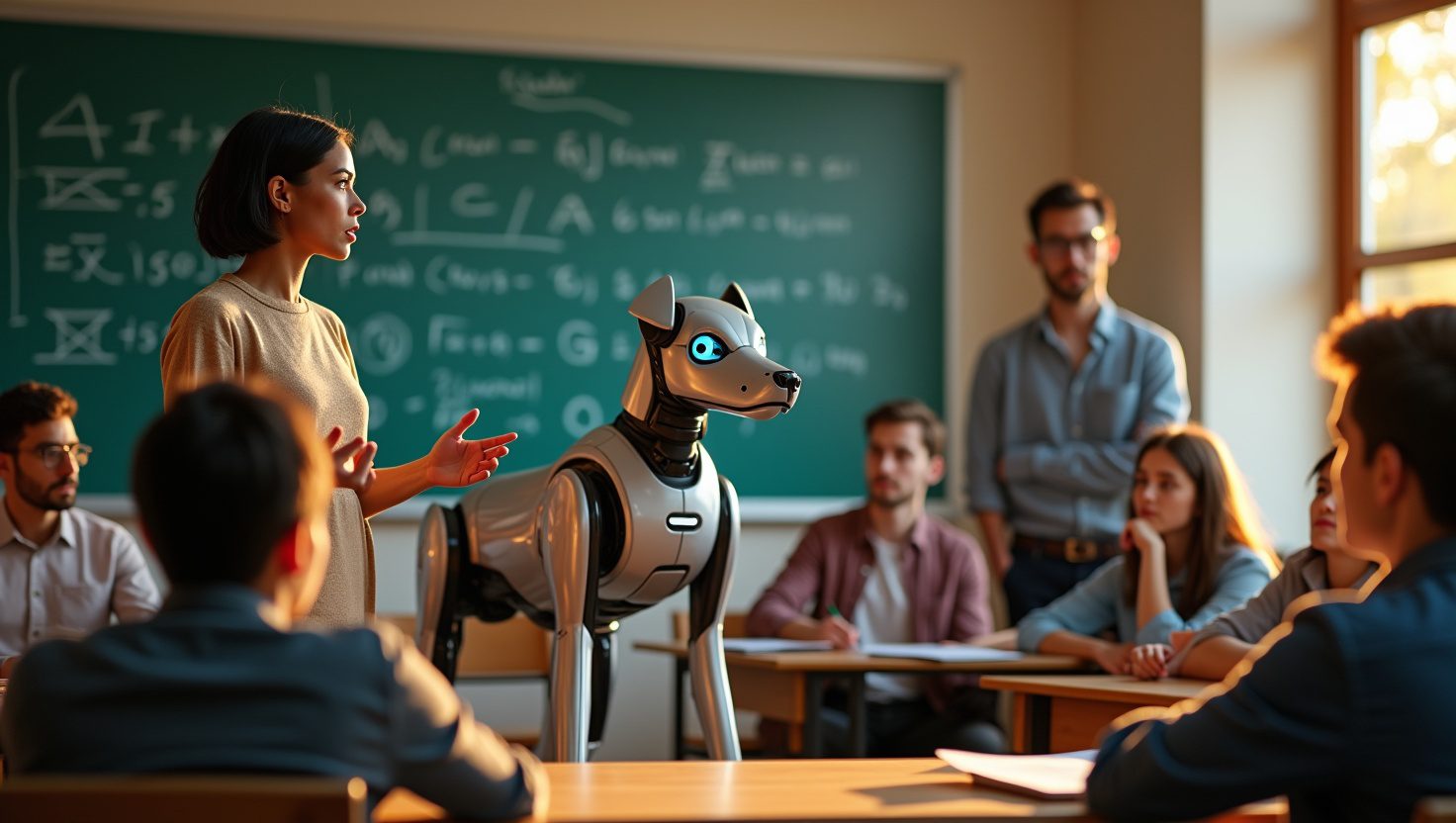
You’d think that in the high-stakes world of artificial intelligence, where nations are jostling for supremacy, the one thing you wouldn’t do is buy a robot dog off the internet and pass it off as your own. And yet, here we are. The recent spectacle at the AI Impact Summit in New Delhi wasn’t just a moment of profound embarrassment; it was a glaring red flag for the state of AI academic integrity. If we can’t trust a university’s presentation at a global summit, what can we trust?
This isn’t just about one university’s spectacular own goal. It’s a story about the immense pressure to innovate, the erosion of research transparency, and the very real consequences of faking it in an industry built on groundbreaking truths. The whole affair serves as a rather clumsy, four-legged metaphor for the ethical tightrope we’re all walking in the age of AI.
The Dog That Didn’t Hunt: A Case of Mistaken Identity
Let’s break down what happened, because the details are as telling as they are absurd. Galgotias University, an Indian institution, took to the stage at a summit attended by global leaders and tech luminaries. Professor Neha Singh, representing the university’s “Centre of Excellence,” proudly presented a robotic dog, apparently a product of their own ingenuity.
There was just one tiny problem. The dog wasn’t theirs. Internet sleuths, the unsung heroes of our digital age, quickly identified the machine as a Unitree Go2, a commercially available robot made by the Chinese firm Unitree Robotics. You can pick one up yourself for about $1,600. As NBC News reported, the university was swiftly expelled from the summit, its credibility in tatters.
Initially, the university bizarrely claimed it was the victim of a “propaganda campaign” before performing a swift U-turn. They later apologised, stating the professor was “ill-informed” and not authorised to speak to the media. This sequence of events raises serious questions about institutional oversight and the casual relationship with truth that can fester when the pressure to perform is high.
Innovation’s Ethical Minefield
This incident is more than just a source of schadenfreude; it’s a live-fire drill in innovation ethics. When an academic institution, supposedly a bastion of truth and rigorous inquiry, engages in such blatant misrepresentation, it corrodes public trust. How can we believe any claims of breakthroughs or advancements if the most basic tech credential verification fails so spectacularly?
It’s like an art forger trying to pass off a print as an original masterpiece. The frame might be nice, and it might look right from a distance, but under scrutiny, the deception is obvious. The problem is, in the world of academic and technological innovation, we rely on the artists – the researchers and institutions – to be honest about their work’s provenance. When they aren’t, the entire market risks being devalued. This places a heavy burden on educators and researchers to not only create but to represent their work with unwavering accuracy.
Technology: The Cause and The Cure
Ironically, the very technology that fuels this innovation race also holds the key to policing it. It has never been easier to get caught.
– Crowdsourced Scrutiny: The Galgotias fiasco was unravelled not by an official body, but by a diffuse network of online observers. Social media acted as a decentralised, brutally efficient fact-checking engine. This collective power is a formidable deterrent to anyone thinking of pulling a similar stunt. It demonstrates a new paradigm for enforcing research transparency.
– Advances in Verification: Beyond public shaming, technology offers more structured solutions. We are seeing the emergence of tools that can bolster tech credential verification. Think about blockchain-based ledgers to immutably record the research process or sophisticated image and code comparison software that can spot plagiarism and uncredited borrowing. The goal is to create a digital paper trail that is too complex to fake.
The future of academic integrity will likely involve a combination of these two forces: the formal, technological verification systems and the informal, but powerful, court of public opinion.
The Global Stakes of Getting It Wrong
This wasn’t just a problem for one university; it was a moment of national humiliation for India. The country is making a huge push to position itself as a global AI powerhouse, a credible alternative to China and the West. An incident like this, broadcast on the world stage, directly undermines that ambition. It feeds a narrative that the country’s innovation ecosystem might be more style than substance.
Of course, this isn’t exclusively an Indian problem. The pressure to “innovate or die” is global. We have seen examples of tech companies in Silicon Valley overstating their AI capabilities and research teams elsewhere fudging data to secure funding or prestige. The temptation to cut corners is universal when the rewards for being first and best are so enormous. Every nation’s reputation in the AI race is fragile, and it’s only as strong as the integrity of its weakest institutional link.
Who Owns the Robots, Anyway?
This brings us to the thorny issue of intellectual property AI. By presenting Unitree Robotics’ work as their own, Galgotias University wasn’t just lying; they were fundamentally disrespecting the intellectual property of the true innovators. They took a product, the result of significant investment in research and development, and attempted to claim the credit.
This highlights a critical challenge in the AI era. As AI models become capable of generating code, text, and designs, the lines of ownership and creation are blurring. We urgently need clearer global guidelines and stronger institutional policies to navigate this landscape. For researchers and universities, this means:
– Rigorous Sourcing: Adopting strict protocols for documenting and crediting all external tools, datasets, and hardware.
– Ethics Training: Making innovation ethics a core part of the curriculum for both students and faculty.
– Internal Audits: Establishing review boards that don’t just check for scientific rigour but also for ethical and intellectual property compliance.
Protecting intellectual property AI isn’t about stifling collaboration; it’s about ensuring that genuine creators are recognised and rewarded, which is the very engine of progress.
This robotic dog incident, while comical on the surface, should serve as a wake-up call. The pursuit of AI advancement cannot come at the expense of our most fundamental academic and ethical principles. The tools to build the future are here, but so are the tools to verify the truth. Institutions that forget this will find themselves, like Galgotias University, kicked out of the room.
So, here’s the question: as the AI gold rush intensifies, how do we ensure that the pressure to stake a claim doesn’t lead to an epidemic of intellectual dishonesty? What other measures should be in place to safeguard AI academic integrity?



