

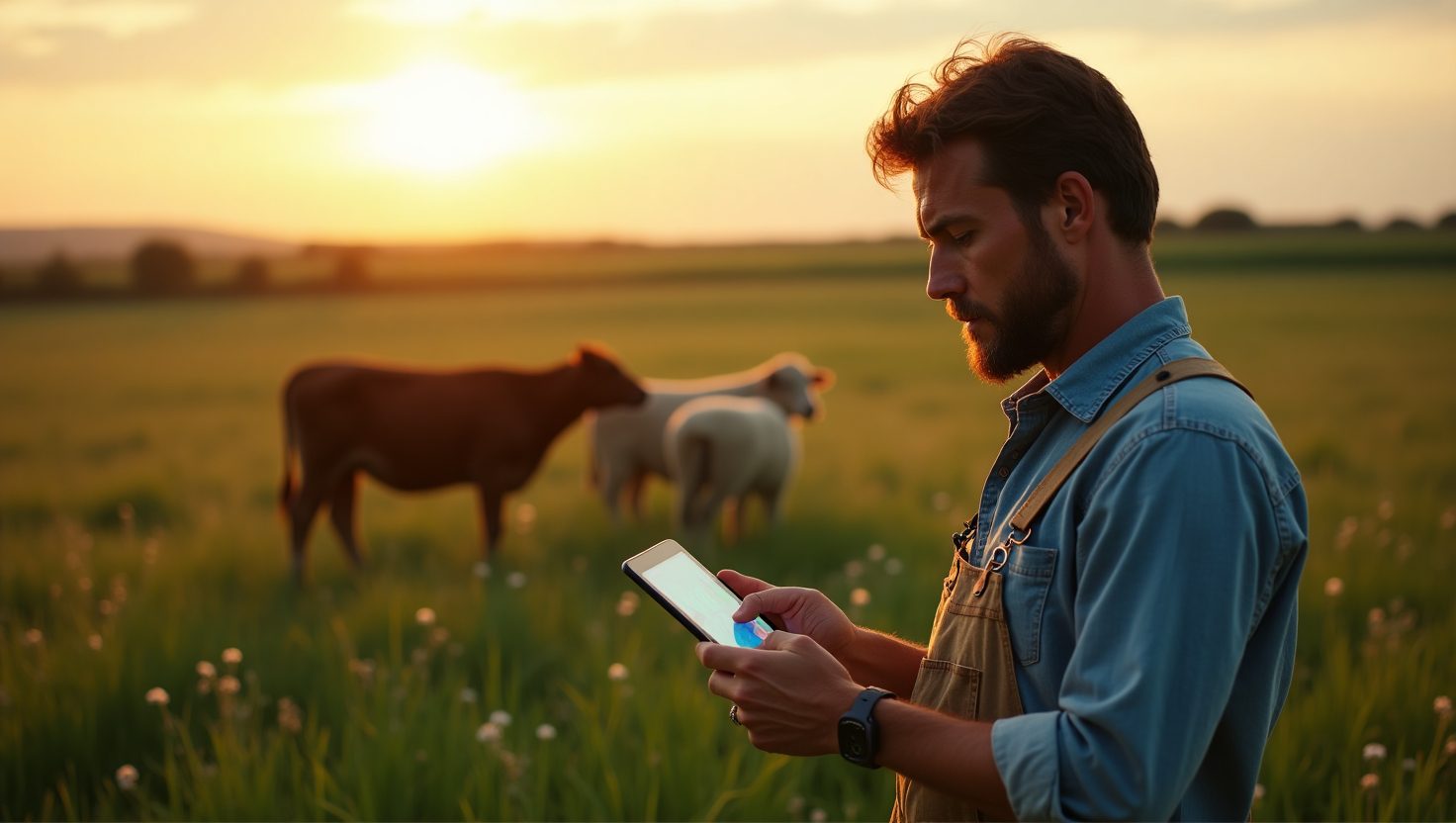
The British Veterinary Association (BVA) is leaning into this debate, staging a panel at its upcoming Congress tellingly titled, ‘AI on farms: is it good for vets and animal welfare?’. It’s a question that cuts to the very heart of the industry’s future. What happens when a computer can spot a sick cow before a human can?
What Are We Even Talking About?
When we say agricultural AI, what do we actually mean? Forget visions of robotic overlords. In this context, AI is essentially a suite of smart tools that collect vast amounts of data and, more importantly, make sense of it. Think of it less as a replacement for the farmer and more like giving the entire farm a central nervous system. This has been made possible by a perfect storm of technological progress: cheap sensors, powerful cloud computing, and sophisticated machine learning models that can spot patterns a human eye would almost certainly miss.
This technology takes many forms:
* Wearable sensors on collars or ear tags that track an animal’s movement, temperature, and even chewing patterns.
* Computer vision systems using cameras in barns to monitor behaviour, social interactions, and physical condition 24/7.
* Acoustic sensors that can detect changes in vocalisations which might indicate stress or respiratory illness.
All this data streams into a central system that churns through it, looking for tell-tale signs, the digital whispers of a problem long before it starts shouting.
The AI Toolkit: From Counting Heads to Predicting Headaches
The practical applications of this technology are already moving from theoretical to tangible, especially in three key areas that are reshaping the farm.
Reinventing Herd Management
Effective herd management has always been a blend of art and science. It’s about ensuring the collective health and productivity of hundreds, sometimes thousands, of animals. Traditionally, this involved a lot of observation, record-keeping in notebooks, and a fair bit of guesswork. AI transforms this into a precise, data-driven operation. Instead of just knowing you have 500 cattle, you can know that Cow #342 has been lying down 15% longer than usual for the past three days, her milk yield has dipped by 5%, and she’s avoiding the main feeding trough.
This is where AI acts like the analytics team for a Premier League football club. Just as a team monitors every player’s biometrics to prevent injury and optimise performance, a farmer can now monitor individual animals within the herd. This allows for early intervention, customised nutrition, and a far more granular understanding of the group’s dynamics. The result is not only a more productive herd but a healthier one, reducing the need for broad-spectrum, reactive treatments.
The Crystal Ball of Disease Prediction
One of the most compelling use cases for agricultural AI is in disease prediction. For any livestock farmer, an outbreak of disease is the stuff of nightmares—it’s devastating for animal welfare and can be financially ruinous. AI offers something akin to a crystal ball. By continuously monitoring subtle behavioural and physiological data points, machine learning models can be trained to recognise the earliest indicators of common ailments like mastitis, lameness, or respiratory infections, often days before physical symptoms become obvious.
For example, a slight change in gait detected by a camera system could be the first sign of lameness. A dip in water consumption tracked by a sensor could signal an impending fever. This early warning system allows a vet to be called in to examine a specific, flagged animal, rather than responding to a full-blown crisis. Integrating these predictive systems into the farm’s overall health strategy means shifting from defence to offence, preventing problems rather than just cleaning up after them.
A New Standard for Animal Welfare Tech
The conversation around animal welfare tech is often fraught with suspicion. Is it just a way to squeeze more out of animals, or can it genuinely improve their lives? The data suggests the latter. AI provides an objective, tireless observer that can monitor welfare around the clock. It doesn’t get tired, it doesn’t have biases, and it doesn’t miss small details. Cameras armed with AI can ensure animals have enough space, detect aggressive behaviours like tail-biting in pigs, or confirm that environmental conditions like temperature and humidity are optimal.
This constant monitoring provides a safety net that simply wasn’t possible before. It helps farmers prove their high welfare standards to consumers and regulators with cold, hard data. For the animals, it means a more comfortable, less stressful existence where problems are identified and rectified quickly. It’s a win-win that elevates welfare from a subjective assessment to a measurable, manageable metric.
The View from the Vets: BVA Insights on the AI Revolution
So, the technology is impressive. But what do the experts on the ground—the vets themselves—think? This is where the latest BVA insights become so revealing. The association’s own research, published ahead of their Congress, shows a fascinating split in opinion. While one in five vets in clinical practice are already using some form of AI, there’s a clear divergence in attitude based on their specialism.
A striking 41% of farm animal vets feel positive about the increased use of AI in their work. This is significantly higher than the 29% of companion animal vets who feel the same way. Why the gap? It likely comes down to scale and the nature of the job. Farm vets work with populations. The ability of AI to monitor a whole herd and flag individuals for attention is a massive force multiplier. It helps them do their job more effectively across a vast number of animals. In contrast, a companion animal practice is built on a one-to-one relationship with a pet and its owner, a far more personal and less data-intensive interaction where the perceived intrusion of AI might feel less obviously beneficial.
Dr. Gwen Rees, the BVA Junior Vice President who will chair the upcoming panel, summed up the situation perfectly. She stated, “The AI revolution presents an important opportunity for vets… but also comes with clear challenges and risks.” This cautious optimism captures the mood of the profession. They see the potential for AI to enhance their diagnostic capabilities and interpret complex data, but they’re not rushing in with their eyes closed.
Navigating the Thorny Issues: Ethics and Practicalities
As Dr. Rees noted, it’s not all smooth sailing. The adoption of agricultural AI brings a host of complex challenges that need to be addressed head-on.
The Ethical Minefield
First, there’s the data. Who owns the data generated by a cow’s sensor? The farmer? The tech company that made the sensor? The vet who analyses the data? This isn’t a trivial question. Aggregated data from thousands of farms is an immensely valuable asset for everything from genetic research to pharmaceutical development. As the BVA article points out, data protection is a primary concern. We need clear frameworks to ensure this sensitive information is used ethically and that farmers aren’t locked into data ecosystems they don’t control.
Then there’s the ‘Big Brother’ question. Does constant surveillance, even for welfare purposes, cross an ethical line? And what happens if the technology is used punitively, to penalise farmers for minor, algorithmically-detected infractions? These are the conversations that panels like the BVA’s, featuring experts like ethicist Jonathan Birch from the London School of Economics, are designed to tackle.
The Hurdles on the Ground
Beyond the ethics, there are immense practical challenges. The latest agricultural AI systems are not cheap, and the return on investment needs to be crystal clear for a farmer operating on tight margins. Furthermore, many of these systems rely on a robust, high-speed internet connection—something that is still a distant dream in many rural areas.
Perhaps the most profound challenge is how AI will change the vet-farmer-animal relationship. Will vets become screen-watchers, interpreting dashboards from a distance rather than getting their hands dirty in the barn? There’s a risk that over-reliance on technology could erode the hands-on skills and intuition that define a good stockperson or vet. Striking a balance, where AI serves as a tool to inform human expertise rather than replace it, will be the single greatest test of its implementation.
The Future is Data-Driven
The march of agricultural AI into our farms is undeniable. The potential benefits for herd management, proactive disease prediction, and provable animal welfare are simply too great to ignore. The statistics from the BVA show that the professionals on the front line, particularly in farm practice, are already seeing the value.
The journey ahead requires a thoughtful approach. Farmers, vets, and technologists must collaborate to navigate the ethical quandaries and practical hurdles. The technology must be designed to empower the user, not overwhelm them, and to supplement, not supplant, the irreplaceable value of human expertise. The conversation is just beginning, and for anyone invested in the future of food, farming, and animal health, it’s one you can’t afford to miss.
So, what do you think? If you were a farmer, would the promise of a healthier, more productive herd convince you to welcome AI onto your farm? Or do the concerns about data, cost, and the changing nature of the job give you pause?



