

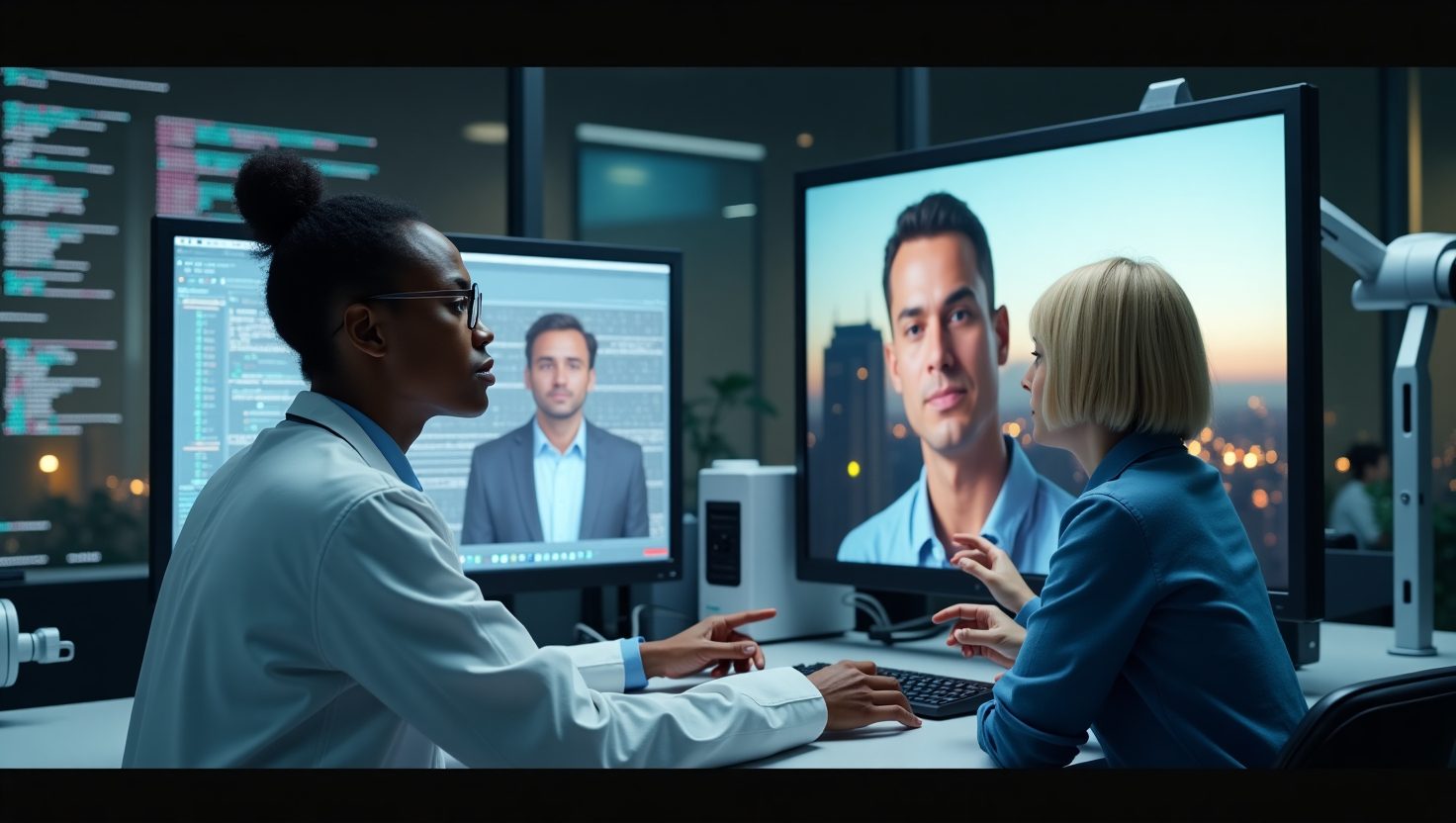
The conversation around deepfakes is often sidetracked by trivial examples—amusing face-swaps of actors in films where they never appeared. This misses the point entirely. We are talking about a technology that can generate photorealistic people from thin air, put words in a politician’s mouth that they never spoke, and create ‘evidence’ of events that never happened. The very fabric of our shared reality is at stake, and the frantic scramble for effective deepfake detection has become one of the most critical technological and ethical battles of our time.
The Uncanniest of Valleys: What Exactly Are We Fighting?
At its core, a deepfake is the product of a clever AI technique, most famously using Generative Adversarial Networks, or GANs. Imagine two AIs locked in a duel. One, the ‘Generator’, creates a fake image—say, a picture of a news anchor. The other, the ‘Discriminator’, has been trained on thousands of real images of that anchor and its job is to spot the forgery. Every time the Discriminator catches a fake, the Generator learns from its mistakes and tries again, getting progressively better. This loop runs millions of times until the Generator becomes so skilled that the Discriminator can no longer tell the difference. And as we’re now discovering, neither can we.
The implications are chilling. Think about the pillars of trust in our society. Journalism relies on photographic evidence. The justice system depends on video proof. Financial markets can be sent into a tailspin by a single, convincing image of a CEO’s fake resignation letter. A deepfake isn’t just a manipulated photo; it’s a weaponised lie, and its proliferation threatens to create a world where everything can be dismissed as fake, and every fabrication can be claimed as real. This is the ‘liar’s dividend’, where the mere existence of deepfakes makes it easier for bad actors to discredit genuine evidence.
Our Failing Eyesight: The Alarming New Reality
If you thought you had a good eye for spotting a fake, some rather sobering news just came out of Wales. A collaborative study by researchers at Swansea University, the University of Lincoln, and Ariel University has delivered a stark verdict: we are hopelessly outmatched. As reported by Nation.Cymru, the study found that AI-generated faces, created with readily available tools like DALL·E, are now “indistinguishable from real photographs”. That’s a direct quote from Swansea University’s Professor Jeremy Tree, and it should send a shiver down your spine.
The researchers ran a series of experiments with participants from several English-speaking countries, showing them a mix of real and AI-generated faces. The results were consistent and brutal. People simply couldn’t tell the difference. Perhaps most alarmingly, even when the images were of famous celebrities—faces we see constantly—our detection ability was just as poor. Professor Tree noted, “Familiarity with a face or having reference images didn’t help much in spotting the fakes”. The digital tells that forensic experts used to look for—odd blinks, weird hair physics, subtle lighting inconsistencies—are being ironed out at an astonishing rate. The forgers, in this case the AIs, are getting exponentially better, while our biological detection tools remain stubbornly analogue and fallible.
The Toolkit for Truth: Building a Defence
So, if our eyes can no longer be trusted, what can? The fight for digital trust isn’t a single battle; it’s a war fought on multiple fronts. Simply waiting for a deepfake to appear and then trying to debunk it is a losing strategy. We need a layered defence, combining proactive and reactive measures.
1. The Proactive Guard: Neural Watermarking and Content Provenance
The best way to spot a fake is to have the original creator vouch for its authenticity from the moment it’s made. This is the idea behind two crucial concepts:
– Content Provenance: Think of this as a digital birth certificate for an image or video. A new standard, spearheaded by the Coalition for Content Provenance and Authenticity (C2PA)—a group that includes Adobe, Microsoft, and Intel—aims to create a verifiable trail for media. When a camera takes a picture, it can cryptographically sign the file with metadata: who took it, when, where, and with what device. Every edit is then logged. When you view the file, your browser or app can check this ‘chain of custody’ and tell you if it has been tampered with. It’s the most promising piece of digital trust infrastructure being built today.
– Neural Watermarking: While content provenance tags a file, neural watermarking tags the AI model itself. Researchers are developing ways to embed an invisible, imperceptible signal into the output of generative AI models. Any image created by that model would carry this hidden watermark. This wouldn’t stop someone from creating a deepfake, but it would make it instantly identifiable as synthetic if the creator’s model used this technology. This is a vital component for any future synthetic media regulation, creating accountability for the model’s creators.
2. The Reactive Detective: Media Forensics and Image Authentication
When a piece of media appears without a clear provenance trail, we enter the world of digital forensics. This is the reactive side of deepfake detection.
– Media Forensics: This is the painstaking work of analysing pixels, compression artifacts, light sources, and other subtle clues to uncover manipulation. For years, experts looked for things like the unnatural smoothness of deepfaked skin or the lack of a proper reflection in the subject’s eyes. The problem, as the Swansea University study proves, is that these clues are vanishing. The AI models are becoming too good. While media forensics will always have a role, relying on it alone is like bringing a magnifying glass to a firefight.
– Image Authentication: This is the broader field that encompasses all the methods, both proactive and reactive, used to verify an image’s integrity. Effective image authentication in the modern era can’t just be about spotting flaws. It must pivot towards verifying authenticity. Instead of asking, “Is this fake?”, the more important question becomes, “Can we prove this is real?”. This shifts the burden of proof and prioritises technologies like content provenance.
The Clock is Ticking, and We’re Still Debating
The findings from Professor Tree and his colleagues are not an academic curiosity. They are a five-alarm fire. We are standing on the precipice of a misinformation crisis that will make the last decade look like a pleasant warm-up. Imagine a general election swayed by a last-minute deepfake video of a candidate. Imagine a company’s stock being wiped out by a faked audio clip of its CEO. This isn’t theoretical; it’s inevitable if we fail to act.
The current approach, a cat-and-mouse game between AI generators and AI detectors, is not a long-term solution. For every detection tool created, a more advanced generation model is already being trained to defeat it. The solution must be structural. It requires a fundamental re-architecting of how we create, share, and verify information online.
This means a few things, none of them easy:
1. Mandatory Standards: Tech companies, social media platforms, and device manufacturers need to aggressively adopt and integrate content provenance standards like C2PA. It should be as standard as HTTPS is for secure websites. A little ‘verified’ icon next to an image could become the most important symbol on the internet.
2. Regulation with Teeth: The discussion around synthetic media regulation needs to move from cautious debate to concrete action. This could involve mandates for neural watermarking in commercial generative AI tools and clear legal liabilities for the malicious creation and distribution of harmful deepfakes.
3. Public Literacy: We need a massive public education campaign, not to teach people how to spot fakes—we’ve just seen that’s a failing game—but to teach them to seek verification. The new mantra shouldn’t be “don’t believe everything you see,” but rather, “don’t trust anything that isn’t verified.”
The deepfake dilemma is a human problem enabled by technology. The researchers at Swansea have given us the final, unambiguous warning. Our own senses are no longer reliable witnesses. The question now is whether we will build the systems necessary to restore a baseline of digital trust, or whether we will let our shared reality dissolve into a sea of plausible deniability.
What do you think? Is a universal standard for content provenance achievable, or is it a pipe dream? And what role should governments play in regulating this technology before it’s too late?



