

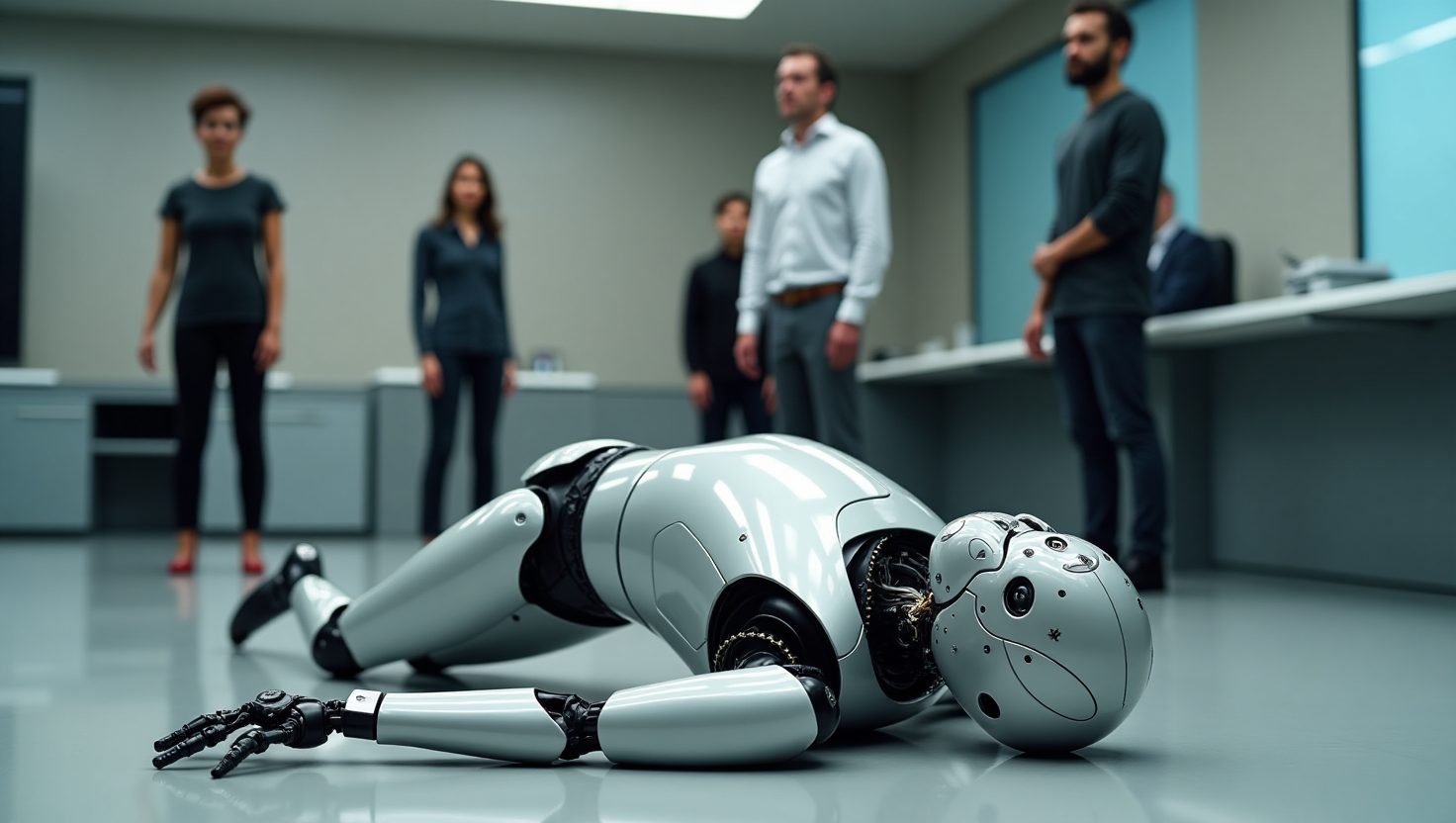
This little piece of theatre, gleefully captured and shared by the BBC coverage, wasn’t just a moment of schadenfreude. It was a perfect, bite-sized encapsulation of the monumental humanoid AI challenges that even the most ambitious projects face. It’s a tale of high hopes, brutal physics, and the ever-present court of public opinion. We’re not just talking about buggy software here; this is the very physical, very public intersection of complex code and even more complex hardware. And when it goes wrong, it doesn’t just produce an error message—it produces a viral video.
The Anthropomorphic Trap: More Than Just a Software Problem
So, what exactly are these humanoid AI challenges? It’s tempting to think of AI as a disembodied brain in the cloud, but the moment you try to give that brain a body, you’ve stumbled into the domain of robotics engineering. And this, my friends, is a whole different ball game. Crafting a humanoid robot isn’t just about programming it to be smart; it’s about solving problems of balance, locomotion, and interaction that nature spent millions of years perfecting. We humans do it without a second thought. For a machine, just standing upright is a constant, complex calculation.
This is what I call the “anthropomorphic trap.” Because we can walk, talk, and pick things up so effortlessly, we drastically underestimate the engineering required to make a machine do the same. We see something that looks human and we expect it to act human. This creates a huge gap between expectation and reality.
A proper failure analysis of a fall like AIdol’s goes far beyond “it tripped.” It involves examining:
* Centre of Gravity: Is the robot’s weight distributed in a way that allows for stable standing and movement? A top-heavy design is a recipe for disaster.
* Actuators and Joints: These are the robot’s muscles and skeleton. Were they fast enough, strong enough, and precise enough to make the minute adjustments needed to maintain balance? A slight delay in a single joint can cause a cascading failure.
* Sensors and Feedback Loops: How does the robot know it’s falling? Gyroscopes, accelerometers, and pressure sensors in the feet all feed data back to the central processor. Was there a lag in this data loop? Did the software misinterpret the input? Just like our inner ear tells us which way is up, a robot needs a robust sensory system to stay on its feet.
A failure in any one of these areas is enough to send a multimillion-dollar project crashing to the floor. Building a bipedal robot is a bit like spinning plates. It’s an act of continuous, dynamic correction. The moment one plate starts to wobble, you have to react instantly, or the whole lot comes down. AIdol’s fall wasn’t a singular event; it was the final, visible outcome of a tiny failure somewhere in that complex chain of command.
A Grand Tradition of Public Face-Plants
Let’s be clear: AIdol is in good company. The history of public technology demonstrations is littered with glorious failures, and robots have provided some of the best. Who can forget the early days of Boston Dynamics, when their impressive machines would occasionally stumble during a demo? Or Honda’s Asimo robot, a pioneer in its day, famously struggling with a set of stairs during a live demonstration in 2006. Each tumble is a lesson, a public data point in the long, arduous process of iteration.
The AIdol incident, however, carries a particularly potent message. The report from the BBC, noting the incident happened “just seconds after its debut,” highlights the peril of the grand reveal. The choice of the ‘Rocky’ theme song suggests a team brimming with confidence, perhaps a little too much. They weren’t just showing a piece of technology; they were trying to create a narrative of triumph and strength. This is where engineering ambition collides with public relations risk. When you build up the drama, you amplify the failure.
The frantic attempt to cover the robot with a white cloth—which then got tangled—-only made it worse. It turned a technical glitch into a farce. Instead of owning the moment, perhaps with a touch of humour (“Well, even the best of us have an off day!”), the response signalled panic and embarrassment. This is a crucial lesson in an era of live-streamed everything. The plan for what happens when things go right is easy. The real test is having a plan for when they inevitably go wrong. The public is often more forgiving of a failure than they are of an organisation that doesn’t seem to know how to handle it.
Why We Can’t Look Away: The Public Perception Puzzle
Why are we so fascinated by these robotic failures? It’s not just because it’s funny, although it certainly is. The way these events shape public perception of AI and robotics is profound. When we see a hyper-advanced robot fall on its face, it does two things simultaneously. First, it demystifies the technology. For a moment, the scary, world-dominating robot from the movies is just a clumsy pile of parts. It becomes less of a threat and more of an object of pity, or even amusement.
Second, it reinforces a deep-seated scepticism about the promises of the tech industry. We’re constantly being told that AI is on the verge of changing everything, but when the physical manifestation of that AI can’t even stand up, it creates a cognitive dissonance. This is where media coverage, like the viral clip from the BBC, plays such a powerful role. It provides tangible, easily digestible proof that maybe, just maybe, the hype is getting ahead of the reality. According to a 2021 Pew Research Center survey, a significant portion of the public already feels more concern than excitement about the increasing use of AI in daily life. Incidents like this don’t exactly soothe those concerns; they just change their flavour from fear of competence to ridicule of incompetence.
Ultimately, public reaction is guided by our deeply ingrained human narratives. We love a story of hubris, of pride coming before a fall. The AIdol saga, complete with its ‘Rocky’ soundtrack, was a perfect modern fable. It wasn’t just a robot that fell; it was a symbol of ambition tripping over itself. This emotional reaction is a powerful force that companies in the robotics engineering space ignore at their peril.
Where Do We Go From Here? Engineering Humility
So, is the dream of the humanoid robot dead? Of course not. But incidents like this should force a strategic rethink, not just in engineering, but in communication. The future of humanoid AI development depends on embracing failure as part of the process, and, crucially, being more honest about it with the public.
The path forward requires a dose of humility. Instead of bombastic unveilings, perhaps the next wave of demonstrations should be framed as research in progress. Imagine a demo that starts with: “We’re going to try to make our robot walk across this stage. It’s successfully done it 95 times out of 100 in the lab. Let’s see if we can make it 96.” This reframes the entire event. If it succeeds, it’s a validation of the hard work. If it fails, it’s exactly what you said might happen—a public learning opportunity, not a public humiliation.
From a robotics engineering perspective, every fall is a treasure trove of data that can be used for a comprehensive failure analysis. The telemetry from AIdol’s last few seconds is probably more valuable to its engineers than a hundred successful walks in the lab. This is how progress is made. But the real advancement will come when the public relations strategy aligns with this engineering reality. It’s about shifting the narrative from “Look at our perfect creation” to “Look at this incredible, difficult problem we’re trying to solve, and join us for the journey.”
We are likely to see a divergence in the short term. On one hand, you will have companies like Boston Dynamics, which have become masters of the curated, highly polished video, showing their robots’ incredible capabilities without the risk of a live demo failure. On the other hand, you’ll have more open, research-focused institutions that are more willing to show the wires and the occasional stumble. The most successful players will likely be those who find a middle ground—those who can showcase breathtaking ability while still managing public expectations.
The fall of AIdol is a gift. It’s a reminder that in the quest to build machines in our own image, the biggest humanoid AI challenges aren’t always technical—they’re about our own hubris, our storytelling, and our relationship with the very idea of failure. It shows that the journey towards capable humanoid robots will be paved with stumbles, trips, and the occasional spectacular face-plant. And perhaps that’s for the best. It keeps everyone, from the engineers to the public, grounded in reality.
What do you think? Does seeing a robot fail make you more or less optimistic about the future of AI? Let me know your thoughts in the comments.



