

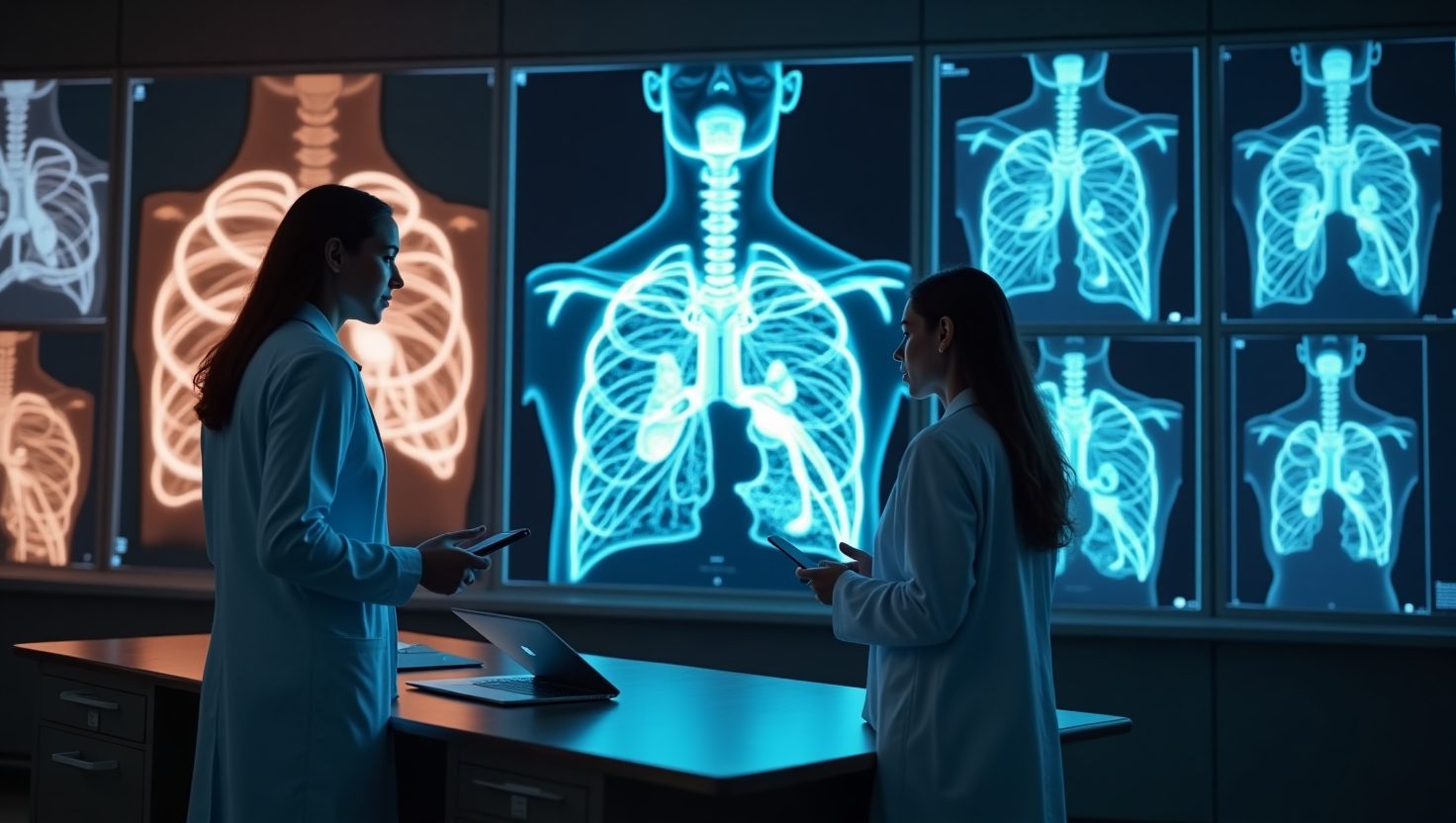
This brings us to a rather fascinating development from the University of Southampton. Researchers there have been working on a problem that is devilishly difficult: finding things in a person’s airway that are, for all intents and purposes, invisible. This isn’t just another academic exercise; it’s a tangible step forward in medical AI imaging that could prevent serious illness and even save lives. It forces us to ask a crucial question: are we finally moving from the hype of healthcare AI to genuine, measurable help?
So, What Exactly Is Medical AI Imaging?
Let’s demystify this. At its core, medical AI imaging involves training a computer model to read medical scans—like X-rays, MRIs, or in this case, CT scans—and identify patterns that might indicate a problem. Think of a radiologist as a master detective, a Sherlock Holmes poring over grainy images for the most subtle clues. They have years of training and an incredible ability to spot anomalies. Now, imagine giving this detective a new partner—an AI that has memorised every single case file in history. It can’t replace the detective’s intuition or experience, but it can flag a detail they might have missed on a Tuesday afternoon after their seventh cup of tea.
This is particularly important in CT scan analysis. A single CT scan can generate hundreds or even thousands of individual image slices. Sifting through this mountain of data to find one tiny, troublesome spot is an immense task. The AI acts as an advanced filter, drawing the expert’s attention to the areas that matter most. It doesn’t make the decision; it sharpens the focus. This collaborative approach is where the true power of healthcare AI lies—not in replacing experts, but in augmenting them.
A Breakthrough in Spotting the Invisible
The specific challenge the Southampton team tackled is known as radiolucent foreign body aspiration (FBA). In plain English, this is when someone, often a child, inhales something that doesn’t show up clearly on a standard X-ray. Think of small plastic toy parts, nuts, or bits of carrots. These objects don’t block X-rays the way bone or metal does, so they are incredibly difficult to spot. According to one study, these “invisible” items account for up to 75% of adult FBA cases, and delays in foreign object detection can lead to serious complications like pneumonia or a collapsed lung.
The results of their research, published in the esteemed journal npj Digital Medicine, are nothing short of remarkable. The team developed an AI model and pitted it against experienced radiologists in analysing 70 CT scans. The findings were stark:
The AI model correctly identified the presence of a foreign body in 71% of the cases.
The human radiologists, working without AI assistance, managed a detection rate of just 36%.
Let that sink in. The AI was nearly twice as accurate. What’s more, the model had a precision rate of 77%, meaning when it flagged something, it was right more than three-quarters of the time. In the world of diagnostics, these aren’t just incremental gains. This is a step-change in diagnostic accuracy. As Dr. Yihua Wang, a lead author on the study, noted, “The results demonstrate the real-world potential of AI in medicine, particularly for conditions that are difficult to diagnose through standard imaging.”
AI as the Expert’s Apprentice, Not Their Replacement
It’s tempting to frame this as a “man versus machine” contest, but that would miss the point entirely. The researchers are very clear that this tool is designed to assist, not replace. Zhe Chen, a PhD student who developed the model, puts it perfectly: “Our AI model acts like a second set of eyes, helping radiologists detect these hidden cases earlier and more reliably.” This vision of human-AI collaboration is the most realistic and promising path forward.
Consider the workflow. A radiologist still examines the scan, bringing their wealth of contextual knowledge to the table. Does the patient have a history of choking? What are their symptoms? The AI, meanwhile, performs its highly specialised task: mapping the intricate branches of the airway and highlighting subtle secondary signs of a blockage, like trapped air or slight inflammation, that are easy for the human eye to miss.
This isn’t about a machine taking over. It’s about building a better toolkit. The radiologist is still the pilot, but they now have a vastly improved navigation system that can see through the fog. This changes the value proposition of the expert. Their job shifts slightly from pure detection to higher-level interpretation, integrating the AI’s findings into a complete clinical picture. The real improvement in diagnostic accuracy comes from this partnership.
The Inevitable Hurdles: Bias and the Data Desert
Of course, it’s not all smooth sailing. Every exciting advance in AI comes with a healthy dose of caution, and medical AI imaging is no exception. The most significant challenge is data bias. This particular model was trained on scans from over 400 patients from hospitals in China. While highly effective on that dataset, a critical question remains: will it perform as well on scans from a different demographic, taken on different machines, in a different part of the world?
This is why the next step, as the researchers point out, is so crucial: multi-centre studies. To build a truly robust and trustworthy healthcare AI, you need to train and validate it on diverse data from various hospitals, countries, and populations. Without this, you risk creating a tool that works wonderfully for one group but fails another, entrenching existing health inequalities. This need for broader, more inclusive research is recognised by funding bodies like the Medical Research Council, which supported this work.
Tackling this data problem is the central strategic challenge for the entire field. It requires unprecedented collaboration between hospitals, which are often protective of their data, and a regulatory framework that can ensure patient privacy while enabling crucial research. Getting this right is arguably harder than developing the algorithm itself.
The Future of the AI-Assisted Clinic
So, where does this leave us? This study is a powerful proof-of-concept. It shows that AI can solve specific, difficult diagnostic problems with remarkable effectiveness. The future of medicine likely won’t involve an all-knowing AI you chat with. Instead, it will be filled with dozens of specialised AIs like this one, each acting as a super-powered assistant for a specific task. There might be one for spotting invisible airway blockages, another for detecting early signs of Alzheimer’s on brain scans, and a third for identifying subtle fractures.
This will fundamentally change the nature of a radiologist’s job. Less time will be spent on the needle-in-a-haystack search and more time on complex case analysis, patient consultation, and treatment planning. The economic and training implications are massive. Medical schools will need to teach future doctors how to work with these AI tools, interpreting their outputs and understanding their limitations.
The road to widespread clinical adoption is long and paved with regulatory approvals, integration challenges with existing hospital IT systems, and the immense task of building trust with both clinicians and patients. But as this Southampton study shows, the technology is no longer the stuff of science fiction. The tools are becoming real, and their potential to improve diagnostic accuracy and patient outcomes is undeniable.
The real journey is just beginning. We’ve seen that the AI can work in a lab. Now, the industry must prove it can work reliably, ethically, and equitably in the messy, unpredictable real world.
What other hidden or difficult-to-diagnose conditions do you believe could be the next frontier for medical AI imaging? Share your thoughts below.



