

This isn’t just about some farmers having slow broadband. This is about the fundamental plumbing of the 21st-century economy. The discussion has moved on from simple connectivity to the capacity for data-intensive computation. Think of it this way: the global tech industry is building sophisticated, world-changing machines—the AIs themselves—but it’s forgetting to build the roads and power stations needed to deliver their benefits to everyone. For rural communities, this isn’t an abstract problem; it’s a barrier to economic survival, better healthcare, and a sustainable future. Closing this gap isn’t an act of charity, it’s a strategic necessity for a balanced and resilient national economy. So, why isn’t more being done?
The Great Digital Disconnect
When we talk about the AI rural infrastructure gap, we’re describing a multipart failure. It starts with the most obvious element: a lack of high-speed, reliable internet. But it goes much deeper. It includes a deficit in local data processing capabilities (edge computing), a scarcity of the sensors and IoT devices that feed AI models, and, crucially, a shortfall in the human skills needed to manage these systems. This combination creates a vicious circle: without the infrastructure, AI applications can’t be deployed; without the applications, there’s no business case to build the infrastructure.
Imagine trying to run a modern, automated warehouse. You have robotic arms, conveyor belts, and inventory management software. Now, imagine trying to power all of that with a single diesel generator that cuts out every few hours. That’s precisely the situation for many rural enterprises hoping to use AI. The tools for precision agriculture or remote diagnostics are technically available, but the power grid—the digital infrastructure—simply isn’t there to support them. While financial news celebrates SoftBank’s Vision Fund gaining $19 billion in a quarter from its tech bets, many rural businesses are still struggling to get a stable enough connection for a simple video call. The disparity is no longer just a gap; it’s a canyon.
5G Deployment: The Motorway Through the Countryside
The foundational solution is, without a doubt, a comprehensive and accelerated 5G deployment programme. To be clear, 5G isn’t just ‘faster 4G’. It’s a fundamentally different kind of network. Its low latency (the near-instantaneous response time) and high bandwidth are the critical ingredients that AI applications feast on. This is the technology that allows a drone to stream high-definition video of a crop field back to an AI model for real-time analysis or enables a surgeon to guide a robotic arm in a remote clinic with no perceptible delay.
Building this digital motorway is a monumental task. It requires laying fibre, erecting masts, and ensuring coverage isn’t just a patchwork of well-served towns and forgotten valleys. The private sector model, driven by customer density and profit, has historically failed these areas. This raises a difficult question: should high-speed rural connectivity be treated as a public utility, as essential as water and electricity? If governments can pass bills to end shutdowns, as the U.S. Senate recently did, surely they can marshal the political will to fund the digital backbone of the nation. The return on investment wouldn’t be measured in quarterly earnings but in national food security, improved public health, and revitalised local economies.
Precision Agriculture: AI Down on the Farm
Nowhere is the potential of AI in rural areas more tangible than in farming. Precision agriculture is the antidote to the old model of farming by the calendar and the almanac. It’s about using data to make surgically precise decisions. Today, this means using AI-powered systems to:
* Analyse soil health: Sensors in the ground feed data to an AI, which recommends the exact blend of nutrients needed for a specific patch of soil, reducing fertiliser waste and environmental runoff.
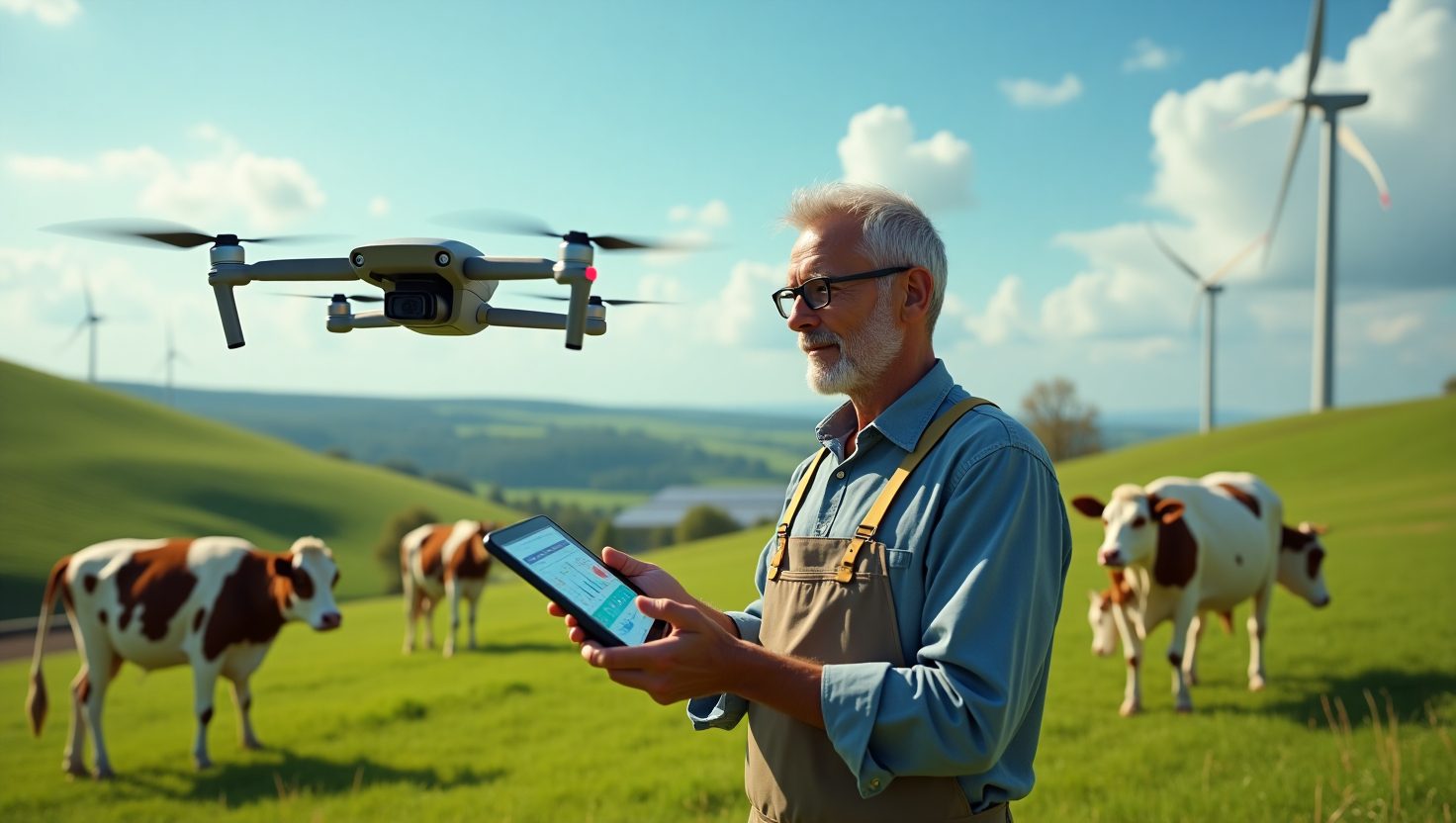
* Monitor crop health: Drones equipped with multispectral cameras can fly over hundreds of acres, with AI algorithms spotting signs of disease or pests weeks before a human eye could. This allows for targeted treatment instead of broad-spectrum pesticide spraying.
* Optimise water usage: By combining weather forecast data with soil moisture readings, AI can predict exactly when and how much to irrigate, a crucial tool in the face of increasingly unpredictable weather patterns.
* Automate harvesting: Autonomous tractors and robotic harvesters, guided by GPS and computer vision, can work around the clock, increasing efficiency and addressing labour shortages.
Each of these innovations promises to make farming more productive, profitable, and sustainable. But they all share a common vulnerability: they are dependent on a constant, robust flow of data. A farmer’s state-of-the-art drone is just an expensive toy if it can’t upload its terabytes of image data for analysis. The promise of precision agriculture will remain unfulfilled as long as the AI rural infrastructure gap persists.
Enhancing Telehealth Access: The AI-Powered Diagnosis
The postcode lottery in healthcare is one of the most unjust consequences of the rural-urban divide. For many living in remote areas, a trip to see a specialist can mean a full day of travel. Telehealth access has been hailed as the solution, but video consultations are just the beginning. The real revolution in remote healthcare will be driven by AI. We are on the cusp of a world where AI can perform initial diagnoses from home-based sensors, analyse medical images like X-rays and MRIs with superhuman accuracy, and create personalised patient care plans.
This technology could be transformative for rural healthcare. It would reduce the burden on local GPs, allow specialists to “see” more patients, and catch serious conditions earlier. However, this, too, is predicated on infrastructure. An AI can’t analyse a high-resolution CT scan if the file can’t be uploaded from the rural clinic. A remote monitoring device for a cardiac patient is useless if its connection keeps dropping. We’re creating incredible life-saving tools that are inaccessible to the very people who might need them most. Is it equitable to have a healthcare system where your quality of care is determined by your broadband speed?
Community Training: You Can’t Just Hand Over the Keys
Let’s assume we solve the physical infrastructure problem tomorrow. We wave a magic wand, and every village, farm, and remote business has gigabit fibre and 5G coverage. Is the problem solved? Not even close. You can’t just parachute advanced technology into a community and expect it to work. The final, and perhaps most important, piece of the puzzle is community training.
This isn’t about running a few evening classes on how to use Microsoft Word. It’s about embedding deep, sustainable digital skills within the community itself. This means:
* Vocational training for new roles: Equipping people with the skills to maintain the new infrastructure, to service the agricultural drones and sensors, and to act as local tech support for AI-driven health devices.
* Digital literacy for business owners: Teaching farmers, small-business owners, and artisans how to leverage AI tools to find new markets, optimise their operations, and manage their data.
* Creating local innovators: Fostering an environment where young people in rural areas don’t just see themselves as consumers of technology made elsewhere, but as creators and innovators in their own right.
Without this investment in people, the shiny new infrastructure will become a “white elephant”—a monument to good intentions but poor execution. The goal of community training is to give people not just access to the tools, but ownership of them. It’s about ensuring the benefits of AI are captured locally, creating jobs and wealth within the community rather than funnelling it all back to a handful of tech companies in the capital.
A Future of Digital Equality or Digital Feudalism?
The AI rural infrastructure gap is one of the defining challenges of our time, but it presents an equally significant opportunity. Addressing it is not simply a technical project; it is an economic, social, and moral imperative. The current trajectory, where investment floods into AI applications while the foundational infrastructure in vast swathes of the country crumbles, is leading us towards a form of digital feudalism. A future where hyper-efficient, AI-driven cities are served by a technologically disenfranchised rural hinterland.
The solutions are within our grasp. It will require a blend of public investment in foundational infrastructure like 5G deployment, private innovation in areas like precision agriculture and telehealth access, and a deep societal commitment to community training. We need policymakers and investors to look beyond the dazzling stock performance of companies like CoreWeave or Broadcom, as reported by outlets like CNBC, and see the far greater long-term value in building an inclusive digital society.
Ultimately, we have to ask ourselves a simple question: what kind of future are we building? Is it one where the transformative power of AI is a privilege for the few, or a right for all? What are your local leaders doing to close this gap in your community?



