

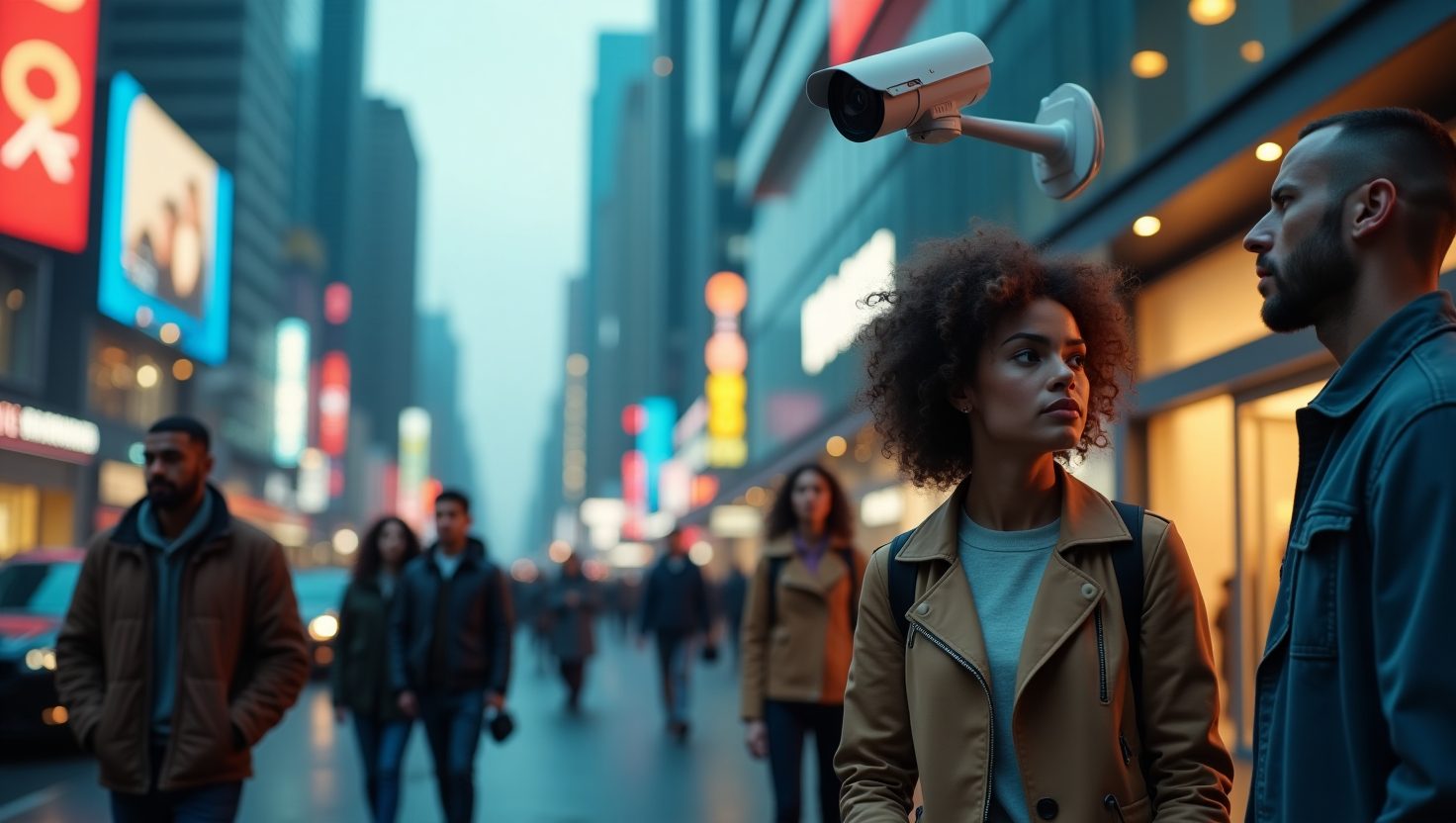
But what if those cameras could do more than just record? What if they could understand what they were seeing? This isn’t science fiction; it’s the very real and rapidly advancing field of context-aware video AI. This technology is poised to transform video security from a passive observer into an active, intelligent participant. It’s the engine that will power not just better security, but also the ambitious visions of smart city monitoring, where technology works to make urban life safer and more efficient for everyone. The era of the dumb camera is ending, and what comes next is far more interesting.
What on Earth is Context-Aware Video AI, Anyway?
So, what separates this new-fangled AI from the old guard of CCTV? It all comes down to one word: context.
Traditional video surveillance is based on simple rules. If pixels move in a certain area, trigger an alert. It doesn’t know if that movement is a burglar, a stray cat, or just a plastic bag blowing in the wind. This leads to a flood of false alarms, a phenomenon security professionals call ‘alert fatigue’. It’s like the boy who cried wolf, but the wolf is usually just a branch swaying. After the hundredth false alarm, a human operator simply starts ignoring them. The system, for all its expense, becomes little more than background noise.
Context-aware video AI, however, operates on a completely different level. Instead of just seeing pixels, it learns the ‘normal’ patterns of a scene. It understands that people walk on pavements but not on railway tracks. It knows that a delivery van arriving at a loading bay at 10 AM is normal, but a person loitering there at 2 AM is not. It understands the relationship between objects, time, and behaviour. This is the core of what makes adaptive surveillance systems so powerful; they adapt their understanding to the environment they are monitoring.
Think of it this way: a traditional camera system is like a security guard who can only see. They can report “a person is in the warehouse,” but that’s it. A context-aware AI system is like a seasoned security chief. They can report, “a person is in the high-value goods section of the warehouse, it’s after hours, they are not wearing a standard uniform, and they are moving towards the exit, not the employee breakroom.” One is simple observation; the other is actionable intelligence. That difference is everything.
The Pillars of Intelligent Surveillance
This shift from seeing to understanding is built on a few key technological and philosophical pillars. It’s not just about better algorithms; it’s a fundamental change in how we design and deploy security systems.
Real-Time Threat Detection That Actually Works
The true magic of context-aware AI lies in its ability to process information and identify genuine threats as they happen. This capability for real-time threat detection moves security from a reactive to a proactive stance. Instead of reviewing footage of a break-in, the system can alert security before the door is even forced open by recognising anomalous behaviour, like someone tampering with the lock.
In a manufacturing plant, for instance, the AI can detect if a worker steps into a hazardous zone without the proper safety gear and send an alert in less than a second. This has been demonstrated in real-world deployments where alerts are delivered almost instantaneously, preventing accidents before they occur. For public safety, it could mean identifying a vehicle driving erratically or a suspicious package left unattended in a transport hub, allowing for an immediate response. The system isn’t just looking for pre-programmed ‘bad things’; it’s looking for anything that deviates from the established norm, which is a far more robust way to spot trouble.
Privacy-First Security: The Great Tightrope Walk
Now for the elephant in the room. The words “AI” and “video surveillance” in the same sentence can, quite rightly, make people nervous. The spectre of an Orwellian surveillance state looms large in these discussions. This is where the concept of privacy-first security becomes not just a feature, but a foundational requirement for any company that wants to be taken seriously.
Intelligent system design can actually enhance privacy compared to old-school CCTV. How? By focusing on metadata, not personal identity. The AI doesn’t need to know who you are; it just needs to know that you’re a ‘person object’ and that you’re in a place where you shouldn’t be. Advanced systems can automatically blur or pixelate faces of individuals not involved in a security event, ensuring that the privacy of innocent bystanders is protected by default.
Furthermore, by processing data at the ‘edge’—meaning on the device itself or a local server—sensitive video footage doesn’t need to be constantly streamed to a centralised cloud. Only clips of relevant security events are sent, and these are typically encrypted from end to end. This decentralised approach dramatically reduces the risk of massive data breaches. It’s about getting the security benefits without creating a giant, tempting database of everyone’s movements.
Powering Smart City Monitoring
When you scale this technology up from a single building to an entire city, you unlock its potential to revolutionise urban management. The goal of smart city monitoring isn’t to watch everyone all the time. Instead, it’s about using data to make cities function better.
Context-aware AI can analyse traffic flow in real time, automatically adjusting traffic light timings to reduce congestion. It can identify overflowing bins to optimise waste collection routes, or spot infrastructure damage like potholes or broken streetlights for faster repairs. In public parks, it can monitor footfall to help authorities understand usage patterns and plan maintenance or new facilities more effectively. This is where surveillance evolves into a civic utility, a nervous system for the city that improves quality of life whilst, if designed correctly, respecting the privacy of its citizens.
Case Study: Lumana and the Art of Ripping It Up and Starting Again
For years, the surveillance industry has been dominated by a few big players content to sell the same old hardware with slight tweaks. But as with any stagnant industry, it was ripe for a shake-up. Enter companies like Lumana, who looked at the situation and decided the only way to fix the problem was to rebuild the entire system from the ground up.
The Rotary Phone Problem
The core challenge, as Lumana’s VP of Marketing, Jordan Shou, so brilliantly put it, is that “Adding AI on top of outdated infrastructure is like putting a smart chip in a rotary phone.” You can try, but you’re fundamentally limited by the old technology. Legacy systems were designed to record and store video, not to analyse it in real time. They lack the processing power, the right software architecture, and the modern data pipelines needed for true AI.
This isn’t just a niche problem. A recent study from F5 revealed a shocking statistic: only 2% of companies consider themselves fully ready to scale their AI systems. This highlights a chasm between the ambition to use AI and the foundational readiness to do so effectively. Most are trying to fit the square peg of AI into the round hole of their existing, decades-old infrastructure. It’s a recipe for failure, frustration, and wasted investment.
Lumana’s Full-Stack Overhaul
Lumana’s strategy is a classic case of attacking the incumbent’s weakness. Instead of selling a piece of software to layer on top of old cameras, they created an integrated system of hardware, software, and proprietary AI. Their hybrid-cloud design is key to this.
* Powerful Edge Computing: They use powerful GPU-based processors at the edge, close to the cameras. This is where the heavy lifting of video analysis happens. It means the system can analyse video streams in real time without the latency of sending everything to a distant data centre.
* Continuous Learning: Their AI models aren’t static. They employ continuous learning, meaning the system gets smarter over time. It learns the specific patterns of its environment, constantly refining its understanding of ‘normal’ and becoming more accurate at spotting anomalies.
* A Focus on Results: This integrated approach delivers tangible results. One of their clients, a manufacturing company called JKK Pack, reported that after implementing Lumana’s system, their security investigations were 90% faster. That’s a staggering improvement in operational efficiency. It’s the difference between spending a full day searching for a 10-second clip and finding it in minutes.
By building the entire stack, they control the whole experience and can guarantee the performance that bolting on an AI solution simply can’t. It’s a more complex and capital-intensive strategy, but it’s the only one that truly solves the customer’s problem.
The Future: From Seeing to Predicting
So, where is this all heading? The evolution of video security is moving beyond just detection and into the realm of reasoning and prediction. Today’s context-aware video AI can tell you something is wrong. Tomorrow’s AI might be able to predict that something is about to go wrong.
By analysing subtle patterns over long periods, these systems could potentially identify precursor behaviours that lead to security incidents, safety violations, or operational bottlenecks. Imagine an AI that notices a machine is vibrating in a slightly unusual way days before it fails, or that a change in pedestrian flow indicates a growing crowd that could become a safety issue. This predictive capability is the holy grail for security and operations teams.
However, this increased power will inevitably bring even more intense scrutiny. The debates around data ownership, algorithmic bias, and the potential for misuse will only grow louder. The companies that will win in this space will be those that not only build the smartest technology but also build the most trust by being transparent, designing for privacy, and engaging in the ethical conversation proactively.
Ultimately, the journey from dumb surveillance to intelligent security is a fascinating one. It’s about more than just better cameras; it’s about building systems that understand the world in a more nuanced way. The shift from reactive recording to proactive, adaptive surveillance systems is well underway. The question for businesses, city planners, and citizens alike is no longer if this technology will become widespread, but how we choose to implement it.
What are your biggest concerns or hopes for this technology? How do we strike the right balance between security and privacy? Let me know your thoughts in the comments below.



