

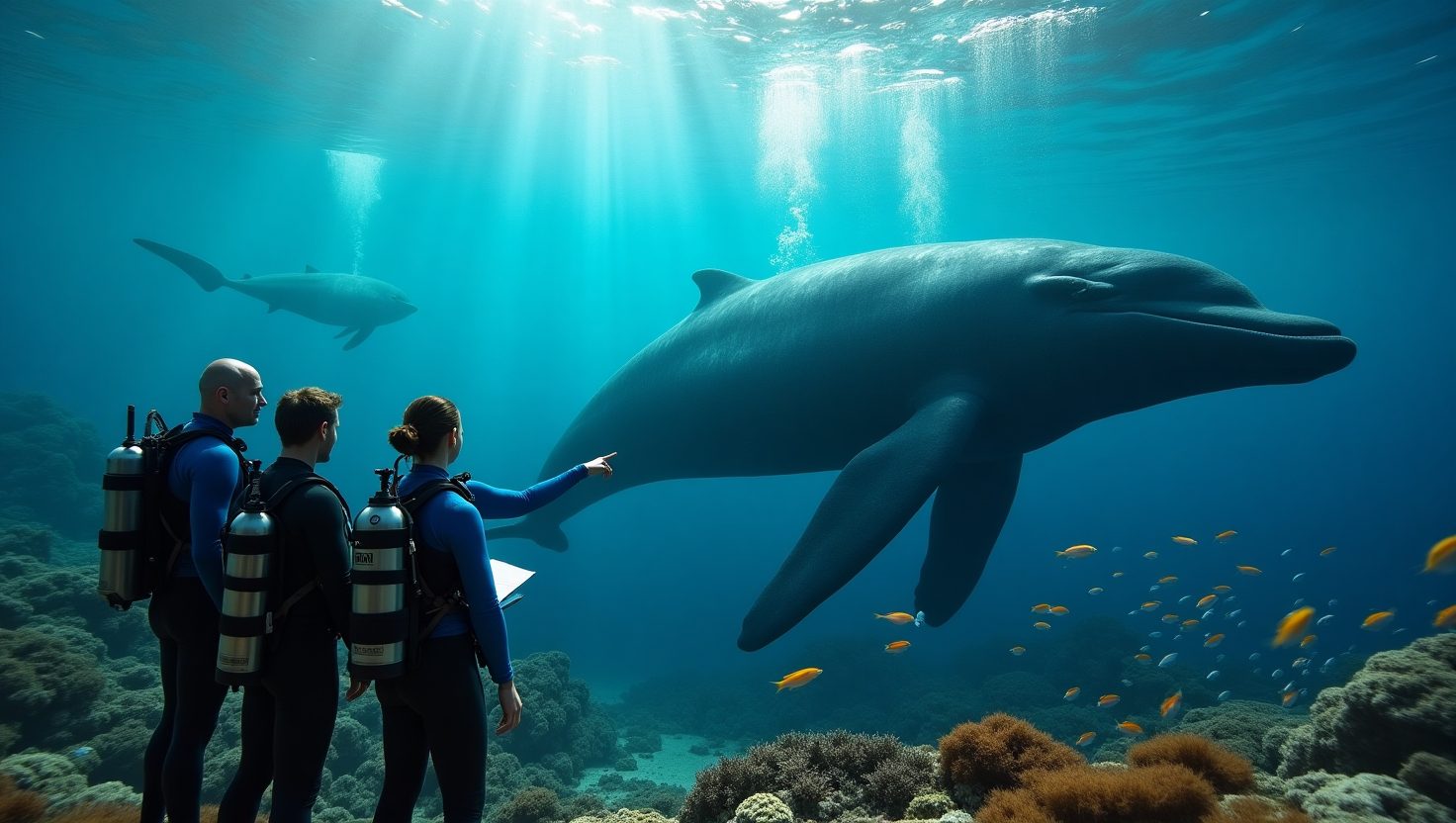
For as long as we’ve told stories, we’ve dreamt of talking to animals. From folklore to Disney films, the idea has been a source of wonder. But let’s be honest, it’s always been filed under ‘fantasy’. Now, what if I told you that the barrier between us and them, the one that’s defined our relationship with the natural world for millennia, is starting to crumble? Not because of magic, but because of machine learning. The field of AI animal communication is exploding, and it’s dragging us into a future that’s more science fact than science fiction—a future where “animal rights” might mean something far more literal than we ever imagined.
This isn’t just about satisfying a childish curiosity. This is about a fundamental shift in how we see ourselves and our place on this planet. By using artificial intelligence to decode the complex vocalisations of other species, we are on the verge of not just listening, but understanding. And once you begin to understand, you can no longer plead ignorance. The implications for law, conservation, and ethics are staggering. We are building a Rosetta Stone for the entire animal kingdom, and what we find might just force us to rewrite the rules.
The AI Engine Listening to the Wild
So, how exactly do you get an AI to speak ‘whale’? The key lies in a field called bioacoustic analysis. For decades, scientists have been painstakingly recording the clicks, whistles, and songs of the animal world. Think of it as a colossal, planet-sized audio library, filled with the sounds of everything from bats to blue whales. The problem has always been one of scale. A human researcher can spend a lifetime analysing a tiny fraction of this data, manually spotting patterns and tagging sounds. It’s valuable work, but it’s like trying to reads the entire internet one page at a time. It’s simply not possible.
This is where artificial intelligence changes the game. Machine learning models, not unlike the large language models powering tools like ChatGPT, can be trained on these massive acoustic datasets. They don’t get tired, they don’t need coffee, and they can process petabytes of audio, identifying subtle patterns in frequency, duration, and rhythm that are completely invisible to the human ear.
Imagine you’re trying to learn a new language by listening to thousands of hours of radio broadcasts all at once. You’d be overwhelmed. An AI, however, can sift through that cacophony and begin to piece together the structure. It might first identify individual ‘letters’ (specific clicks or chirps), then notice how those letters form ‘words’ (recurring sequences), and eventually, how those words are arranged into ‘sentences’ with a discernible grammar. This is precisely what’s happening with AI animal communication. It’s moving bioacoustic analysis from a manual craft to a high-throughput science, revealing a hidden layer of complexity in the animal kingdom.
Speaking with Giants: The Cetacean Translation Initiative
Nowhere is this technological leap more apparent than in the ocean’s depths. Let’s talk about the Cetacean Translation Initiative, or CETI, a moonshot project with a goal that is as simple as it is audacious: to translate the communication of sperm whales. As detailed in a recent report by Inside Climate News, CETI is a multidisciplinary team of cryptographers, roboticists, linguists, and marine biologists who are pointing some of the world’s most sophisticated AI at the clicks of sperm whales.
Why sperm whales? Because they are intensely social and cultural creatures with the largest brains on Earth. They communicate using a series of clicks called ‘codas’. For a long time, we knew these codas existed, but we didn’t understand their intricacy. The CETI project, led by figures like City University of New York biology professor David Gruber, has deployed an arsenal of high-tech listening devices to capture these sounds with unprecedented clarity.
What the Whales Are Saying
The early results are mind-blowing. By feeding millions of recorded codas into their machine learning algorithms, CETI has started to uncover what they describe as a “sperm whale phonetic alphabet.” They’ve discovered that whales don’t just click randomly; they structure these codas into elaborate exchanges that bear all the hallmarks of a real conversation. They have accents, dialects, and family-specific conversational styles. The AI has revealed a combinatorial system of communication—where basic units are combined to create a vast vocabulary—that looks suspiciously like a key feature of human language.
From Translation to Liberation?
This isn’t just an academic exercise. The findings have profound implications for conservation tech and animal rights. If we can prove scientifically that whales possess a complex, cultural, and linguistic society, the argument for their legal protection becomes almost unassailable. How can we justify industrial-level noise pollution that effectively blinds and deafens them? As David Gruber puts it, “A deaf whale is a dead whale.” Their entire social world is built on sound. Disrupting that isn’t just an inconvenience; it’s an act of cultural destruction. The data from CETI could become Exhibit A in a courtroom, a powerful tool for advocates arguing for a whale’s right to exist free from human-caused harm.
If We Can Talk, What Are Our Obligations?
This brings us to the thorniest question of all: so what happens when we do translate? The nascent field of interspecies ethics is trying to grapple with this very problem. It’s one thing to advocate for animals based on our assumptions about their suffering. It’s another thing entirely if they can tell us themselves. Suddenly, concepts like ‘consent’ and ‘negotiation’ don’t seem so far-fetched.
César Rodríguez-Garavito, who directs the More-Than-Human Life program (MOTH) at New York University, is at the forefront of this legal frontier. He and his team are exploring how the evidence gathered through AI animal communication could be used to advance the global ‘rights of nature’ movement. This movement seeks to grant legal personhood to non-human entities like rivers, forests, and entire species, giving them standing in court.
If a corporation—a legal fiction—can have rights, why not a sperm whale clan with a demonstrable culture and language stretching back millennia? This research could provide the scientific backbone needed to make that argument stick.
Beyond the Western Lab
Crucially, this isn’t just a project for Western scientists in lab coats. The most forward-thinking researchers are actively involving Indigenous leaders in these initiatives. As Ashley Otilia Nemeth, a Cree woman from the Misipawistik Cree Nation and a fellow at MOTH, points out, Indigenous knowledge systems have always regarded animals as intelligent, sentient beings with their own societies and rights. Science is, in a way, just catching up to ancient wisdom. By integrating these two worldviews, we can approach interspecies ethics with far more humility and respect, avoiding the colonialist trap of simply imposing our own frameworks on the natural world.
The legal goal isn’t necessarily to have a human lawyer representing a pod of whales, but to establish fundamental rights, such as:
– The right to life and physical liberty.
– Protection from torture and cruel treatment (like deafening sonar).
– The preservation of their cultural environment.
That last point is revolutionary. It acknowledges that the staggering statistic of over 300,000 whales dying annually as fishing bycatch isn’t just a loss of individual lives; it’s the destruction of their cultural fabric. When an elder whale is killed, generations of knowledge about feeding grounds, migration routes, and social traditions can be lost forever.
AI as the Ultimate Conservation Tool
While full translation may still be years away, the technology is already delivering powerful wins for conservation tech. We don’t need a perfect whale dictionary to make a difference right now. The same AI models that are hunting for linguistic patterns can be used for more immediate, practical purposes.
For instance, algorithms can be trained to distinguish between different types of animal vocalisations. They can learn the difference between a ‘we’re just cruising’ call and a ‘there’s a predator nearby!’ alarm. They can identify the sounds of mothers communicating with their calves or the unique calls of a specific, identifiable individual.
Success in the Field
This is already happening. Here are a few ways this is being applied:
– Real-time Threat Detection: Hydrophone arrays in shipping lanes can use AI to listen for the presence of whales. If whale chatter is detected, the system can automatically send alerts to nearby vessels, telling them to slow down to avoid a collision.
– Anti-Poaching: In terrestrial environments, hidden microphones in rainforests can be trained to recognise the sound of gunshots or chainsaws. The moment the sound is detected, the AI can triangulate the location and notify rangers in real time, turning the entire forest into a smart security system.
– Monitoring Biodiversity: Instead of sending teams of people into the wild to conduct painstaking manual counts, we can simply listen. AI can analyse the soundscape of an ecosystem and provide a detailed, continuous census of the species present, tracking population health over time.
This application of AI animal communication is a game-changer for conservation. It allows us to monitor and protect ecosystems in a non-invasive, scalable, and highly effective way. By understanding the chatter of the natural world, we can become far better stewards of it.
Are We Ready to Listen?
We stand at a remarkable crossroads. The very technology that many fear will alienate us further from nature—artificial intelligence—may be the key to our deepest-ever connection with it. The work being done by CETI and others, powerfully documented by sources like Inside Climate News, is more than just a scientific project; it’s a philosophical one. It challenges the long-held assumption of human exceptionalism and asks us to consider the possibility that we are but one voice in a global choir.
Synthesising advanced AI with bioacoustic analysis is not just about decoding sounds. It is about opening a dialogue that could redefine our moral and legal responsibilities to the millions of other species with whom we share this planet. The journey into interspecies ethics will be complex and fraught with challenges, but it is a necessary one.
The technology has opened the door. The data is flowing in. The only remaining question is: are we truly prepared to listen to what they have to say? And what will we do when we find out we’re not alone in our ability to think, feel, and speak?



