

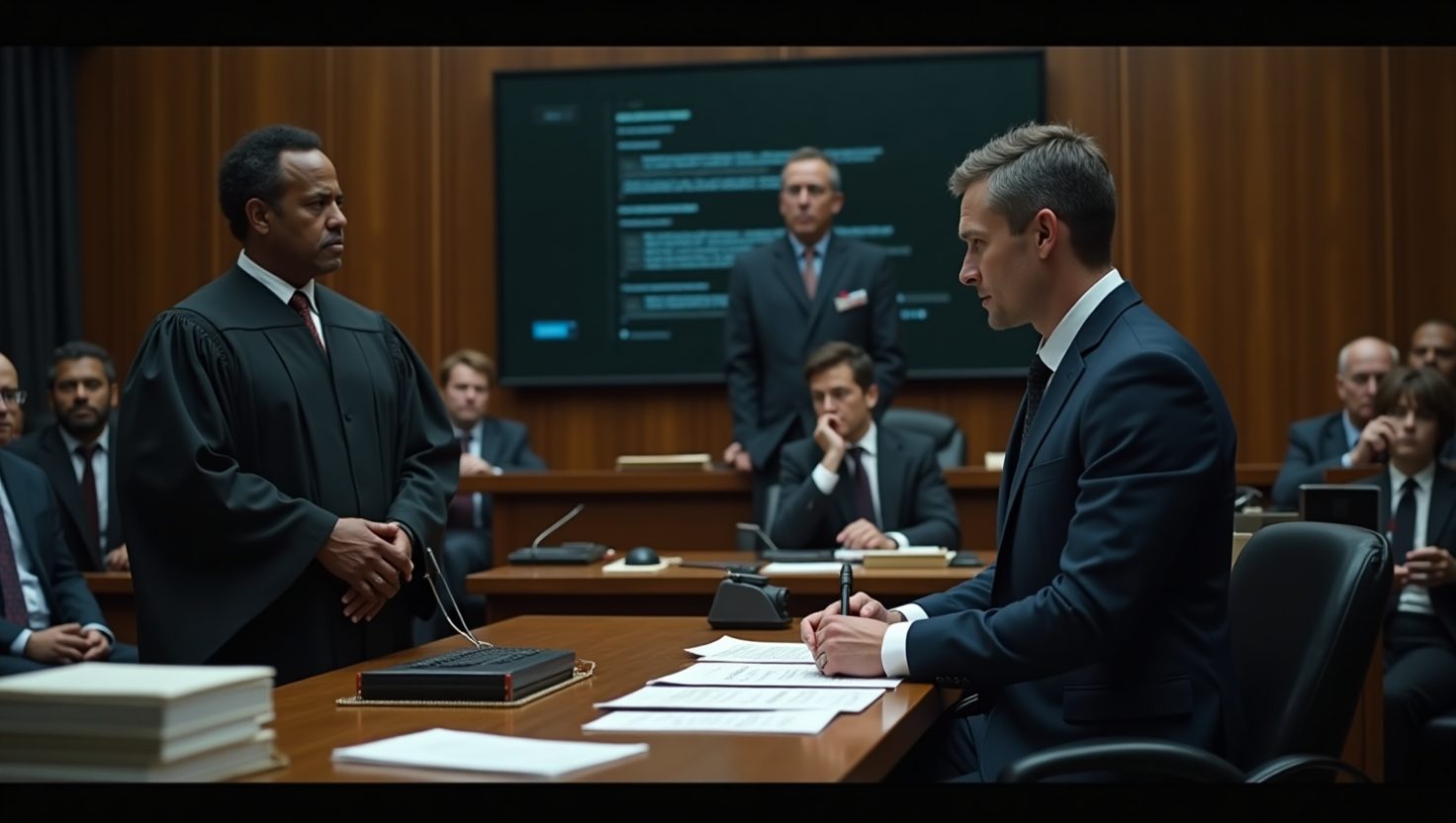
For years, we’ve been told that AI would revolutionise the legal profession. And to a degree, it has. Algorithms can now sift through mountains of case documents in seconds, a task that would take a squadron of junior solicitors weeks to complete. The promise is tantalising: democratise the law, make legal advice more accessible, and slash costs for everyone from multinational corporations to individuals fighting a parking ticket. It’s the classic tech playbook—aggregate a complex, fragmented industry and streamline it through a single, intelligent interface. But we’re now seeing the other side of that coin. What happens when the intelligence is, well, artificial in the worst sense of the word?
So, Your AI Walked Into a Courtroom…
Let’s talk about Mr Fu De Ren. He’s the owner of a property in a very desirable part of Vancouver that, unfortunately, suffered significant fire damage. B.C. Assessment, the provincial body responsible for valuing properties, initially pegged his lot at a cool $19,082,000. Mr Fu, quite reasonably, felt that a fire-damaged building wasn’t worth nearly that much and appealed to have the value slashed to a more modest $10 million. This dispute ended up before the Property Assessment Appeal Board of B.C.
To support his case, Mr Fu, who was representing himself, submitted several legal citations. The problem? They were completely fake. According to an official filing from the board, these cases were likely “AI hallucinations”. Andrew Loi, a senior appraiser for B.C. Assessment, put it bluntly in his submission: “The referenced cases do not exist, nor do the referenced quotes.” It’s like citing a blockbuster film in a scientific paper. The board panel chair, John Bridal, expressed clear frustration, noting that “the unraveling of these falsehoods has required investigation and research by both the Assessor and the Board.”
This isn’t some harmless error. It’s a waste of the court’s time and taxpayer’s money. This case, as reported by the CBC, highlights a looming crisis of accountability. When a solicitor presents false information, they can be disbarred. When a self-represented litigant does it, they can face costs and penalties. But what about the AI tool that generated the falsehood? It faces no consequences at all. It just moves on to the next query, blissfully unaware of the chaos it has sown. Who is the responsible party here? The user who trusted the black box, or the company that sold it to them?
The Trouble with Robots and Real Estate
The Fu De Ren case is a fascinating window into how these AI failures can warp critical processes like property valuation. In British Columbia, as in many jurisdictions, a property’s value isn’t just based on its current, fire-scorched state. Assessors look at its ‘highest and best use’—what it could be worth if developed to its full potential. This is a nuanced, principle-based concept. It requires an understanding of zoning laws, market trends, and economic potential.
An AI chatbot, however, doesn’t understand principles. It’s a statistical prediction engine. It mimics the structure of a legal argument and pulls text from its training data that looks like a legal precedent. It has no concept of truth, only of patterns. It’s the ultimate mimic, an empty vessel that can generate grammatically perfect, contextually appropriate, and utterly false information. In this case, the AI likely ignored the complex ‘highest and best use’ doctrine and simply fabricated cases that supported a lower valuation based on the property’s current condition.
This isn’t a problem that can be fixed with a simple software patch. It’s a fundamental misalignment. We are asking a tool designed for statistical pattern-matching to perform a task that requires genuine reasoning and an understanding of abstract legal principles. It’s like asking a dictionary to write a novel; it has all the words, but no understanding of the story.
The Spectre of Algorithmic Bias
Whilst AI hallucinations are the most glaring and almost comical failures, a far more sinister problem is algorithmic bias. This isn’t about the AI making things up; it’s about the AI learning and amplifying the very real biases present in its training data. If a model is trained on decades of legal or financial data, it will inevitably absorb a historical record of societal prejudices.
Let’s imagine an AI tool designed to assist with property valuation.
* What if it’s trained on historical sales data from racially segregated neighbourhoods? It might systematically undervalue properties in minority communities, perpetuating a cycle of economic disadvantage.
* What if a credit-scoring AI is trained on data that shows a correlation between postcodes and default rates? It could end up penalising perfectly creditworthy individuals simply because of where they live.
This isn’t a hypothetical risk. We’ve already seen it happen in AI systems used for hiring, loan applications, and even criminal sentencing. Unlike a fabricated legal case, algorithmic bias is subtle. It’s concealed within millions of data points and complex mathematical weights. It’s a quiet, invisible thumb on the scales of justice and finance, and it’s much harder to detect and challenge than a non-existent court record. The Fu De Ren case is a loud warning siren, but the quiet hum of biased algorithms may pose an even greater long-term threat.
Can Regulation Keep Up?
This brings us to the thorny issue of regulation. The truth is, our legal and regulatory frameworks are woefully unprepared for this new reality. Most municipal regulations and court procedures were designed in an analogue era. They are built on the assumption that the information presented comes from a human mind, with all the accountability that implies. How do you regulate an algorithm that has no legal personhood, no professional liability, and no conscience?
Some are calling for new laws that would hold the developers of these AI tools liable for the outputs. This seems sensible, but the tech industry will inevitably push back, arguing that they are merely platforms, not publishers or legal advisors, and that such regulation would stifle innovation. It’s the same argument we’ve heard for two decades about social media, and we’ve seen how that has played out. We cannot afford to make the same mistake with AI in a domain as critical as the law.
The solution will likely require a multi-pronged approach:
* Clearer Standards: We need industry-wide standards for the testing, validation, and transparency of legal AI tools. Users should be given a clear “nutrition label” detailing the model’s limitations and potential for error.
* Judicial Guidance: Courts and tribunals, like the board in B.C., are already started to issue Practice Directions, or official guidance, putting litigants on notice that they are responsible for the accuracy of anything they submit, regardless of whether a human or an AI wrote it.
* Updated Regulations: Government and municipal regulations must evolve. This could mean creating a new “duty of care” for AI providers or establishing sandboxes where new technologies can be tested under regulatory supervision.
The Verdict on AI in the Courtroom
The misadventure of Fu De Ren and his hallucinating AI assistant is more than just a quirky news story. It’s a canary in the coal mine. It’s a perfect, self-contained case study of the immense promise and an even more immense peril of integrating generative AI into high-stakes, principle-based professions. The goal of using technology to make the law more accessible is a noble one, but we cannot achieve it by outsourcing our reasoning to unreliable statistical models.
The board ultimately reduced the property’s assessment, but only to $18,182,000—a far cry from the $10 million Mr Fu was hoping for, and a decision made without relying on his AI-generated fantasies. He now faces the possibility of being ordered to pay for the costs incurred by the board in debunking the fake cases.
This case forces us to ask some very difficult questions. As we rush to embed this technology into every facet of our lives, from how we value our homes to how we plead our cases, who is ultimately responsible when the code goes wrong? Is it the user, the developer, or the platform? How do we balance the drive for innovation with the fundamental need for accuracy and integrity in our legal system?
We’d better find answers soon. Otherwise, the very concept of legal truth risks becoming the next thing to be hallucinated out of existence. What do you think is the fairest way to assign accountability for AI errors in legal settings? Let the debate begin.



