

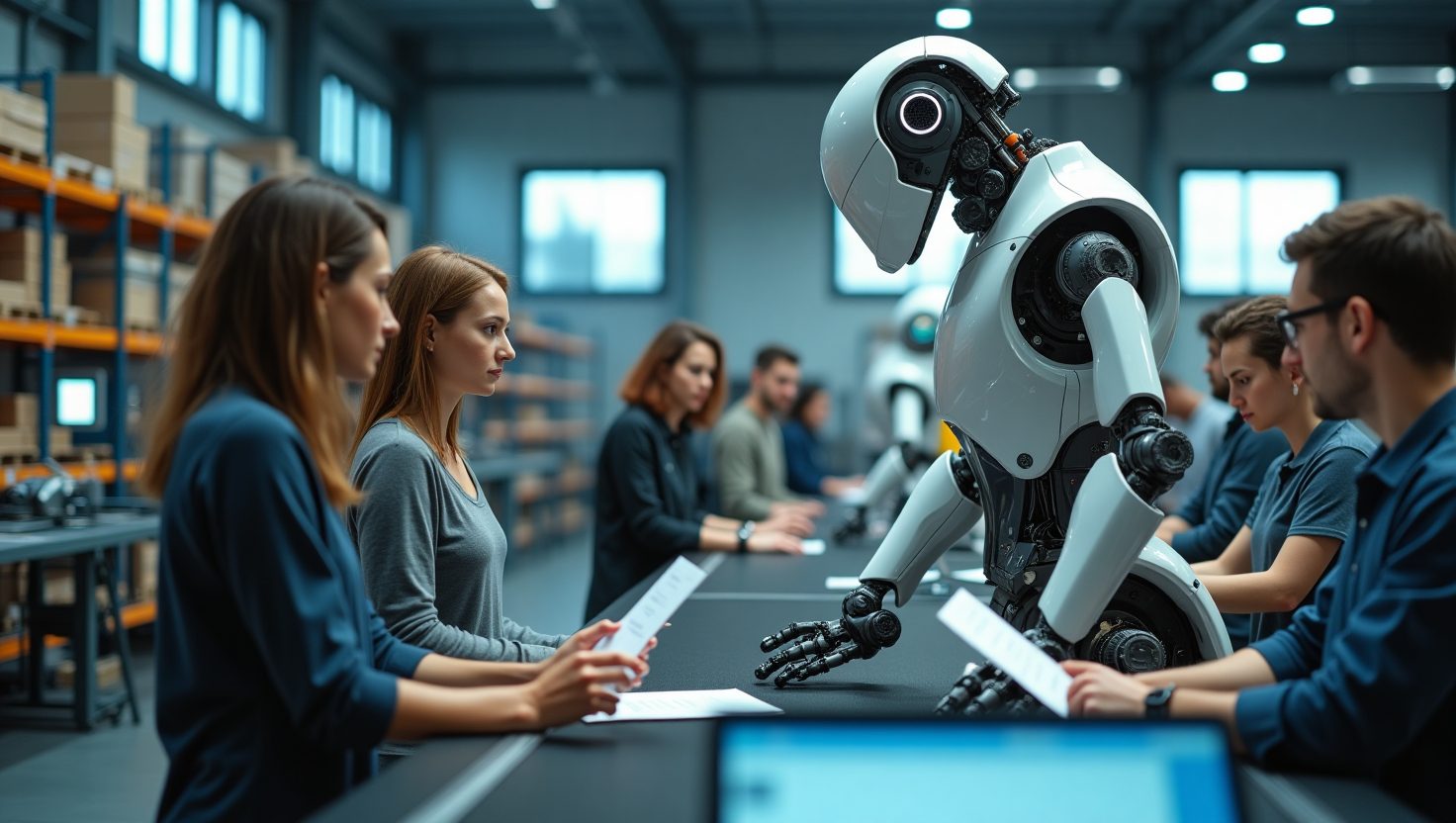
The Relentless March of the Warehouse Robots
Industrial automation isn’t new. For decades, mechanical arms have been a fixture on car assembly lines, performing simple, repetitive tasks with tireless precision. But what we’re witnessing now is different. This isn’t your grandad’s factory robot. Today’s automation is powered by artificial intelligence, giving machines the ability to ‘see’, ‘learn’, and adapt. Think of it as the difference between a music box that plays one tune and a concert pianist who can improvise jazz.
The catalyst for this change is a potent cocktail of cheaper sensors, immense computing power, and sophisticated AI algorithms. This combination is making supply chain robotics not just a feasible option but a strategic necessity for giants like Amazon. The goal is to build a logistics network that is not just fast, but resilient, predictive, and almost entirely frictionless. And with its latest announcements, Amazon has given us a clear look at what that future entails.
Amazon’s New Toys: Meet Blue Jay and the All-Seeing AI
According to a recent dispatch from its own news blog, Amazon has unveiled two key pieces of technology: the ‘Blue Jay’ robotics system and an AI model called ‘Project Eluna’. Let’s be clear: this isn’t a minor update. This is a fundamental rethinking of how goods move through a warehouse.
– Blue Jay: Imagine a symphony of robotic arms, all working in perfect harmony. That’s Blue Jay. It isn’t a single robot but a coordinated system designed to handle the crucial “pick and stow” process. Rather than having a human rummage through a bin of items to find the one you ordered, Blue Jay uses computer vision and multiple arms to identify, pick, and sort items. In its initial trials in South Carolina, Amazon claims the system can already handle an impressive 75% of the item types it processes. What’s more, by using “digital twin” simulations, Amazon’s engineers sped up the development from a projected three years to just one. That’s a staggering acceleration.
– Project Eluna: If Blue Jay represents the muscle, Project Eluna is the brain. Amazon describes it as an “agentic AI” model, which is a fancy way of saying it’s an AI that can make its own decisions. Project Eluna acts like an omniscient warehouse manager, constantly analysing data from across the fulfillment centre to spot potential bottlenecks before they happen. It doesn’t just flag problems; it provides data-backed recommendations to human managers on how to redeploy staff or resources. Think of it as an air traffic controller for packages, able to see the entire system at once and guide everything to its destination with maximum efficiency.
This isn’t just about replacing a few manual tasks. It’s about creating a self-optimising system where machines handle the physical and cognitive grunt work, freeing up human supervisors to manage exceptions and oversee the big picture.
What Does This Mean for the Supply Chain?
The benefits of this level of automation are difficult to overstate. For a company obsessed with shaving seconds off delivery times, advancements like these are gold dust. The advantages are clear:
– Pinpoint Accuracy: With AI-driven vision systems, robots like Blue Jay are far less likely to pick the wrong item, reducing costly errors and returns.
– Crushing Bottlenecks: Project Eluna is designed specifically to prevent the operational logjams that can cripple a supply chain, especially during peak seasons like Christmas.
– A Safer Workplace?: Amazon is quick to frame these innovations as a win for employee safety. As Tye Brady, Chief Technologist for Amazon Robotics, puts it, they are “using AI and robotics to create an even better experience for our employees and customers”. The argument is that robots can take over the strenuous, repetitive tasks—reaching, lifting, twisting—that lead to injuries. Indeed, systems like Blue Jay work at ergonomic heights, a direct response to longstanding criticisms of warehouse working conditions.
The AI Workforce Displacement Debate: A Convenient Narrative?
Here we arrive at the thorniest part of the discussion: AI workforce displacement. The tech industry’s party line is always the same: automation doesn’t destroy jobs, it changes them. It eliminates dull, dirty, and dangerous work, creating new, higher-skilled roles in their place. Amazon points to this narrative by highlighting its employee training programmes and its recent announcement to hire 250,000 seasonal workers for the holidays.
But is it that simple? The optimistic view suggests that for every person who stops manually picking items, a new job is created for someone to maintain the robots, analyse the data from Project Eluna, or manage the increasingly complex automated systems. This creates pathways to higher-skilled, better-paid work.
The more skeptical view, however, asks some uncomfortable questions. Are these new, “good” jobs being created at the same rate that the old, “bad” jobs are being eliminated? And are the people whose jobs are displaced the same ones who will be able to fill these new roles? It’s one thing to say you’ll retrain a warehouse picker to become a robotics technician; it’s another thing to do it at the scale of hundreds of thousands of employees. The transition from manual labour to a supervisory or technical role requires a significant leap in skills and training, one that not everyone will be able to make. We must demand more transparent data from companies like Amazon about the net effect of these changes.
This isn’t about being a Luddite or resisting progress. The technology is genuinely impressive. Yet, we have to look past the slick corporate videos and ask what the industrial automation impact really looks like on the ground, for the millions of people who form the backbone of the global supply chain.
Preparing for the Inevitable
The responsibility here doesn’t just lie with the individual worker to “be more adaptable.” Companies that profit immensely from this automation have a profound social obligation to invest in their workforce. Meaningful upskilling isn’t about running a few online courses. It requires deep, sustained investment in education, apprenticeships, and clear career pathways.
Governments, too, have a crucial role to play in modernising education systems and creating social safety nets to support workers during this transition. We cannot simply airdrop high-tech robotics into our economy and hope for the best. Without a strategy for the human side of the equation, we risk exacerbating inequality, leaving a significant portion of the workforce behind in an economy that no longer values their skills.
The Vision for Smart Manufacturing 2025
What we’re seeing at Amazon is a prelude to a much broader trend: smart manufacturing 2025. This isn’t just about warehouses. It’s about creating entire factories and production lines that are intelligent, connected, and autonomous. By 2025, expect to see the principles behind Blue Jay and Project Eluna applied across countless industries.
Imagine a factory where AI anticipates a machine failure and orders a replacement part before it even breaks. Picture a construction site where robotic bulldozers, guided by AI, perform earthworks with centimetre-level precision. This is the world of smart manufacturing 2025—a world where the digital and physical are completely intertwined. The development of Blue Jay in just one year, thanks to digital simulations, is a powerful indicator of how quickly this future is arriving. Prototyping and problem-solving can now happen in a virtual world at lightning speed, before a single physical bolt is turned.
A Future We Must Choose, Not Just Accept
The relentless drive towards automation is a double-edged sword. On one side, there’s the promise of incredible efficiency, lower costs for consumers, and the elimination of gruelling manual labour. The technological achievements from companies like Amazon are, without a doubt, extraordinary.
On the other side looms the shadow of widespread AI workforce displacement and the social disruption that could follow. The industrial automation impact will not be evenly distributed. It will create winners and losers, and right now, the rulebook for navigating this transition is still being written.
We stand at a critical juncture. We can either be passive observers, allowing technology to dictate the future of work, or we can be active participants, shaping a future where the gains from automation are shared more broadly. Companies need to move beyond paying lip service to upskilling and make genuine, large-scale investments in their people. As consumers and citizens, we must continue to ask the tough questions and demand accountability.
The robots are here, and more are coming. They aren’t the villains of this story. The real question is, what role have we decided for ourselves?



