

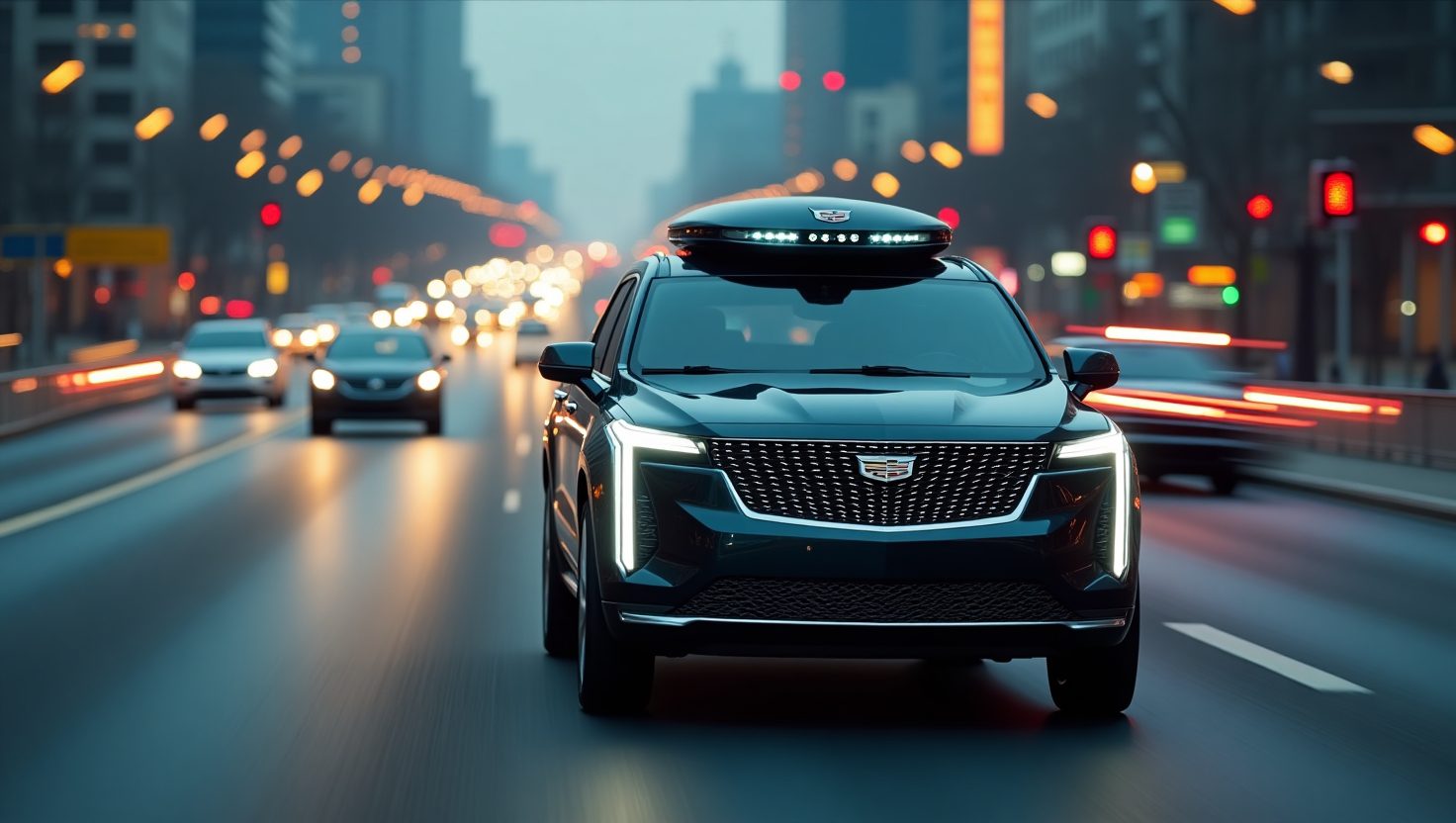
Is this a moment of supreme corporate audacity, a Hail Mary pass born from the ashes of a multi-billion-dollar bet, or is it the most logical strategic pivot in the automotive world today? The answer is probably a bit of all three. What GM is attempting here is more than just launching a new feature. It’s an effort to fundamentally redefine the relationship between driver, car, and the road by leveraging a treasure trove of data it paid for in both cash and reputation. This is autonomous vehicle AI finally attempting to graduate from a science project into a real, commercial product for you and me.
What Are We Even Talking About With ‘Autonomous AI’?
Before we get carried away, it’s crucial to understand what this technology actually is. For years, the industry has been throwing around terms like “self-driving” with a looseness that borders on irresponsible. What GM is proposing is a significant step towards true autonomy, built on the complex interplay of sensors, software, and immense computing power. This isn’t your dad’s cruise control.
The Brain and Nerves of the Modern Car
At its core, autonomous vehicle AI is a system designed to perceive its environment, predict the actions of other road users, and navigate a path safely—all without human input. It’s a synthesis of two critical elements:
– Advanced Driver-Assistance Systems (ADAS): Think of these as the car’s nervous system. You’re already familiar with them, even if you don’t know the acronym. Lane-keeping assist, adaptive cruise control, and automatic emergency braking are all forms of ADAS. GM’s Super Cruise is one of the most sophisticated ADAS suites on the market today, allowing for hands-off driving on 600,000 miles of pre-mapped highways. What we expect from ADAS systems 2025 and beyond is for this “hands-off” capability to become the baseline, a mere stepping stone to the “eyes-off” future.
– Vehicle Neural Networks: This is the car’s brain. A neural network is a type of machine learning model that learns from data, much like a human does. Imagine showing a new driver millions of hours of videos of every possible traffic situation—a lorry merging aggressively, a cyclist swerving unexpectedly, a sudden downpour. a lorry merging aggressively, a cyclist swerving unexpectedly, a sudden downpour. The driver would eventually develop an intuition for the road. That’s what GM has been doing with the data from Cruise’s five million driverless miles. The vehicle neural networks in their new system have been trained on an unprecedented volume of complex, real-world urban driving scenarios, creating a predictive capability far beyond anything a human could learn in a lifetime.
GM’s Calculated Gamble with the Escalade IQ
So, how is GM packaging this all up? The plan, as detailed in a recent announcement and reported by TechCrunch, is to integrate this next-generation system into the Cadillac Escalade IQ, its top-of-the-line electric SUV, starting in 2028. This isn’t an accident. By launching on a high-margin, luxury vehicle, GM can absorb the high cost of the advanced sensor suite while marketing it as the ultimate premium feature. It’s a classic tech adoption strategy: start at the top and let the costs trickle down over time.
More Than Just a Better Super Cruise
This new system is a quantum leap beyond Super Cruise. While Super Cruise relies on detailed maps, GM’s new tech is designed to function on most motorways without needing them. How? By creating a real-time, 360-degree model of the world around it using a “belt and braces” approach to sensors.
The system fuses data from three different types of sensors:
– Lidar: Uses lasers to create a precise 3D map of the environment, excellent for detecting object shapes and distances.
– Radar: Uses radio waves to detect objects and their speed, performing exceptionally well in bad weather like rain or fog where cameras might struggle.
– Cameras: Provide rich, high-resolution visual data, allowing the AI to read road signs, identify traffic lights, and understand context.
By layering the inputs from all three, the AI gets a redundant, superhuman view of the road. If a camera is blinded by sun glare, the lidar and radar are still working. This multi-modal approach is widely seen as the most robust path to safe automation, a pointed contrast to competitors who have tried to rely on cameras alone, with mixed results. This is the hardware that makes the brain’s decisions trustworthy.
The Bigger Picture: A New Philosophy for Safety
This announcement is about more than just a single car company’s product roadmap. It signals a fundamental shift in the industry’s approach to transportation safety AI. For decades, the driver has been the ultimate failsafe. The car could help, but the final responsibility rested with the human behind the wheel. GM is now explicitly trying to flip that equation.
Moving Beyond the “Human Escape Hatch”
In the TechCrunch article, Baris Cetinok, GM’s senior vice president of software and services, made a statement that should be pinned to the wall of every automotive engineering department: “Human intervention should not be the escape hatch for sudden incidents.”
This is a profoundly important philosophical stance. It means the system must be designed from the ground up to handle emergencies on its own. It needs to be able to execute a safe stop or an evasive manoeuvre without asking the driver—who might be reading a book or watching a film—to suddenly take control in a crisis. This is the make-or-break challenge. If the autonomous vehicle AI can’t be trusted in a pinch, the whole “eyes-off” concept is dead on arrival. This commitment moves the burden of safety from the driver to the manufacturer, a massive shift in liability and engineering focus.
The Pivot from Robotaxis to Personal Cars
The move also provides a fascinating insight into the business of autonomy. For years, the consensus was that fully autonomous robotaxis, like those Cruise was running in San Francisco, were the key to unlocking the market. As GM’s EVP of advanced driver assistance, Sterling Anderson, put it, “Robotaxi as a proof of concept when you start makes a lot of sense.” It allows for deep learning in concentrated, complex environments.
But the robotaxi model has proven incredibly difficult to scale. The costs are astronomical, regulatory approval is a minefield, and public acceptance is fragile at best. GM’s pivot suggests a new strategy: instead of trying to replace taxis and Ubers overnight, why not sell a slightly less autonomous, but still revolutionary, capability directly to consumers? It’s a more pragmatic, profitable, and perhaps faster path to getting millions of autonomous miles on the road. The robotaxi fleet becomes the R&D lab, and the private car owner becomes the first commercial customer.
What Does the Road to 2028 and Beyond Look Like?
GM has thrown down the gauntlet, but the journey to 2028 will be anything but a Sunday drive. The company faces immense challenges, but also enormous opportunities.
The Coming Arms Race in ADAS and Neural Networks
We’re about to see an acceleration in the development of ADAS systems 2025 is just around the corner, and competitors aren’t standing still. Mercedes-Benz already has a certified Level 3 “eyes-off” system, Drive Pilot, though it operates under far more limited conditions—daytime, on specific pre-mapped motorways, and only below 40 mph. GM is aiming to blow past that with a system that works at higher speeds and on a much wider range of roads.
This will spur a talent and technology arms race centred on vehicle neural networks. The winning companies will be those that can not only collect the most high-quality driving data but also build the AI models that can process it most effectively and safely. GM is betting that its five million miles of chaotic, urban, driverless data from Cruise gives it an invaluable head start.
The Mountain of Trust
Ultimately, the biggest hurdle isn’t technological; it’s psychological. Can GM, or any carmaker, earn enough public trust to convince millions of people to take their eyes off the road and their hands off the wheel? The fallout from the Cruise incident, where a vehicle dragged a pedestrian, severely damaged public perception.
Rebuilding that trust requires radical transparency and a near-perfect safety record. Every incident will be scrutinised. Every software update will be viewed with suspicion. GM’s success hinges on launching a system that is not just a little better than a human driver, but demonstrably, quantifiably, and overwhelmingly safer.
GM’s 2028 timeline is ambitious. It’s a bold declaration that the future of personal transportation is one where the car does the heavy lifting, freeing up the human for other tasks. They are leveraging the painful lessons and expensive data from their robotaxi experiment to build what they hope will be the defining feature of the next generation of automobiles.
It’s a high-stakes bet, but if they pull it off, it won’t just redefine Cadillac; it could redefine driving itself. The question remains: is the world ready to let go of the wheel? What would it take for you to trust an AI with your commute?



