

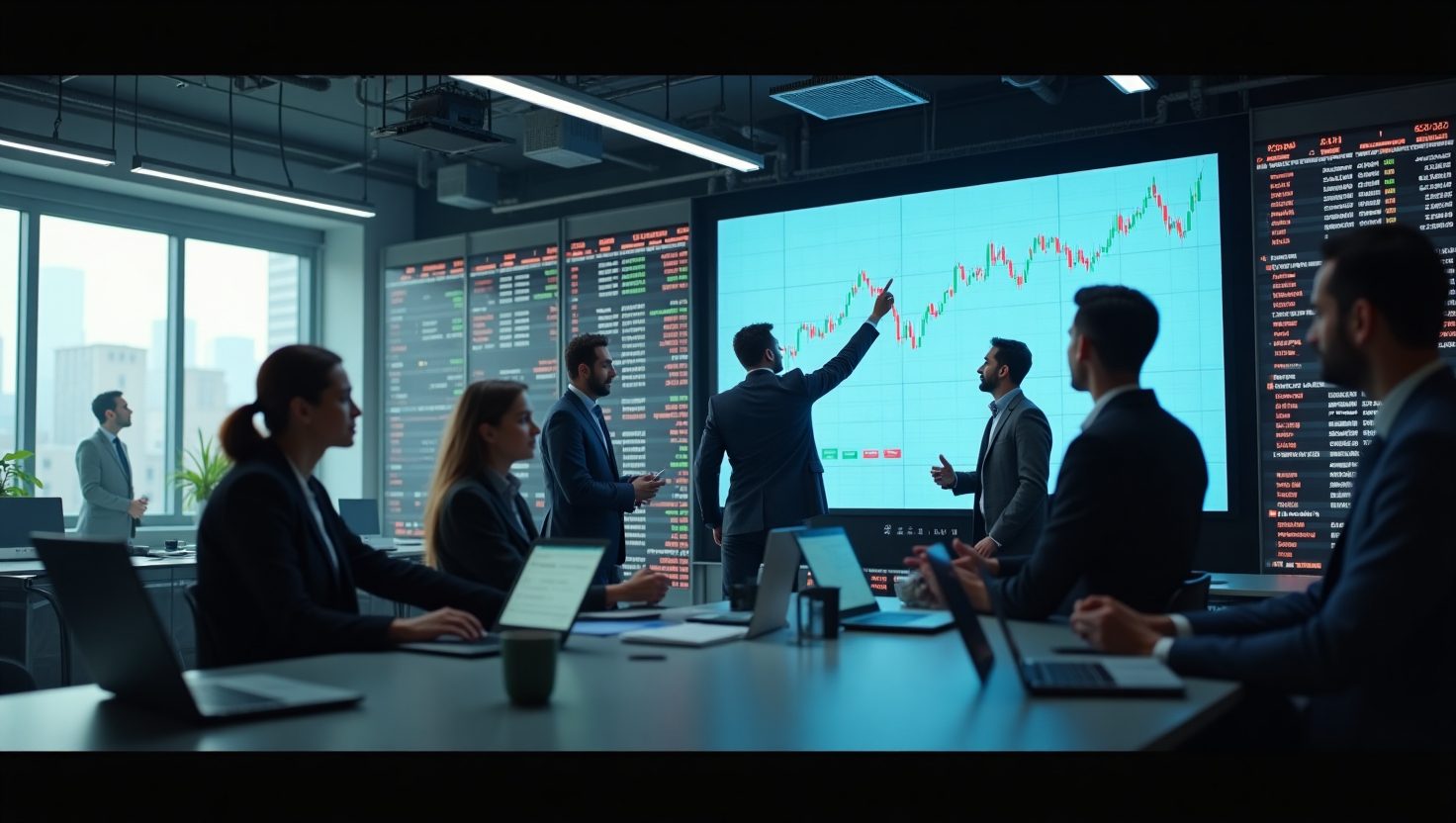
The consensus view is that we’re in another bubble, a frothy, speculative frenzy reminiscent of the dot-com era. But this isn’t just another bubble. It’s a tectonic shift, a fundamental rewiring of the global economy. And the financial wizards supposed to be guiding us through it are, for the most part, looking in the wrong direction.
Wall Street’s Déjà Vu Problem
Listen to the bigwigs, and you’ll hear a familiar tune. Blackstone’s President, Jonathan Gray, recently fired a warning shot across Wall Street’s bow. As reported by PYMNTS, he acknowledged the immense investor enthusiasm but drew a parallel to the dot-com crash of 2000. It’s a comparison everyone loves to make because it feels familiar and, therefore, manageable. We’ve seen this movie before, right? A lot of hype, a spectacular crash, and then a few giants (your Amazons, your Googles) emerge from the wreckage.
But Gray, and others like Amazon founder Jeff Bezos, are smart enough to see the crucial difference. Bezos correctly identifies that while investor excitement might create “temporary misallocations of capital”—a polite way of saying some people are going to lose their shirts on silly ventures—this isn’t just a financial bubble. It’s an industrial one. Gray echoes this, reportedly telling his teams, “Address AI on the first pages of your investment memos… This is going to be profound.”
What’s the difference? A financial bubble is driven by speculation about future profits. The dot-com bubble was about betting on which online pet food company would dominate the market. An industrial revolution, however, is about a fundamental change in how value is created. It’s about the steam engine, not just investing in the best railway company. The dot-com bubble was about which websites would succeed; the AI revolution is about what happens when the very concept of “rules-based industries” becomes obsolete. As Gray puts it, “AI is real, it’s going to change every industry.” Wall Street is still trying to pick the fastest horse, not realising the race is about to be replaced by teleportation.
Rethinking Investment Strategies for a New Industrial Age
So if the old map is useless, what do the new investment strategies look like? The dominant logic in public markets is short-term. It’s all about quarterly earnings, user growth metrics, and hitting analyst targets. This approach is dangerously ill-suited for the AI era. Investing in true foundational AI isn’t about next quarter’s revenue; it’s about a five-to-ten-year transformation.
The real challenge for investors is shifting from a mindset of picking winners to one of understanding system-level change. The risk assessment required is entirely different.
– Traditional Risk: Does this company have a strong balance sheet? Is its product better than its competitor’s? Will it hit its growth targets?
– AI-Era Risk: Could this entire industry be made redundant by a large language model? Is this company’s competitive advantage—its people, its processes, its data—defensible against an algorithm that can replicate it for a fraction of the cost?
This isn’t about whether your favourite software-as-a-service company will grow 20% or 30% next year. It’s about whether its entire business model will even exist in 2030. Think about industries built on synthesising information, filling out forms, or applying a complex but ultimately definable set of rules—law, accounting, insurance underwriting, and even parts of software development. These are not just being disrupted; they are facing an extinction-level event. Trying to assess risk here using traditional financial models is like trying to measure an earthquake with a rain gauge. It measures something, but it completely misses the scale and nature of the event.
When Economic Models Simply Break
This brings us to the heart of Wall Street’s intellectual failure: its over-reliance on traditional economic modeling. These models are, by their very nature, backward-looking. They are built on decades of historical data that assumes a certain linear, predictable progression of economic activity. They can model the impact of interest rate changes or shifts in consumer spending because we have countless past examples.
But how do you model a technology whose progress is exponential and whose impact is systemic? You can’t. AI doesn’t just make a factory worker 10% more productive; it has the potential to replace the entire factory floor with a single, self-improving system. Standard economic models fail to capture this for a few key reasons:
1. They assume linear change: They are designed for incremental improvements, not for sudden, step-change transformations that render entire data sets irrelevant.
2. They struggle with zero marginal cost: Once an AI model is trained, the cost of replicating its “labour” is virtually zero. How does that fit into models built around labour costs, wages, and productivity per hour? It breaks the formula.
3. They can’t price obsolescence: A model can predict that a company might lose market share. It can’t predict that the entire market it operates in will vanish because an AI can now provide that service for free, or as a feature of a different product.
Integrating AI into these outdated frameworks isn’t enough. We need a new kind of economic modeling that embraces uncertainty and non-linearity. It would look more like epidemiological models that track the spread of a virus—focusing on vectors, transmission rates, and systemic effects—than a traditional financial spreadsheet. Until that happens, the official AI market predictions coming out of major banks will continue to be, at best, educated guesses and, at worst, dangerously misleading.
Unveiling the Hidden Dangers of AI in Finance: Are We Overshadowing Regulation?
The ‘It Won’t Happen to Me’ Syndrome
The disconnect isn’t just confined to the trading floors of New York and London. It’s happening at kitchen tables and in office cubicles across the country. According to a fascinating PYMNTS Intelligence report, there’s a massive cognitive dissonance at play within the workforce. The data shows that while around 70% of workers believe AI poses a systemic risk to jobs, most feel personally secure in their own roles.
This is a classic case of what psychologists call “optimism bias.” We see the hurricane on the news and acknowledge its destructive power, but we somehow believe it will swerve and miss our house. This “it won’t happen to me” syndrome is a perfectly human response, but it’s just as flawed as Wall Street’s models. People in so-called “creative” or “white-collar” jobs have long felt insulated from the automation that hollowed out manufacturing.
That sense of security is now a fantasy. Generative AI is coming for the cognitive tasks that were once the exclusive domain of highly paid professionals. The barrier to entry for creating reports, writing code, drafting legal documents, and producing marketing copy is collapsing. Companies don’t need to just think about adapting their technology; they need a radical plan for adapting their people. This means less focus on rigid job descriptions and more on cultivating skills like critical thinking, strategic oversight, and the ability to ask an AI the right questions. Workers, in turn, can’t afford to be complacent. The most important career skill in the next decade might be the ability to continuously learn how to partner with these new intelligent systems.
The Real Forecast: Unpredictability is the Only Certainty
So, where does this leave us? The financial world is making AI market predictions with broken tools. Their investment strategies are often misaligned with the long-term nature of this shift, and their risk assessment frameworks are laughably inadequate for measuring the true scale of the disruption. They see a tech bubble when they should be seeing an industrial revolution.
Meanwhile, the workforce is caught in a state of collective denial, acknowledging the storm but believing they have a personal umbrella. This is a recipe not for a gentle transition, but for a series of painful shocks to both the market and the labour force. The greatest returns won’t go to those who correctly pick the next hot AI stock. They will go to those who fundamentally grasp that the rules of the game are being rewritten from the ground up.
The question you should be asking isn’t “Is this AI company a good investment?” The question you should be asking is, “How will my investments, my industry, and my career function in a world where the cost of intelligence approaches zero?”
How are you preparing for that?



