

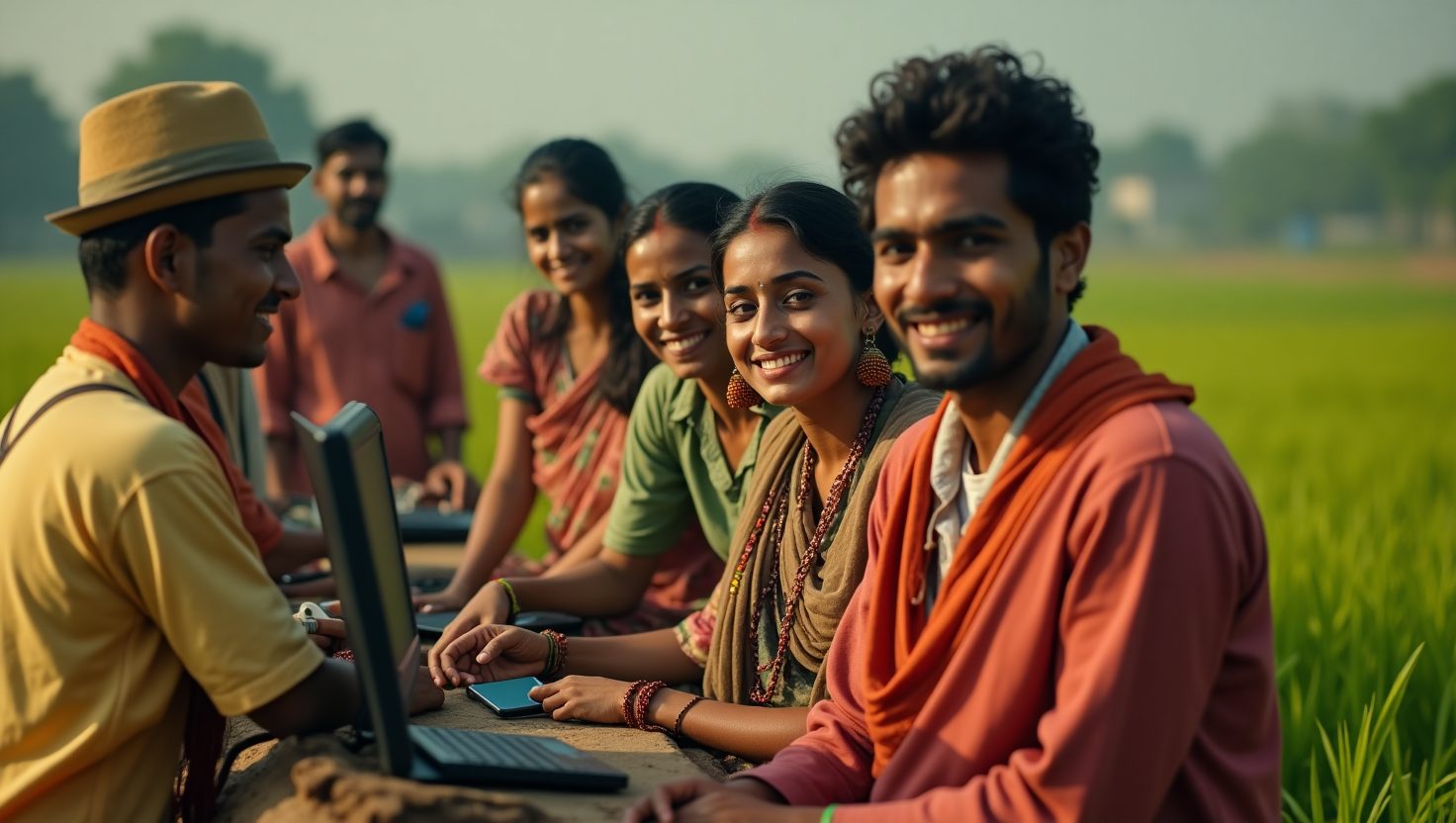
The real story here is the critical need for AI localization datasets. For artificial intelligence to be truly global, it must speak the world’s languages—all 7,000 of them. This means training models on vast quantities of data that reflect local dialects, accents, and cultural nuances. And as it turns out, the people best equipped to create this data are the native speakers themselves, leading to a boom in a new kind of digital work that is quietly transforming economies and challenging our very idea of what a ‘tech job’ looks like.
Can AI Speak Your Language? The Vernacular NLP Revolution
Let’s be clear about something: most of the early AI development was incredibly biased towards English. The models were trained on data scraped from the English-speaking internet, which is why your smart speaker initially struggled with anything other than a standard American or British accent. Vernacular NLP, or Natural Language Processing for local languages, is the essential corrective to this. It’s the science of teaching machines to understand and generate language as it’s actually spoken, from Tamil in Chennai to Marathi in Mumbai.
Why Your Mother Tongue is AI’s Next Frontier
Think of it this way: teaching an AI model is like raising a child. If you only expose it to one language and one culture, its worldview will be incredibly narrow. To build a truly intelligent and useful global AI, you need to expose it to the rich diversity of human communication. This is where vernacular languages become mission-critical. An AI that can process a loan application spoken in rural Bengali or provide healthcare advice in Gujarati isn’t just a novelty; it unlocks entire markets. These are the building blocks of emerging market AI, the next great frontier for tech growth.
As Mannivannan J K, whose firm Desicrew is a major player in this space, told the BBC, the initial step is often transcription. His teams listen to audio clips and type out what’s being said. It sounds simple, but it is the foundational layer upon which complex AI is built. “Machines understand text far better,” he notes. This human-led process of turning spoken words into machine-readable text is the very first step in making AI multilingual.
Crowdsourcing the Digital Assembly Line
So, where does all this data come from? How do you annotate millions of hours of audio or tag countless images with the right local context? The answer is crowdsourced annotation. Forget the idea of a single, centralised office. Instead, picture a distributed network of thousands of skilled workers, operating from their homes or small delivery centres in their hometowns. This is the model being perfected by Indian companies like Desicrew and NextWealth.
The New Face of the Tech Workforce
These organisations are tapping into a vast, underutilised talent pool: educated young people in rural and semi-urban areas who, until recently, had to migrate to megacities like Bangalore or Chennai to find a decent job. Now, the jobs are coming to them. Take Dhanalakshmi Vijay, an engineering graduate featured in the BBC report. She works for Desicrew from her village in Tamil Nadu, a job that allows her to support her family without leaving her community. She is the human face of the AI revolution.
The statistics are compelling and paint a picture of a significant economic shift:
– At Desicrew, a staggering 70% of the workforce are women, many of whom are the first in their families to have a formal job.
– NextWealth, another key firm, sources 60% of its staff from small towns, directly creating opportunities outside the traditional tech hubs.
– For Desicrew, AI-related work already constitutes 30-40% of their business, a figure that is only set to grow.
This isn’t gig work in the traditional sense. These companies are building sustainable careers, turning rural towns into vital nodes in the global AI supply chain. They are proving that high-quality, secure tech work can be done from anywhere, provided the right training and infrastructure are in place.
The Strategic Imperative: AI Localization and Emerging Markets
From a strategic perspective, this is all about the next phase of tech expansion. The North American and European markets are saturated. Where do the likes of Google, Amazon, and Meta look for their next billion users? They look to India, South East Asia, Africa, and Latin America. But you can’t simply parachute a product designed for California into rural Indonesia and expect it to succeed. This is the core challenge of emerging market AI.
Building a Competitive Moat, One Dialect at a Time
The companies that will win in these markets are the ones whose technology feels local. An AI that understands the specific needs of a farmer in Uttar Pradesh or a small shop owner in São Paulo has a massive competitive advantage. This requires deep AI localization datasets that capture not just language, but context, culture, and commerce.
Building these datasets is a monumental task. It’s also a powerful strategic moat. Once a company has invested in creating a high-fidelity AI model for a specific region, it becomes incredibly difficult for competitors to catch up. They are, in effect, building a digital infrastructure that is just as critical as physical roads or communication networks. The crowdsourced work being done in places like rural India is, therefore, not just data entry; it’s the foundational work for the next generation of global digital empires. The challenge, as Mohan Kumar, an investor in Desicrew points out, is overcoming client perception. There’s a lingering bias that work done in a village can’t be as secure or high-quality as work done in a major city—a notion that is being actively disproven day by day.
The Road Ahead: Challenges and a Staggering Opportunity
Of course, this journey is not without its bumps in the road. The two biggest hurdles are predictable yet significant: security and infrastructure. When you’re dealing with sensitive client data—be it healthcare records or financial information—ensuring it remains secure across a distributed network of workers is paramount. It requires robust protocols and a culture of trust. Likewise, the model is entirely dependent on reliable electricity and high-speed internet, which can still be a challenge in more remote areas.
A Hundred Million New Jobs?
Despite these challenges, the opportunity is almost too large to comprehend. Mythily Ramesh of NextWealth makes a breathtaking prediction: AI could create as many as 100 million jobs globally in the training and validation sector alone. Let that sink in. We spend so much time worrying about AI taking jobs that we often miss the story of the entirely new categories of work it is creating.
This isn’t just about low-skilled labelling. As the AI models become more sophisticated, the annotation work required becomes more complex. It’s evolving from simple transcription to what’s known as Reinforcement Learning from Human Feedback (RLHF), where workers rank AI responses, correct its reasoning, and essentially teach it to think more like a human. These are skilled digital jobs, and they are forming the basis of a new global middle class.
The future here is one of increasing specialisation. We will see rural centres of excellence for specific AI domains—one town might become the global leader in annotating medical imaging, whilst another focuses on financial AI for a specific linguistic region. What begins as ‘cloud farming’ could evolve into a vibrant, decentralised ecosystem of AI expertise.
The rise of rural India as a powerhouse for training global AI is one of the most important and under-reported stories in technology today. It reveals the hidden human labour behind the automated curtain and shows how the demand for more inclusive, localised AI is creating economic opportunity in unexpected places. The polished, intelligent AI of the future won’t be built just by PhDs in Palo Alto; it will be meticulously crafted and refined by people like Dhanalakshmi Vijay in villages across the world.
The big question we must ask ourselves is this: As tech giants build their next generation of products on the back of this global, crowdsourced workforce, what is their responsibility to these communities? Is this a truly symbiotic relationship that fosters sustainable development, or is it just the next evolution of digital colonialism? What do you think?



