

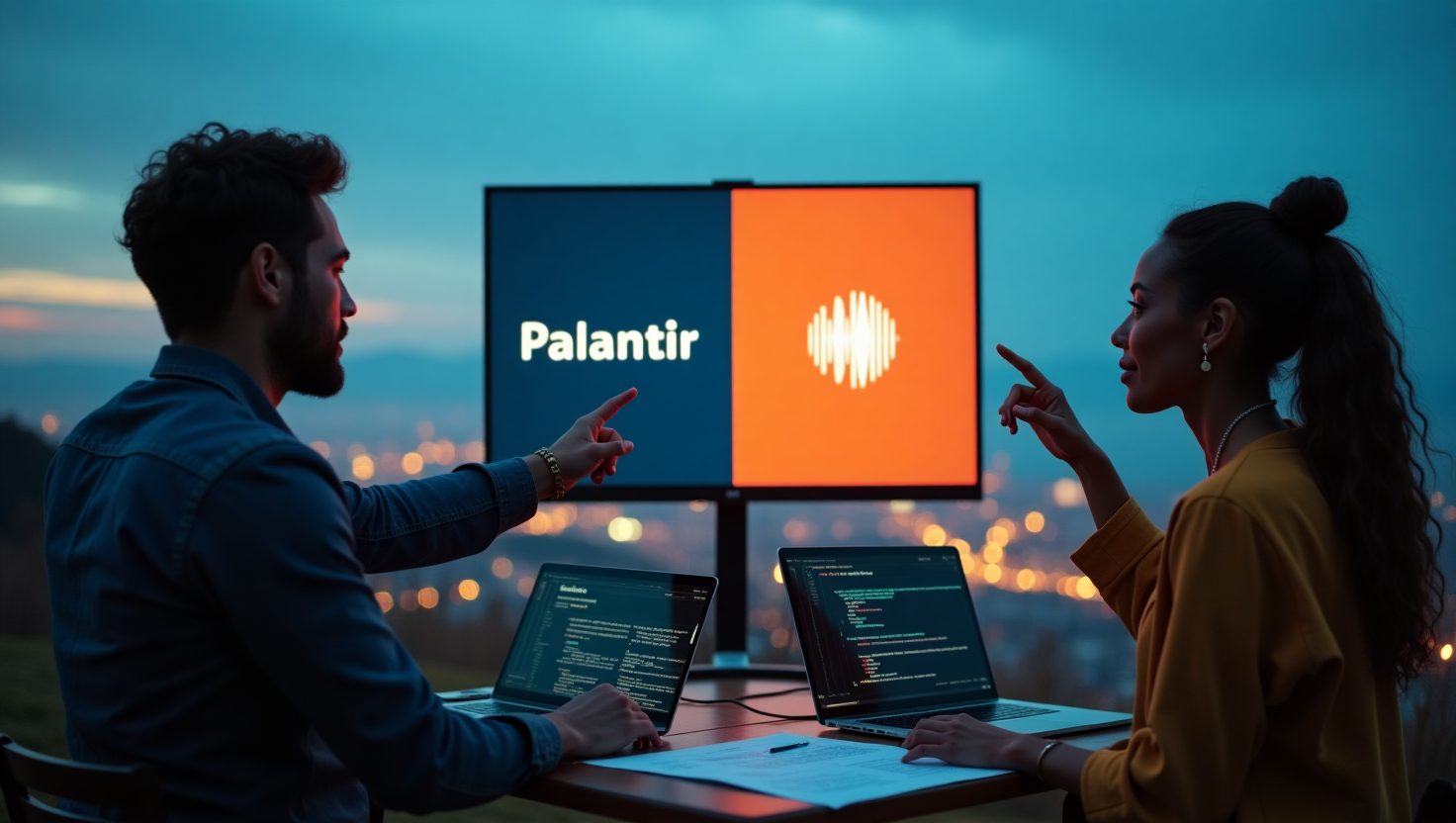
It seems you can’t open a browser or glance at your phone without being bombarded by the latest AI gold rush. Everyone, from seasoned investors to your cousin who just discovered stock trading apps, is scrambling to find the next Nvidia. But beneath the headline-grabbing valuations of the tech titans lies a far more intriguing landscape of specialist companies. This is where the real detective work begins, demanding a sharp AI stock comparison to separate the genuine innovators from the hype-fuelled hopefuls.
Today, we’re putting two fascinatingly different AI players under the microscope: Palantir Technologies and SoundHound AI. One is a data-crunching leviathan with deep ties to the corridors of power; the other is a nimble specialist betting everything on the power of the human voice. Trying to decide which is the “better” stock is like asking if a tank is better than a racing car. The answer entirely depends on where you’re trying to go.
So, What Exactly Is an ‘AI Stock’ Anyway?
Let’s get one thing straight. Slapping “.ai” at the end of a company name or peppering a press release with buzzwords does not an AI company make. A true AI stock belongs to a company where artificial intelligence isn’t just a feature; it’s the very core of the product, the engine driving its value proposition. Think of companies whose primary business would cease to exist without their proprietary algorithms and data-processing capabilities.
We’re talking about firms that are building the foundational models, the specialised applications, or the unique hardware that powers this technological shift. It’s in this context that the comparison between Palantir, a master of data integration and analysis, and SoundHound, a pure-play in conversational intelligence, becomes so compelling. They represent two distinct, yet equally valid, paths in the evolution of applied AI.
The Contenders: Palantir vs. SoundHound
Palantir (PLTR): The Data Behemoth with a Black Box
If AI had an old guard, Palantir would be it. Born from the minds of Silicon Valley contrarians and backed by Peter Thiel, Palantir has long cultivated an aura of mystery and power. Its business is split into two primary platforms: Gotham, which serves government agencies, and Foundry, for commercial clients. At its heart, Palantir doesn’t sell flashy robots; it sells a way to make sense of incomprehensible amounts of data. It’s like a digital Rosetta Stone for sprawling databases, helping organisations find the needle of insight in a planetary-sized haystack.
Financially, Palantir is beginning to look like the grown-up in the room. A recent analysis highlighted some impressive figures:
– Quarterly Revenue: Surpassing $1 billion with a robust 48% year-over-year growth.
– Profitability: Boasting a seriously healthy net income margin of 33%.
These numbers paint a picture of a company hitting its stride. It’s successfully translating its deep expertise from lucrative government contracts into the commercial sector, proving its model has legs beyond the intelligence community. Palantir’s story is one of converting deep tech into consistent, predictable, and, crucially, profitable revenue.
SoundHound AI (SOUN): The Voice Whisperer
On the other side of the ring is SoundHound AI. If Palantir is the data behemoth, SoundHound is the audio specialist. The company is laser-focused on one of the most natural human interfaces: voice. Its platform for voice recognition tech and conversational AI aims to let people talk to devices, cars, and services as fluidly as they talk to each other. From in-car assistants that actually understand you to voice-enabled ordering at a drive-thru, SoundHound is betting that the future is spoken, not typed.
SoundHound’s financial narrative, as detailed in a report by The Motley Fool, is one of explosive, almost startling, growth.
– Quarterly Revenue: A reported $43 million, which on its own is modest.
– Revenue Growth: A staggering 217% increase year-over-year.
That 217% figure is enough to make any investor’s ears prick up. However, this comes with a huge caveat: SoundHound is not profitable. Not even close. It’s in full, cash-burning growth mode, pouring every penny back into capturing market share and refining its technology. This makes it a classic high-risk, high-reward proposition.
Valuation: Reading the Tea Leaves of Price-to-Sales
Here’s where it gets really interesting. How does the market value these two radically different companies? One of the most common metrics for growth stocks, especially those not yet profitable, is the Price-to-Sales (P/S) ratio. It tells you how much investors are willing to pay for every dollar of a company’s sales.
Let’s think of it like buying property. Palantir is like a grand, profitable hotel in Mayfair. It’s expensive, but it’s already generating a steady income. SoundHound, on the other hand, is like buying a plot of land in a forgotten part of town just after rumours have started that a new railway line is being built. The current value is low, but the speculative potential is enormous.
According to The Motley Fool’s analysis, the numbers are stark:
– Palantir’s P/S Ratio: 40.9
– SoundHound’s P/S Ratio: 173.5
You read that right. The market is currently willing to pay over four times more for each dollar of SoundHound’s revenue than for Palantir’s. This isn’t a typo; it’s a reflection of radically different expectations. Investors are pricing Palantir as a mature, profitable growth company. They are pricing SoundHound for world-domination in its niche, betting that its current £43 million in revenue is just the tip of a multi-billion-dollar iceberg.
Market Position and the Growth Runway
A market niche analysis reveals the strategic logic behind these valuations. Palantir’s moat is built on deeply-entrenched relationships and incredibly complex software. Government contracts are sticky; once a defence or intelligence agency integrates Gotham into its core operations, ripping it out is almost unthinkable. This provides a stable, long-term revenue base. The challenge for Palantir is to continue expanding its commercial business at a pace that justifies its premium valuation.
SoundHound’s battlefield is entirely different. The market for voice recognition tech is vast and still relatively nascent. While giants like Amazon, Google, and Apple have their own voice assistants, they are largely locked into their own ecosystems. SoundHound offers a crucial, independent alternative for car manufacturers, appliance makers, and restaurant chains who don’t want to be beholden to Big Tech. Its opportunity is to become the “Intel Inside” for voice. The risk? That those same tech giants decide to offer their technology more freely, squeezing specialists like SoundHound out of the market.
The Eternal Trade-Off: Growth vs. Profit
This brings us to the fundamental dilemma of this AI stock comparison: do you bet on proven profitability or explosive growth?
Palantir has already crossed the chasm. It has proven its business model is not just viable but highly lucrative. The question for investors is no longer “Will it survive?” but “How fast can it grow?”. Its path forward is one of execution and scaling an already successful formula.
SoundHound is still very much in the “growth at all costs” phase. Profitability is a distant dream, a milestone on a future roadmap. Investors in SoundHound aren’t buying current earnings; they are buying a story about the future. They believe its 217% growth rate is sustainable and that, at some point, the company will be able to flip the switch and let profits flow to the bottom line. It’s a bet that requires patience and a strong stomach for volatility.
Final Thoughts: Which Bet Are You Willing to Make?
So, which is the better AI stock? Palantir offers a clearer path, paved with profits and powerful customers. It is a bet on the enduring importance of data integration in a complex world. The risks are known: sales cycles can be long, and competition in the commercial sector is fierce.
SoundHound offers a shot at the moon. It is a pure-play on a future where voice is a primary computing interface. If that future materialises and SoundHound becomes a key enabler, its current valuation will look like a bargain in retrospect. The risk, of course, is that it burns through its cash before reaching scale or gets outmanoeuvred by larger, better-funded competitors.
Ultimately, the choice between Palantir and SoundHound isn’t just an analytical one; it’s philosophical. It’s a question of your own conviction about the future of technology and your appetite for risk.
Are you betting on the established data behemoth steadily conquering the enterprise, or the nimble voice specialist aiming to redefine human-computer interaction? There’s no single right answer, and I’d be keen to hear your thoughts in the comments below.



