

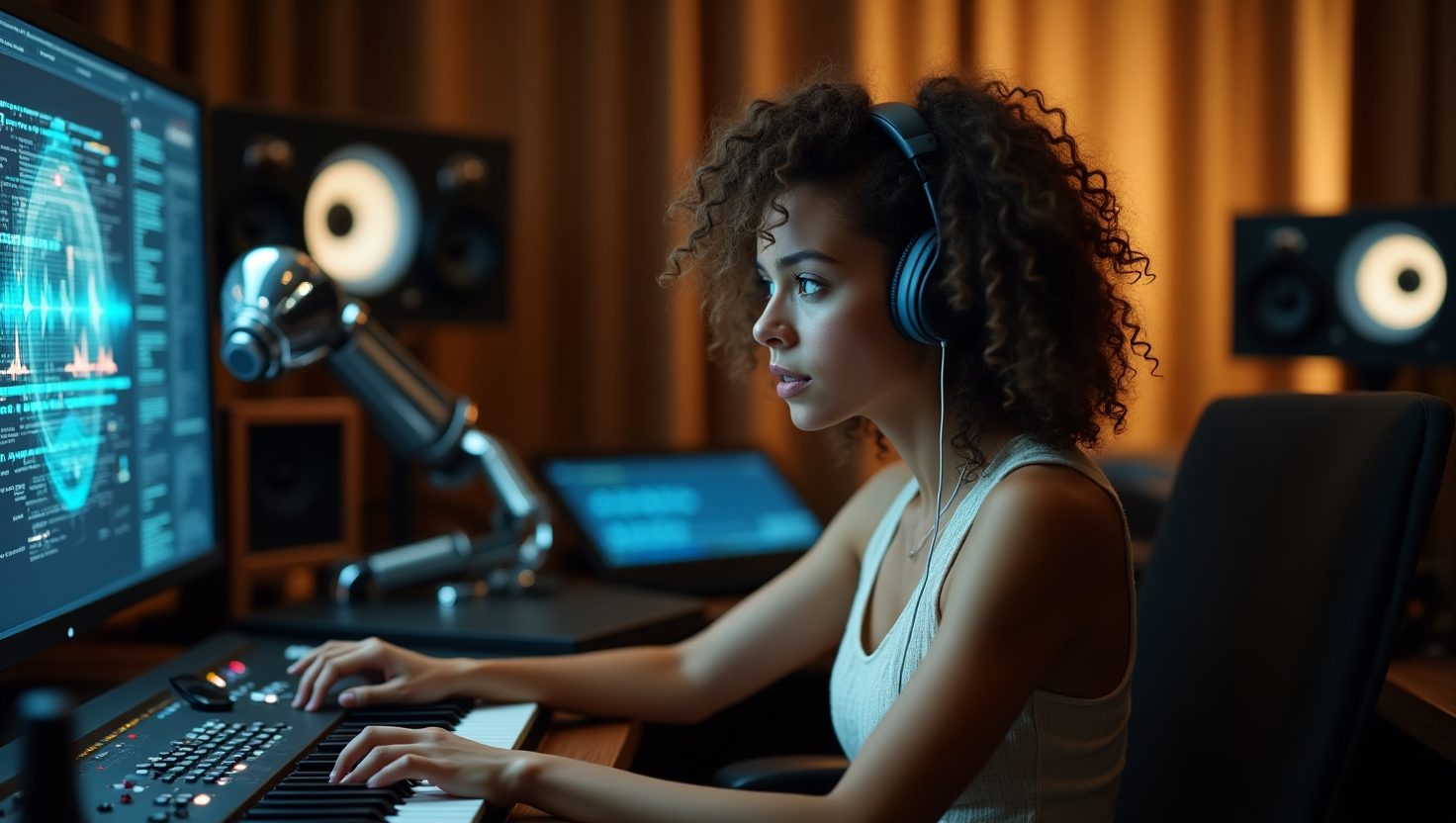
Let’s be honest, the phrase “AI is coming for [insert industry here]” is beginning to sound like a stuck record. We’ve heard it for art, writing, coding, and now it’s music’s turn in the spotlight. But before you dismiss this as just another tech-bro fever dream destined to fizzle out, it’s worth paying attention. The music industry, a sector that has been fundamentally reshaped by technology more times than most—from vinyl to Spotify—is once again at a fascinating, and frankly, chaotic, crossroads. This isn’t just about algorithms spitting out soulless muzak for corporate videos. What we are witnessing is the dawn of widespread AI music creation, a development that could either democratise musical genius or devalue it into oblivion. It’s complicated, messy, and absolutely captivating.
The New Soundscape of AI Music
So, what exactly are we talking about when we say AI music creation? At its core, we’re looking at sophisticated software that can generate melodies, harmonies, rhythms, and even vocals based on simple text prompts. Think of it less as a musician and more as an exceptionally talented musical collaborator that has listened to, and analysed, practically every piece of music ever recorded. It is a powerful new instrument, and companies like Suno and Anthropic are leading the charge, building platforms that are turning “I wish I could write a song” into “I just wrote a song in two minutes”.
The Magic Behind Generative Composition
The technology driving this is generative composition. It’s a branch of artificial intelligence that doesn’t just regurgitate what it’s been taught; it creates something novel. These models are trained on unimaginable volumes of data. According to insights from the recent All That Matters conference in Singapore, some experts predict these AI programmes will be analysing trillions of data points by next year. That’s a scale of musical education that no human could ever achieve. The AI learns the underlying patterns, structures, and emotional triggers of music. It understands what makes a chord progression feel melancholic or a beat feel energetic.
Think of it like this: Imagine a master chef who has memorised every recipe in the world. They don’t just copy dishes; they understand the fundamental principles of flavour, texture, and chemistry. You could ask them for “something that tastes like a sunset on a Greek island”, and they could invent a new dish that perfectly captures that feeling. That’s what these generative models are doing for music. You give them a prompt like, “Create an upbeat folk-pop song about leaving a small town, with a female vocalist,” and it composes, arranges, and produces a shockingly plausible track in moments. This isn’t just enhancing creativity; for many, it is the creativity, opening doors for a world of new creators. The current estimate of 100 million active music creators is already a huge leap from the 50,000 in Mozart’s time, and AI is poised to inflate that number exponentially.
When the Artist Meets the Algorithm
The narrative that AI will simply replace human artists is, to put it mildly, a bit simplistic. It misses the most interesting part of the story: the artist-AI collaboration. The most compelling use of this technology isn’t to remove the human from the loop, but to augment their abilities. For established artists, it’s a new tool in the studio—a way to quickly sketch out ideas, break through creative blocks, or experiment with genres they’d never otherwise touch. For aspiring musicians, it lowers the barrier to entry, which was once protected by expensive studio time and the need for session musicians.
A New Era of Partnership
We are already seeing the incredible potential of this synergy. Artists can use AI to generate a dozen different bass lines for a track and pick the one that fits best. They can ask it to create a string arrangement in the style of a specific composer or generate lyrical ideas to overcome writer’s block. It’s a partnership where the human provides the vision, the taste, and the emotional direction, while the AI provides the raw technical execution and infinite possibilities.
This collaborative spirit is also extending to the relationship between artists and their fans. Imagine an artist building a unique sonic “world” with an AI and then inviting fans to create their own songs within that universe, using the same set of AI tools and sounds. As mentioned in a recent Global News report on the future of AI in music, this creates a powerful new form of engagement and co-creation, transforming passive listeners into active participants in an artist’s world. That’s a fundamentally new revenue and engagement model that simply didn’t exist before. The music industry is shifting from a top-down broadcast model to a more interactive and community-driven ecosystem. And while a fully AI artist like Xania Monet signing a million-dollar record deal might grab headlines, the bigger story is how millions of human artists will integrate these tools into their workflow.
The Billion-Dollar Question: Copyright
Of course, this brave new world comes with an enormous, complicated, and legally fraught set of copyright challenges. This is where the utopian vision of democratised music collides with the cold, hard reality of intellectual property law. When an AI creates a song, who owns it? The user who wrote the prompt? The company that built the AI? Or the thousands of artists whose music was used to train the model in the first place? The answer, right now, is a giant, messy “it depends”.
Untangling the Legal Knot
The music industry is, understandably, on high alert. The “Big Three” record labels—Universal, Sony, and Warner—and music publishers are in tense negotiations with AI companies. They argue, quite reasonably, that their vast catalogues of copyrighted music are the essential raw material that makes these AI models work, and they expect to be compensated for it. This has resulted in a flurry of lawsuits and the beginnings of licensing discussions. As noted during the All That Matters conference, major licensing deals are reportedly pending, which could set a precedent for the entire industry. These agreements will be critical in determining whether the future of AI music creation is one of legitimate, licensed collaboration or a new digital wild west reminiscent of the early days of Napster.
The ethical questions run just as deep. Is it fair for a model to learn from an artist’s unique style and then allow anyone to replicate it with a text prompt? Where is the line between inspiration and infringement? These are not just legal quandaries; they strike at the heart of what we value about artistic identity and creative labour. Finding a solution will require a delicate balance: compensating rights holders for the use of their work without stifling the incredible innovation these new tools unlock. The path forward will likely involve a combination of:
– Licensing agreements: AI companies paying for access to music catalogues.
– Watermarking: Embedding invisible markers in AI-generated tracks to identify their origin.
– Revenue sharing: Models where a portion of the income from AI-generated music is distributed back to the human artists whose work informed it.
Navigating this will be the music industry’s great challenge of the next decade. Get it right, and you foster a vibrant new creative ecosystem. Get it wrong, and you risk an endless cycle of litigation that benefits no one but the lawyers.
Harmonising the Future
So, where does this leave us? AI music creation is no longer a theoretical concept; it’s a practical reality that is already reshaping how music is made, distributed, and even conceived. It presents a classic case of technological disruption, complete with the promise of creative liberation and the perils of economic upheaval and legal chaos. The technology is a powerful new instrument in the hands of musicians, a tool for artist-AI collaboration that can unlock unprecedented creativity. At the same time, the unresolved copyright challenges loom large, threatening to embroil the industry in conflict for years to come.
What seems certain is that the wall between creator and consumer is crumbling. The tools of production are becoming accessible to everyone, which will undoubtedly lead to an explosion of new music and new artists. The question is not whether AI will be a part of music’s future, but rather how we will choose to integrate it. Will we build a system that empowers human artists and fairly compensates them for their foundational contributions? Or will we let it devalue creative work in a race to the bottom?
The next few years will be crucial in setting the tone. The deals struck between AI labs and record labels, the legal precedents set in court, and the ways artists themselves choose to adopt—or reject—these tools will write the next chapter in music history.
What do you think? Have you tried out tools like Suno? Are you excited by the prospect of generative composition, or worried about what it means for human musicians? Let me know your thoughts below.



