

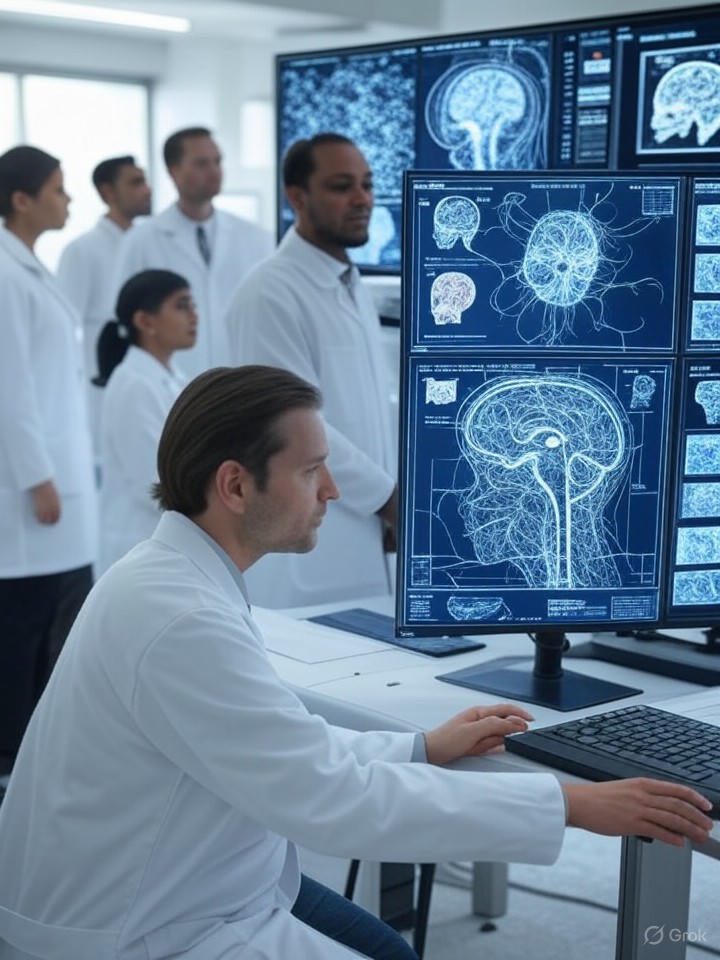
Right, so we’ve spent years marvelling at how our brains just see things – the sheer effortlessness with which we recognise a face in a crowd or a cat hiding in the bushes. Meanwhile, our artificial intelligence models have been slogging it out, trying to replicate even a fraction of that natural brilliance. But what if the very tools we’re building to understand AI could, in turn, help us decode the mysteries of our own grey matter? That’s precisely the intriguing tightrope Meta AI and NYU researchers are walking with their latest work on DINOv3 models. It’s a fascinating peek into how AI and Brain function, and frankly, it’s a bit of a mind-bender.
For too long, the chasm between artificial and biological intelligence seemed vast. We built neural networks that were great at specific tasks, but they rarely offered much insight into the elegant, complex ballet happening inside our skulls. However, this new research, looking at how DINOv3 mirrors human visual processing, suggests we might finally be getting somewhere with bridging artificial and biological intelligence. It’s not just about building smarter machines; it’s about using those machines as incredibly sophisticated microscopes to understand ourselves better. And that, dear reader, is a truly compelling narrative.
DINOv3: Learning by Watching, Not Labelling
First off, let’s talk about DINOv3 itself. This isn’t your grandad’s image recognition algorithm, trained on millions of carefully labelled photos like some diligent but ultimately rote-learning student. No, DINOv3 employs something far more akin to how a child might learn about the world: through self-supervised learning. Imagine a toddler simply observing everything around them, noticing patterns, differences, and similarities without anyone explicitly telling them, “That’s a ‘car’,” or “That’s a ‘dog’.” They just figure it out.
That’s the essence of self-supervised learning. DINOv3, a type of Vision Transformer model, learns by taking an image, augmenting it in various ways (like cropping or changing colours), and then trying to predict how different parts of these augmented images relate to each other. It’s a bit like giving a system a jigsaw puzzle and asking it to figure out the picture without ever having seen the original. This method forces the model to develop a deep, intrinsic understanding of visual features and their relationships, rather than just memorising superficial labels. It’s truly a game-changer for AI visual processing.
Mirror, Mirror: How AI Reflects the Primate Visual Cortex
Now, here’s where it gets really juicy. The researchers took these DINOv3 models and put them to the test against something incredibly complex: the primate visual cortex. This is the part of our brains responsible for, well, seeing. It’s a beautifully organised system, arranged in a hierarchy where simple features (like edges and lines) are processed in earlier areas, and then combined into increasingly complex representations (like shapes, objects, and faces) further along the visual pathway.
What they found was genuinely astonishing. The internal representations developed by DINOv3 – how it “sees” and organises visual information – showed a striking resemblance to the neural responses recorded from the brains of primates. Specifically, as the DINOv3 model processed information through its layers, it developed a similar hierarchical visual processing structure to the primate brain. Early layers of DINOv3 seemed to respond to basic visual elements, just like the early areas of the visual cortex. Deeper layers, on the other hand, developed more abstract and complex feature selectivity AI, akin to what we see in higher cortical areas.
This isn’t just a happy coincidence. The research demonstrated that these similarities between AI and human brain vision were not only qualitative but also quantitatively strong. The DINOv3 models were remarkably good at predicting neural responses in various areas of the visual cortex. For instance, the later layers of DINOv3, those responsible for more sophisticated visual recognition, showed a significantly higher correlation with neural activity in the higher-order visual areas of the brain. This suggests that the self-supervised learning paradigm, by encouraging an intrinsic understanding of visual structure, naturally leads to an architecture that mirrors biological intelligence.
The Deep Implications for Neuroscience and Beyond
So, why does this matter? Well, the implications of DINOv3 for AI and neuroscience are profound. For AI, it reinforces the power of self-supervised learning as a pathway to more robust, efficient, and perhaps even more “human-like” artificial intelligence brain systems. Imagine AI that doesn’t need vast, expensive, and often biased labelled datasets to learn. That’s a huge leap forward.
For neuroscience, this is like finding a Rosetta Stone. The study highlights the benefits of self-supervised learning for understanding brain function. If AI models can spontaneously develop visual processing mechanisms that closely resemble our own, then these models become invaluable computational models brain for testing hypotheses about how our brains work. We can poke and prod the DINOv3 architecture, observe its internal workings, and gain insights into complex neural phenomena that are incredibly difficult to study directly in biological systems.
Think about understanding visual disorders, for example. If we can build AI models that mimic how a healthy brain processes visual information, we might then be able to simulate what goes wrong when certain parts of that process are disrupted, offering new avenues for diagnosis and treatment. This is the promise of AI neuroscience convergence – where each field accelerates the other’s progress.
The Road Ahead: What’s Next for Our Artificial Intelligence Brain?
The work from the Meta AI NYU DINOv3 research is more than just a scientific curiosity; it’s a signpost. It points towards a future where artificial intelligence isn’t just a tool for automation but a partner in scientific discovery, helping us unravel the most intricate biological puzzles. Could these DINOv3 models, or their successors, help us understand consciousness, memory, or even the very nature of thought? Perhaps.
Of course, we’re still a long way from a perfect replication of the brain. The human visual system is immensely complex, integrated with attention, memory, and emotion in ways DINOv3 currently can’t touch. But the fact that how DINOv3 models mimic human visual processing is so compelling is a testament to the power of novel AI architectures. It truly makes you wonder, doesn’t it?
What do you think these fascinating convergences between AI and neuroscience mean for the future of both fields? Are we on the cusp of truly understanding the brain, or is this just another fascinating step on a much longer journey?



